cape hatteras
No public image is available for this record.
At a glance
Place
- Country
- USA
This description is machine-translated and has not yet been reviewed.
LIGHTHOUSE MOVES AWAY FROM THE SEA
 **
**
**
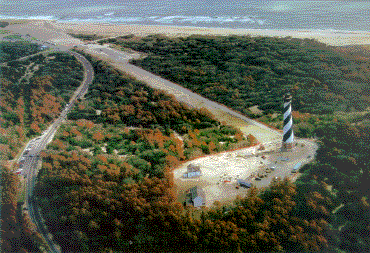
The lighthouse on Cape Hatteras, protruding into the ocean from the island of the same name on the Atlantic coast of the United States, was built immediately after the end of the Civil War, in 1870. Then its fire was necessary for ship captains to avoid dangerous sandbanks and sea currents (at this point the Gulf Stream seems to hit the coast of America, deviating towards the shores of Europe). From the time of European settlement of America until the advent of the lighthouse, it is estimated that about a thousand ships were lost in the area.
The ocean constantly washes away Cape Hatteras, and if in the year the construction was completed the lighthouse stood 550 meters from the water's edge, then by our time the waves began to splash only 37 meters from its foundation. For decades, engineers have tried to combat the ocean's encroachment by adding sand and building barriers. They even tried to plant artificial algae near the shore to protect them from the surf, but the experience was not successful. It became clear that the lighthouse, once considered the most important in America, but which has now lost its role to radar and satellite navigation systems, will fall after the first serious storm. The US National Academy of Sciences 10 years ago recommended moving the structure, which has become a monument to the era, away from the ocean.
At 63 meters 40 centimeters high, the lighthouse is the tallest brick lighthouse tower in the world. His weight is
43,545 tons. Two companies undertook to carry out the unique operation - International Chimney Corporation and Experienced House Movers. A massive column of brick, granite, marble, steel and bronze was sawed off from the base with a diamond cable saw, raised with hydraulic jacks by almost two meters (one hundred jacks with a lifting capacity of 50 tons each were needed) and a steel frame was slipped into place of the foundation. The frame slowly rolled on rollers under the pressure of five horizontal hydraulic jacks on seven steel rails lubricated with soap. The vertical position of the tower was maintained by computers that controlled vertical and horizontal jacks. One day, work stalled for half a day because the computer claimed that the top of the lighthouse was dangerously deviated from the vertical, but the plumb lines showed that everything was in order. It turned out that it was a computer failure. The completed section of rails was dismantled from time to time and moved forward. They moved the foundation to a new place and assembled it, and then they placed a lighthouse on it.
The move 884 meters further from the coast took 23 days, two weeks less than planned. The entire operation cost $11.8 million. Judging by the rate of coastal erosion, the lighthouse may stand in its new location for a hundred years. It still flashes once every 7.5 seconds, and its light is visible in the ocean as far as before, since the new location is slightly higher above sea level than the old one.
The materials in the section used articles and reports from the following foreign publications: “Economist” and “New Scientist” (England), “Bild der Wissenschaft” (Germany), “National Geographic”, “Popular Mechanics”, “Popular Science”, “Psychology Today” and “Smithson” (USA), “Science et Vie Junior” (France), as well as messages from the LPS agency and information from the Internet.
Source: SCIENCE AND LIFE
This description is machine-translated and has not yet been reviewed.
LIGHTHOUSE MOVES AWAY FROM THE SEA
**
**
The lighthouse on Cape Hatteras, protruding into the ocean from the island of the same name on the Atlantic coast of the United States, was built immediately after the end of the Civil War, in 1870. Then its fire was necessary for ship captains to avoid dangerous sandbanks and sea currents (at this point the Gulf Stream seems to hit the coast of America, deviating towards the shores of Europe). From the time of European settlement of America until the advent of the lighthouse, it is estimated that about a thousand ships were lost in the area.
The ocean constantly washes away Cape Hatteras, and if in the year the construction was completed the lighthouse stood 550 meters from the water's edge, then by our time the waves began to splash only 37 meters from its foundation. For decades, engineers have tried to combat the ocean's encroachment by adding sand and building barriers. They even tried to plant artificial algae near the shore to protect them from the surf, but the experience was not successful. It became clear that the lighthouse, once considered the most important in America, but which has now lost its role to radar and satellite navigation systems, will fall after the first serious storm. The US National Academy of Sciences 10 years ago recommended moving the structure, which has become a monument to the era, away from the ocean.
At 63 meters 40 centimeters high, the lighthouse is the tallest brick lighthouse tower in the world. His weight is
43,545 tons. Two companies undertook to carry out the unique operation - International Chimney Corporation and Experienced House Movers. A massive column of brick, granite, marble, steel and bronze was sawed off from the base with a diamond cable saw, raised with hydraulic jacks by almost two meters (one hundred jacks with a lifting capacity of 50 tons each were needed) and a steel frame was slipped into place of the foundation. The frame slowly rolled on rollers under the pressure of five horizontal hydraulic jacks on seven steel rails lubricated with soap. The vertical position of the tower was maintained by computers that controlled vertical and horizontal jacks. One day, work stalled for half a day because the computer claimed that the top of the lighthouse was dangerously deviated from the vertical, but the plumb lines showed that everything was in order. It turned out that it was a computer failure. The completed section of rails was dismantled from time to time and moved forward. They moved the foundation to a new place and assembled it, and then they placed a lighthouse on it.
The move 884 meters further from the coast took 23 days, two weeks less than planned. The entire operation cost $11.8 million. Judging by the rate of coastal erosion, the lighthouse may stand in its new location for a hundred years. It still flashes once every 7.5 seconds, and its light is visible in the ocean as far as before, since the new location is slightly higher above sea level than the old one.
The materials in the section used articles and reports from the following foreign publications: “Economist” and “New Scientist” (England), “Bild der Wissenschaft” (Germany), “National Geographic”, “Popular Mechanics”, “Popular Science”, “Psychology Today” and “Smithson” (USA), “Science et Vie Junior” (France), as well as messages from the LPS agency and information from the Internet.
Source: SCIENCE AND LIFE
This description is machine-translated and has not yet been reviewed.
LIGHTHOUSE MOVES AWAY FROM THE SEA
**
**
The lighthouse on Cape Hatteras, protruding into the ocean from the island of the same name on the Atlantic coast of the United States, was built immediately after the end of the Civil War, in 1870. Then its fire was necessary for ship captains to avoid dangerous sandbanks and sea currents (at this point the Gulf Stream seems to hit the coast of America, deviating towards the shores of Europe). From the time of European settlement of America until the advent of the lighthouse, it is estimated that about a thousand ships were lost in the area.
The ocean constantly washes away Cape Hatteras, and if in the year the construction was completed the lighthouse stood 550 meters from the water's edge, then by our time the waves began to splash only 37 meters from its foundation. For decades, engineers have tried to combat the ocean's encroachment by adding sand and building barriers. They even tried to plant artificial algae near the shore to protect them from the surf, but the experience was not successful. It became clear that the lighthouse, once considered the most important in America, but which has now lost its role to radar and satellite navigation systems, will fall after the first serious storm. The US National Academy of Sciences 10 years ago recommended moving the structure, which has become a monument to the era, away from the ocean.
At 63 meters 40 centimeters high, the lighthouse is the tallest brick lighthouse tower in the world. His weight is
43,545 tons. Two companies undertook to carry out the unique operation - International Chimney Corporation and Experienced House Movers. A massive column of brick, granite, marble, steel and bronze was sawed off from the base with a diamond cable saw, raised with hydraulic jacks by almost two meters (one hundred jacks with a lifting capacity of 50 tons each were needed) and a steel frame was slipped into place of the foundation. The frame slowly rolled on rollers under the pressure of five horizontal hydraulic jacks on seven steel rails lubricated with soap. The vertical position of the tower was maintained by computers that controlled vertical and horizontal jacks. One day, work stalled for half a day because the computer claimed that the top of the lighthouse was dangerously deviated from the vertical, but the plumb lines showed that everything was in order. It turned out that it was a computer failure. The completed section of rails was dismantled from time to time and moved forward. They moved the foundation to a new place and assembled it, and then they placed a lighthouse on it.
The move 884 meters further from the coast took 23 days, two weeks less than planned. The entire operation cost $11.8 million. Judging by the rate of coastal erosion, the lighthouse may stand in its new location for a hundred years. It still flashes once every 7.5 seconds, and its light is visible in the ocean as far as before, since the new location is slightly higher above sea level than the old one.
The materials in the section used articles and reports from the following foreign publications: “Economist” and “New Scientist” (England), “Bild der Wissenschaft” (Germany), “National Geographic”, “Popular Mechanics”, “Popular Science”, “Psychology Today” and “Smithson” (USA), “Science et Vie Junior” (France), as well as messages from the LPS agency and information from the Internet.
Source: SCIENCE AND LIFE
МАЯК ПЕРЕЕХАЛ ПОДАЛЬШЕ ОТ МОРЯ
Маяк на мысе Гаттерас, выступающем в океан с одноименного острова Атлантического побережья США, был построен сразу после окончания Гражданской войны, в 1870 году. Тогда его огонь был необходим капитанам судов, чтобы избегать опасных песчаных банок и морских течений (в этом месте Гольфстрим как бы ударяется о берег Америки, отклоняясь к берегам Европы). Со времен заселения Америки европейцами до появления маяка в этом районе, по оценкам, погибло около тысячи судов.
Океан постоянно подмывает мыс Гаттерас, и если в год окончания строительства маяк стоял в 550 метрах от уреза воды, то к нашему времени волны стали плескаться всего в 37 метрах от его фундамента. Много десятилетий инженеры пытались бороться с наступлением океана, подсыпая песок и строя барьеры. Пробовали даже высаживать у берега искусственные водоросли для защиты от прибоя, но опыт не принес успеха. Стало ясно, что маяк, когда-то считавшийся самым важным в Америке, но к нашему времени уступивший свою роль радиолокаторам и спутниковым системам навигации, упадет после первого же серьезного шторма. Национальная академия наук США 10 лет назад порекомендовала передвинуть сооружение, ставшее памятником эпохи, подальше от океана.
Маяк высотой 63 метра 40 сантиметров представляет собой самую высокую кирпичную маячную башню в мире. Его вес -
43 545 тонн. Осуществить уникальную операцию взялись две фирмы - «Международная корпорация дымоходов» и «Опытные перевозчики домов». Массивную колонну из кирпича, гранита, мрамора, стали и бронзы отпилили от основания алмазной тросовой пилой, приподняли гидравлическими домкратами почти на два метра (понадобилось сто домкратов грузоподъемностью каждый 50 тонн) и подсунули на место фундамента стальную раму. Рама медленно ехала на катках под нажимом пяти горизонтальных гидравлических домкратов по семи стальным рельсам, смазанным мылом. Вертикальное положение башни поддерживали компьютеры, управлявшие вертикальными и горизонтальными домкратами. Однажды работа застопорилась на полдня, так как компьютер утверждал, будто верхушка маяка опасно отклонилась от вертикали, а отвесы показывали, что все в порядке. Оказалось, что это сбой компьютера. Пройденный участок рельсов время от времени разбирали и перекладывали вперед. Перенесли фундамент на новое место и собрали его, а затем на него поставили маяк.
Переезд на 884 метра дальше от берега занял 23 дня, на две недели меньше, чем планировалось. Вся операция обошлась в 11,8 миллиона долларов. Судя по скорости эрозии берега, на новом месте маяк может простоять лет сто. Он все так же мигает раз в 7,5 секунды, и его огонь виден в океане столь же далеко, как раньше, поскольку новое место немного выше старого над уровнем моря.
В материалах рубрики использованы статьи и сообщения следующих иностранных изданий: «Economist» и «New Scientist» (Англия), «Bild der Wissenschaft» (Германия), «National Geographic», «Popular Mechanics», «Popular Science», «Psychology Today» и «Smithson» (США), «Science et Vie Junior» (Франция), а также сообщения агентства LPS и информация из Интернета.Источник: НАУКА И ЖИЗНЬ
This description is machine-translated and has not yet been reviewed.
LIGHTHOUSE MOVES AWAY FROM THE SEA
**
**
The lighthouse on Cape Hatteras, protruding into the ocean from the island of the same name on the Atlantic coast of the United States, was built immediately after the end of the Civil War, in 1870. Then its fire was necessary for ship captains to avoid dangerous sandbanks and sea currents (at this point the Gulf Stream seems to hit the coast of America, deviating towards the shores of Europe). From the time of European settlement of America until the advent of the lighthouse, it is estimated that about a thousand ships were lost in the area.
The ocean constantly washes away Cape Hatteras, and if in the year the construction was completed the lighthouse stood 550 meters from the water's edge, then by our time the waves began to splash only 37 meters from its foundation. For decades, engineers have tried to combat the ocean's encroachment by adding sand and building barriers. They even tried to plant artificial algae near the shore to protect them from the surf, but the experience was not successful. It became clear that the lighthouse, once considered the most important in America, but which has now lost its role to radar and satellite navigation systems, will fall after the first serious storm. The US National Academy of Sciences 10 years ago recommended moving the structure, which has become a monument to the era, away from the ocean.
At 63 meters 40 centimeters high, the lighthouse is the tallest brick lighthouse tower in the world. His weight is
43,545 tons. Two companies undertook to carry out the unique operation - International Chimney Corporation and Experienced House Movers. A massive column of brick, granite, marble, steel and bronze was sawed off from the base with a diamond cable saw, raised with hydraulic jacks by almost two meters (one hundred jacks with a lifting capacity of 50 tons each were needed) and a steel frame was slipped into place of the foundation. The frame slowly rolled on rollers under the pressure of five horizontal hydraulic jacks on seven steel rails lubricated with soap. The vertical position of the tower was maintained by computers that controlled vertical and horizontal jacks. One day, work stalled for half a day because the computer claimed that the top of the lighthouse was dangerously deviated from the vertical, but the plumb lines showed that everything was in order. It turned out that it was a computer failure. The completed section of rails was dismantled from time to time and moved forward. They moved the foundation to a new place and assembled it, and then they placed a lighthouse on it.
The move 884 meters further from the coast took 23 days, two weeks less than planned. The entire operation cost $11.8 million. Judging by the rate of coastal erosion, the lighthouse may stand in its new location for a hundred years. It still flashes once every 7.5 seconds, and its light is visible in the ocean as far as before, since the new location is slightly higher above sea level than the old one.
The materials in the section used articles and reports from the following foreign publications: “Economist” and “New Scientist” (England), “Bild der Wissenschaft” (Germany), “National Geographic”, “Popular Mechanics”, “Popular Science”, “Psychology Today” and “Smithson” (USA), “Science et Vie Junior” (France), as well as messages from the LPS agency and information from the Internet.
Source: SCIENCE AND LIFE
Rights & Attribution
Content License
Original editorial content on this page: Creative Commons Attribution-NonCommercial-ShareAlike 4.0 International. See Rights & Reuse.
Media Rights
No published media with documented rights on this record.
Attribution
"cape hatteras" · © LUX143 · Creative Commons Attribution-NonCommercial-ShareAlike 4.0 International · https://light.lux143.org/node/184/
Citation
LUX Light Archive, Archive record: "cape hatteras", , https://light.lux143.org/node/184/, accessed 2026-09-24, archive v0.24.572.
Legacy archive provenance
This object now uses its LUX identity as the public record. The original Drupal node is preserved as migration provenance and a compatibility route.
- Canonical LUX ID
- node:184
- Legacy node
- node:184
- Legacy URL
- /node/184/
- Drupal source type
- book
- Source system
- drupal_migration
- Source path
- /node/184
Record identifiers
- Node
- 184
- Source type
- book
- Created
- 19/06/2010 12:42:40 UTC
- Changed
- 19/06/2010 12:42:40 UTC
- Source path
- /node/184