Lighthouse keeper in the 21st century
No public image is available for this record.
This description is machine-translated and has not yet been reviewed.
Lighthouse Keeper in the 21st Century
More presentations from Mayachnik
Script:
- Speaker: Vasily Korablev President of the Foundation for Support of Lighthouses and Lighthouses "Russian Lighthouse Society" Head of the project "Lighthouse. Lighthouses of Russia and the world" "Lighthouse. Lighthouses of Russia and the world"
- 2. MAYAKI.RF Foundation for the support of lighthouses and lighthouses "Russian Lighthouse Society" Project "Lighthouse. Lighthouses of Russia and the world". • Encyclopedia of lighthouses in Russia, the world, lighthouse makers • Models of lighthouses • Forum about lighthouses and lighthouse makers http://mayaki.ru/ • Communities on social networks “Lighthouse Lovers Club” Our projects Founded: July 1, 2016 Founded: 2008 mayachnik.ru MAYAKI.RF
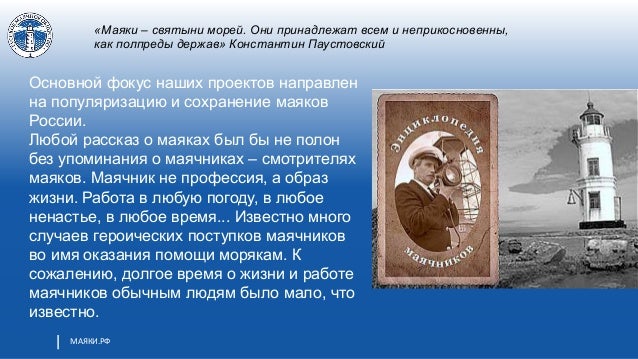
- 3. LIGHTHOUSES.RF The main focus of our projects is aimed at popularizing and preserving Russian lighthouses. Any story about lighthouses would not be complete without mentioning the lighthouse keepers. Lighthouse maker is not a profession, but a way of life. Work in any weather, in any bad weather, at any time... There are many known cases of heroic deeds of lighthouse workers in the name of helping sailors. Unfortunately, for a long time ordinary people knew little about the life and work of lighthouses. “Lighthouses are shrines of the seas. They belong to everyone and are inviolable, like the plenipotentiaries of the powers" Konstantin Paustovsky
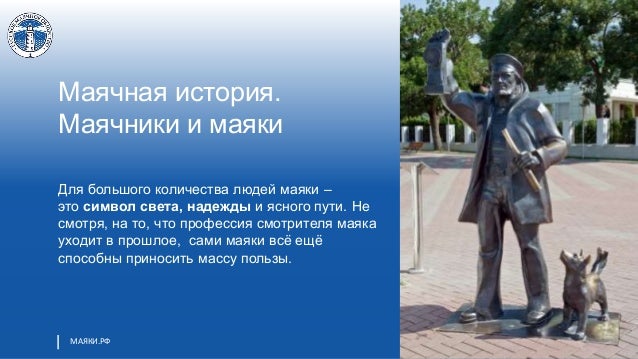
- 4. MAYAKI.RF Lighthouse history. Lighthouses and beacons For a large number of people, lighthouses are a symbol of light, hope and a clear path. Despite the fact that the profession of a lighthouse keeper is becoming a thing of the past, the lighthouses themselves are still capable of bringing a lot of benefits.
- 5. MAYAKI.RF 5 Lighthouse - one who works at the lighthouse (lighthouse staff), including the Lighthouse Keeper. Lighthouse 'Efremova's Explanatory Dictionary' m. The one who works at the lighthouse. Mayachnik 'Ozhegov's Explanatory Dictionary' -a, m. Lighthouse Keeper Mayachnik 'Dictionary of synonyms' lighthouse noun, number of synonyms: (1) • ↑keeper (20) Dictionary of synonyms ASIS, Trishin V.N., 2010
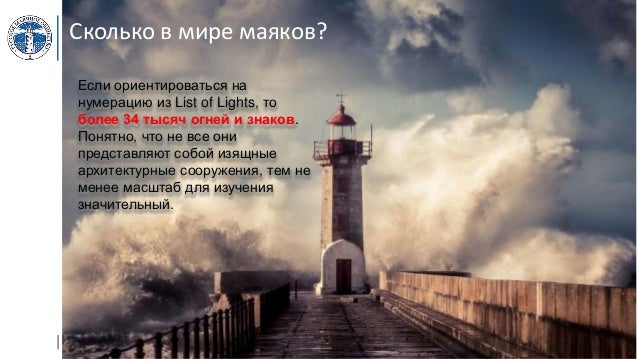
- 6. LIGHTHOUSES.RF 6 How many lighthouses are there in the world? If you go by the numbering from the List of Lights, then there are more than 34 thousand lights and signs. It is clear that not all of them are elegant architectural structures, however, the scale for study is significant.
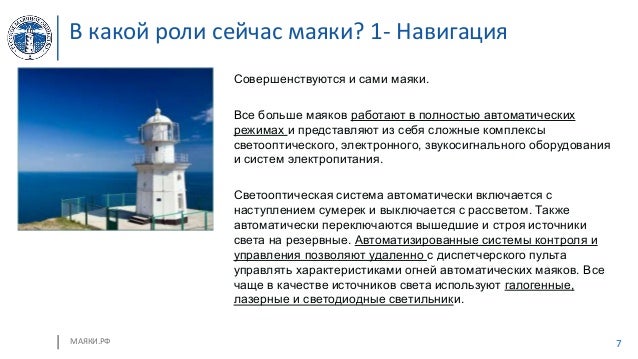
- 7. MAYAKI.RF 7 What is the role of lighthouses now? 1- Navigation The lighthouses themselves are also being improved. More and more beacons operate in fully automatic modes and are complex complexes of light-optical, electronic, sound-signaling equipment and power supply systems. The light-optical system automatically turns on at dusk and turns off at dawn. Also, light sources that are out and under construction are automatically switched to backup ones. Automated monitoring and control systems allow you to remotely control the characteristics of automatic beacon lights from the dispatch console. Increasingly, halogen, laser and LED lamps are used as light sources.
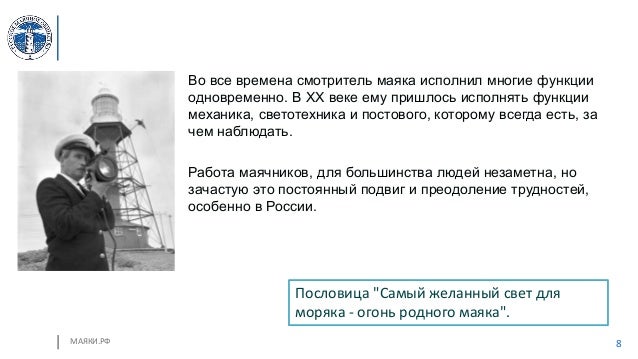
- 8. LIGHTHOUSES.RF 8 At all times, the lighthouse keeper performed many functions at the same time. In the twentieth century, he had to perform the functions of a mechanic, lighting technician and guard, who always had something to watch. The work of lighthouses is invisible to most people, but often it is a constant feat and overcoming difficulties, especially in Russia. Proverb: “The most desirable light for a sailor is the fire of his native lighthouse.”
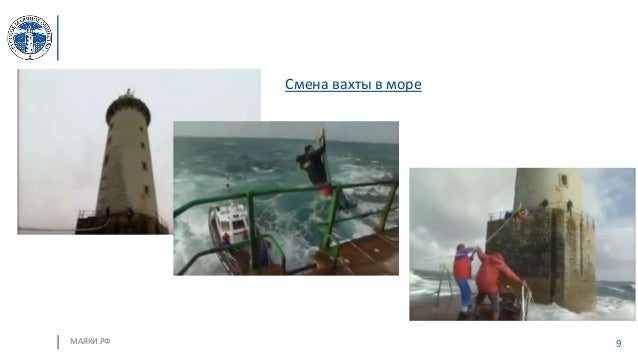
- 9. MAYAKI.RF 9 Change of watch at sea
- 10. LIGHTHOUSES.RF 10 With the advent of GPS, Glonass in many countries, the need as such for lighthouses has disappeared and the profession of a lighthouse keeper (lighthouse) began to gradually become a thing of the past. Some lighthouses have already ceased to be used. Satellite navigation leaves no chance for lighthouses, but this does not mean that history should simply be forgotten. Abroad, lighthouse keepers are more the custodians of lighthouse traditions and supervise the operation of modern navigation aids.

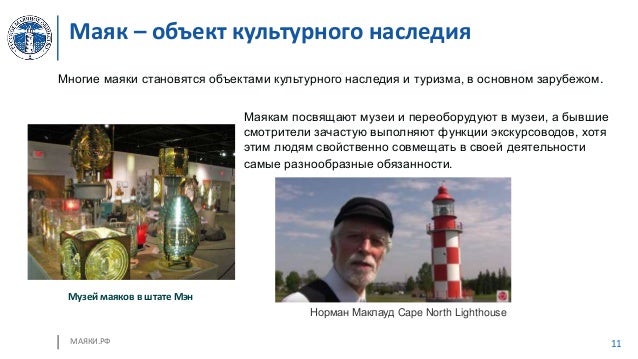
- 11. LIGHTHOUSES.RF 11 Lighthouse - an object of cultural heritage Many lighthouses become objects of cultural heritage and tourism, mainly abroad. Lighthouses are dedicated to museums and converted into museums, and former keepers often serve as tour guides, although these people tend to combine a wide variety of responsibilities in their activities. Maine Lighthouse Museum Norman MacLeod Cape North Lighthouse
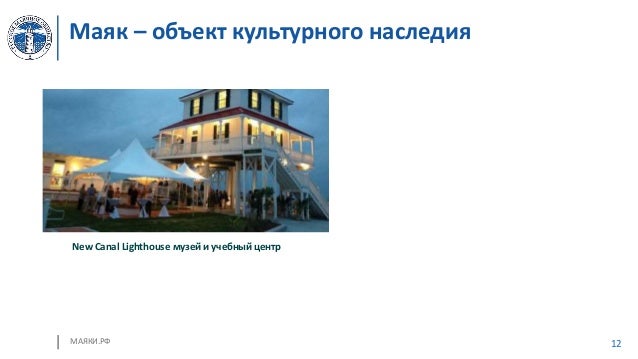
- 12. LIGHTHOUSE.RF 12 Lighthouse - cultural heritage site New Canal Lighthouse museum and training center
- 13. LIGHTHOUSES.RF 13 In order to preserve these magnificent buildings, lighthouse protection societies are being created around the world, in which former keepers also participate. Some lighthouse buildings are used scientists who observe the behavior of whales. In addition, lighthouses often help ornithologists.
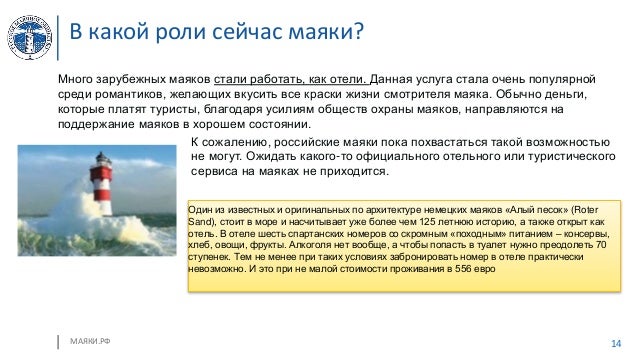
- 14. MAYAKI.RF 14 What is the role of lighthouses now? Many foreign lighthouses began to operate as hotels. This service has become very popular among romantics who want to taste all the colors of the life of a lighthouse keeper. Typically, the money that tourists pay, thanks to the efforts of lighthouse preservation societies, is used to maintain lighthouses in good condition. Unfortunately, Russian lighthouses cannot yet boast of such an opportunity. You shouldn’t expect any official hotel or tourist services at lighthouses. One of the famous and architecturally original German lighthouses, “Scarlet Sand” (Roter Sand), stands in the sea and has a history of more than 125 years, and is also open as a hotel. The hotel has six spartan rooms with modest “camping” food - canned food, bread, vegetables, fruits. There is no alcohol at all, and to get to the toilet you need to climb 70 steps. However, under such conditions it is almost impossible to book a hotel room. And this is at a rather low cost of living of 556 euros
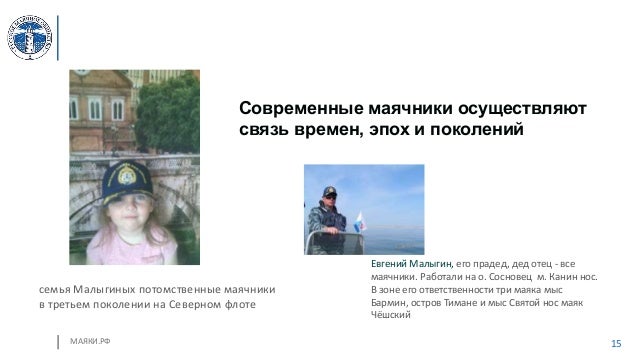
- 15. MAYAKI.RF 15 Modern lighthousemen connect times, eras and generations the Malygin family hereditary lighthousemen in the third generation in the Northern Fleet Evgeny Malygin, his great-grandfather, grandfather and father - all lighthouse workers. We worked on o. Sosnowiec metro station Kanin Nos. In his area of responsibility there are three lighthouses: Cape Barmin, Timan Island and Cape Svyatoy Nose, Cheshsky Lighthouse
- 16. MAYAKI.RF Famous people in lighthouse history
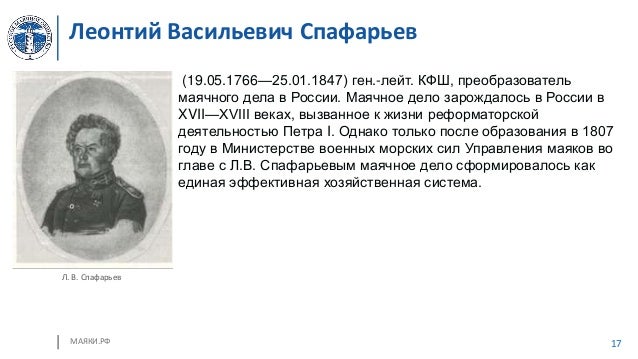
- 17. MAYAKI.RF 17 Leonty Vasilievich Spafarev (05/19/1766—01/25/1847) Lieutenant General. KFSh, transformer of lighthouse business in Russia. The lighthouse business originated in Russia in the 17th-18th centuries, brought to life by the reform activities of Peter I. However, only after the formation of the Lighthouse Directorate in the Ministry of Military Maritime Forces in 1807, headed by L.V. Spafariev formed the lighthouse business as a single effective economic system. L. V. Spafarev
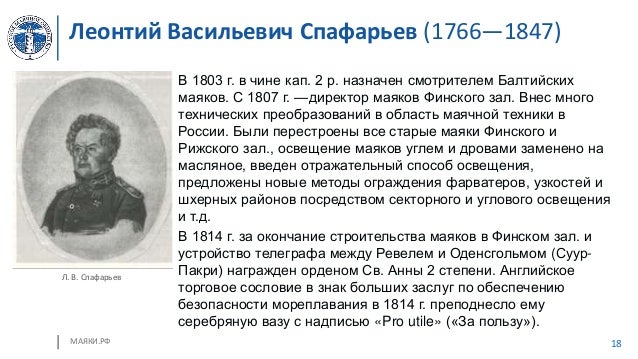
- 18. MAYAKI.RF 18 Leonty Vasilyevich Spafarev (1766-1847) In 1803 in rank of cap. 2 r. appointed keeper of the Baltic lighthouses. Since 1807 - director of the lighthouses of the Finnish Hall. He made many technical changes in the field of lighthouse technology in Russia. All the old lighthouses of the Finnish and Riga Gulfs were rebuilt, the lighting of the lighthouses with coal and firewood was replaced with oil, a reflective lighting method was introduced, new methods were proposed for fencing fairways, narrows and skerry areas through sector and corner lighting, etc. In 1814 for the completion of the construction of lighthouses in the Finnish Hall. and the installation of a telegraph between Revel and Odensholm (Suur-Pakri) was awarded the Order of St. Anne, 2nd degree. The English merchant class, as a sign of great merit in ensuring the safety of navigation, in 1814 presented him with a silver vase with the inscription “Pro utile” (“For benefit”). L. V. Spafarev
- 19. MAYAKI.RF 19 Leonty Vasilievich Spafarev (1766-1847) Thanks to energetic and tireless activity Spafarev, by 1820, all the old lighthouses of the Gulf of Finland and Riga were rebuilt and 19 new ones were built, of which 13 were stone and 6 wooden. During the same period, the first floating lighthouses were built and began to operate, in particular, off the London Shoal (lighthouse ship Nordstern). By the time Spafariev began his activities in Russia, there were no regulatory documents that determined the operating hours of lighthouses. They were lit, as a rule, “with the onset of darkness” and extinguished “with the onset of daylight,” and these moments were interpreted differently by everyone, which often led to misunderstandings. For the first time in Russia, Spafariev calculated the time of sunset and sunrise for each lighthouse and compiled the corresponding tables. He also established the operating time of the beacons depending on the time of year. L. V. Spafarev
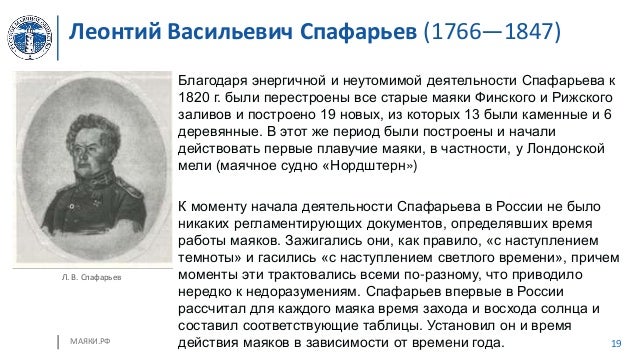
- 20. MAYAKI.RF 20 Leonty Vasilyevich Spafarev (1766-1847) Published the first in Russia at his own expense Atlas of the Finnish Hall. indicating all the lighthouses from Kronstadt to Luzerort. In 1817 he was promoted to major general. In 1825-1837 was commander of the Revel port (since 1829 with the rank of lieutenant general) while maintaining his previous position. In 1830 he was enrolled in the KFS. Two years later, for “excellently diligent” service, he was awarded the Order of St. Vladimir, 2nd degree. In 1834, at his suggestion, the publication of the Description of Lighthouses and Towers of the Russian Empire began. In 1838, he was “appointed to serve in the Naval Ministry.” He died in St. Petersburg and was buried at the Volkovskoye Orthodox Cemetery. An island in Tauiskaya Bay and a bay on the Alaska Peninsula (Chukchi Sea) are named after him. Main work: “Description of the lighthouses of the Gulf of Finland and Riga” (1820). L. V. Spafarev

- 21. MAYAKI.RF 21 Bazhenov Roman Ivanovich Years of life (4.05.1823—1.09.1904), senior adm., beginning GSU. 1 Jan 1865 Promoted to Cap. 1 rub. and appointed Art. pom. Director of lighthouses and pilotage of the Baltic Sea, in 1874 received the title of Candidate of Adm. and became director of lighthouses. Having been at the head of the management of the lighthouses of the Baltic Sea for more than 20 years, he brought this service to an exemplary state: in most of the Baltic lighthouses the catoptric lighting system was replaced by a dioptric lighting system, 15 new lighthouses were built, the first electric lighthouse and the first steam siren on the Baltic Sea were installed, the Moonsund Strait was fenced with coastal lights and luminous buoys. etc. For distinguished service in 1885, he was promoted to senior adm. and a year later the beginning was appointed. GSU and Chairman of the Marine Scientific Committee. Over the next two and a half years, he reviewed and revised the regulations on the workshop of nautical instruments, charters and regulations on the Naval Cadet Corps, established a compass unit at the State University and actively worked in the commission for the revision of pilot charters. Thanks to his persistence and energy, the publication of the journal began in 1887.
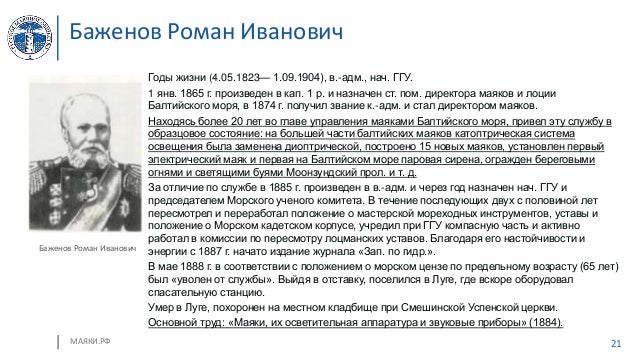
magazine "Zap. according to hydr." In May 1888, in accordance with the provisions on the maritime qualifications based on the age limit (65 years), he was “dismissed from service.” After retiring, he settled in Luga, where he soon equipped a rescue station. He died in Luga and was buried in the local cemetery at the Smeshinskaya Assumption Church. Main work: “Lighthouses, their lighting equipment and sound devices” (1884). Bazhenov Roman Ivanovich
- 22. MAYAKI.RF 22 Bashmakov Pavel Ivanovich Years of life (January 1890–1942). Arctic hydrographer, specialist in lighthouses and navigation aids. Born into a large family of a servant of the Zhuzmuy lighthouse in Onega Bay. In 1904 he entered the nautical department of the Arkhangelsk Trade and Maritime School. After the death of the father, the family found itself in a very difficult financial situation. The mother was forced to submit a petition for financial assistance to her son. Despite all the difficulties, Bashmakov, thanks to his will and enormous capacity for work, successfully completed his studies in 1909 and began serving in hydrographic organizations. He devoted more than 30 years to the hydrographic fencing of the White, Barents and Kara Seas. Since 1933, Bashmakov headed the Arkhangelsk and Novaya Zemlya hydrographic departments, during 1921–1940. combined work with teaching at the Arkhangelsk Maritime College, where he taught courses in navigation, pilotage, meteorology and astronomy. Bashmakov published a number of books and articles on hydrography, the history of the development of the Northern Sea Route, wrote reviews of
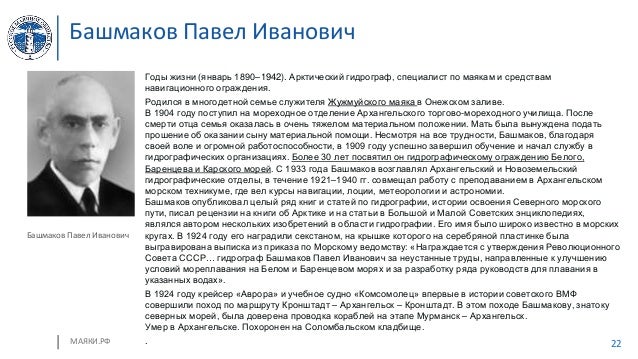
books about the Arctic and articles in the Great and Small Soviet Encyclopedias, and was the author of several inventions in the field of hydrography. His name was widely known in maritime circles. In 1924, he was awarded a sextant, on the cover of which, on a silver plate, was engraved an extract from the order of the Maritime Department: “Awarded with the approval of the Revolutionary Council of the USSR... hydrographer Pavel Ivanovich Bashmakov for tireless work aimed at improving navigation conditions in the White and Barents Seas and for developing a number of guidelines for navigation in these waters.” In 1924, the cruiser "Aurora" and the training ship "Komsomolets" made a voyage along the route Kronstadt - Arkhangelsk - Kronstadt for the first time in the history of the Soviet Navy. In this campaign, Bashmakov, an expert on the northern seas, was entrusted with escorting ships on the Murmansk-Arkhangelsk stage. Died in Arkhangelsk. He was buried at the Solombala cemetery. . Bashmakov Pavel Ivanovich
- 23. MAYAKI.RF 23 Bashmakov Pavel Ivanovich • Bashmakov P.I. Lighthouse business and its historical development, construction of beacons, warning lights, automatic buoys and their lighting apparatus and mechanisms. L., 1925. S. 2.

- 24. MAYAKI.RF Lighthouse romance

- [25. ]. the sailor determines a place in the ocean. William Shakespeare
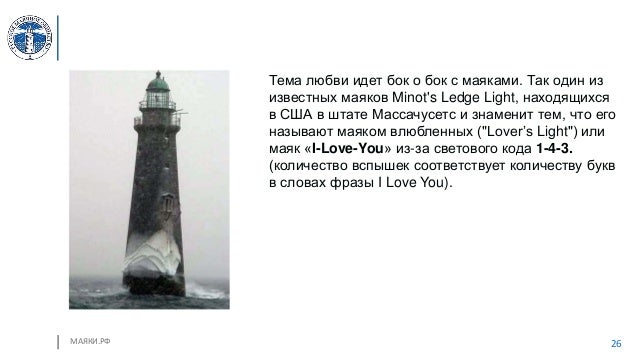
- 26. MAYAKI.RF 26 The theme of love goes side by side with lighthouses. Thus, one of the famous lighthouses, Minot's Ledge Light, located in the USA in the state of Massachusetts, is famous for being called the “Lover’s Light” lighthouse or the “I-Love-You” lighthouse because of the light code 1-4-3. (the number of flashes corresponds to the number of letters in the words of the phrase I Love You).
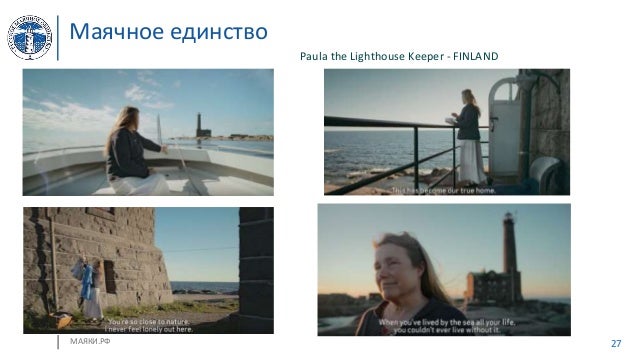
- 27. MAYAKI.RF 27 Lighthouse Unity Paula the Lighthouse Keeper - FINLAND
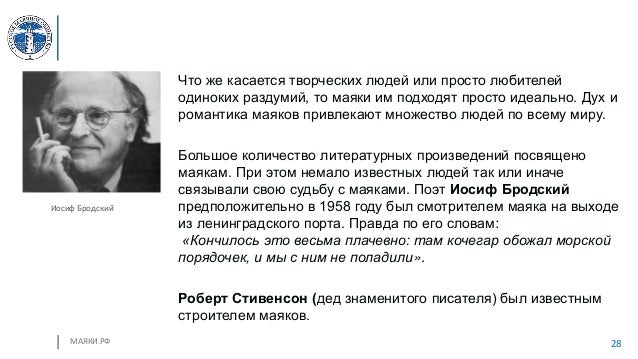
- 28. MAYAKI.RF 28 As for creative people or just lovers of lonely thoughts, lighthouses are just perfect for them. The spirit and romance of lighthouses attracts many people around the world. A large number of literary works are dedicated to lighthouses. At the same time, many famous people connected their fate with lighthouses in one way or another. The poet Joseph Brodsky was supposedly a lighthouse keeper at the exit from the Leningrad port in 1958. True, in his words: “It ended very badly: the fireman there loved the naval order, and we didn’t get along with him.” Robert Stevenson (the famous writer's grandfather) was a famous lighthouse builder. Joseph Brodsky
- 29. MAYAKI.RF Modern lighthouses

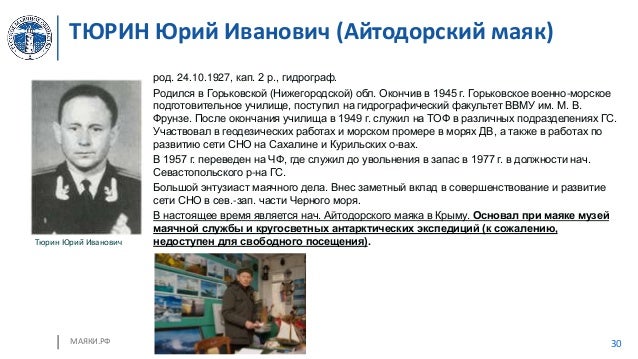
- 30. LIGHTHOUSES.RF 30 TYURIN Yuri Ivanovich (Aytodor Lighthouse) b. 10/24/1927, cap. 2 rubles, hydrograph. Born in the Gorky (Nizhny Novgorod) region. After graduating from the Gorky Naval Preparatory School in 1945, he entered the hydrographic department of the VVMU named after. M. V. Frunze. After graduating from college in 1949, he served at the Pacific Fleet in various units of the Civil War. Participated in geodetic work and marine sounding in the Far East seas, as well as in work on the development of the aid to navigation network on Sakhalin and the Kuril Islands. In 1957 he was transferred to the Black Sea Fleet, where he served until his transfer to the reserve in 1977 as chief. Sevastopol district GS. A big lighthouse enthusiast. Made a significant contribution to the improvement and development of the aid to navigation network in the north-west. parts of the Black Sea. Currently is the beginning. Aytodor lighthouse in Crimea. Founded a museum of lighthouse service and round-the-world Antarctic expeditions at the lighthouse (unfortunately, not available for free visits). Yuri Ivanovich Tyurin
- 31. MAYAKI.RF So that history is not distorted

- 32. MAYAKI.RF 32 Despite the long history of lighthouse business in Russia, there is very little information about lighthouses in open sources, usually something there are about modern ones, and very little about their predecessors. It is often quite difficult to restore the correct chronology for each lighthouse. One example is the Zhuzmuysky lighthouse
- 33. MAYAKI.RF 33 Zhuzhmuysky since 1871 After the exhibition in Arkhangelsk in 2015, it became clear that the statement was wrong, that “the Ageev dynasty monitored the lighthouse for 130 years and the only break was for 12 years, when Natalya Kokova and Alexey Akulov monitored the lighthouse. He was written off from the lighthouse for embezzlement. Nikolai Ageev and his family came to replace him. Nikolai monitored the lighthouse until it was decommissioned (around 2010).”
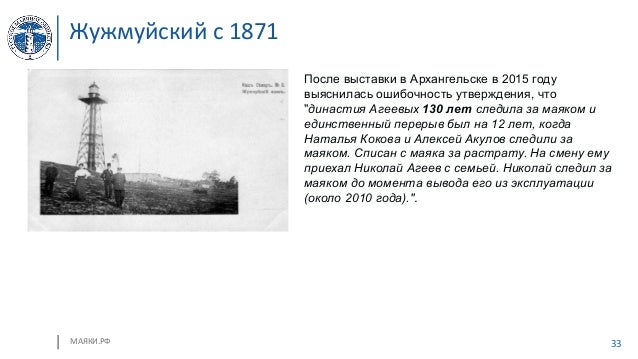
- 34. MAYAKI.RF 34 Zhuzhmuysky since 1871 Zhuzhmuysky some of the smotels: Chronology approximate chronology caretakers, guardians told by Valery Plaksin: 1. let's start with Bashmakov - apparently the end of the 19th and beginning of the 20th century, 2. then most likely there was Serebryanikov - then he was arrested. 3. Great-grandfather Katarin A. - worked until 1940, I don’t know his position, I know that he served at the lighthouse and was buried there, 4. then - Agafonov Philip Prokopievich, either from 1940, or from 1945 to 1961. 5. Plaksin Anatoly Grigorievich since 1954 technician and since 1961 Chief. lighthouse until November 1966 He was buried in Arkhangelsk in Solombala, and later F.P. Agafonov was buried there. 6. Then the lighthouse was taken over by Popov Nikolay Prokopyevich (before that the head of the State Migration Service) 7. And now I don’t remember, but I didn’t ask anyone, in about 1970-71, Ageev Anatoly Grigorievich came to work at the lighthouse, 8. and further on the list Akulov for 12 years 9. then Ageev Nikolay Anatolyevich until the closure of the lighthouse.
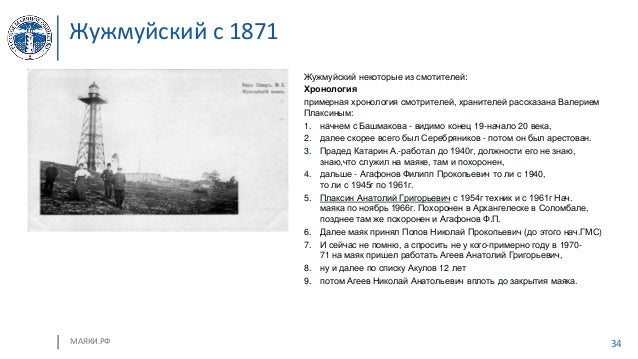
- 35. MAYAKI.RF 35 Head of the lighthouse Agafonov Philip Prokopyevich, he is wearing a cap during the period of work according to available data 1945-1961. To his right is the captain of GPB-16 Safonov, and the young hydrometeorologist and radio operator of the HMS Morozov Slava. On the left with a suitcase is the boatswain GPB-16. (from the personal archive of Valery Plaksin)
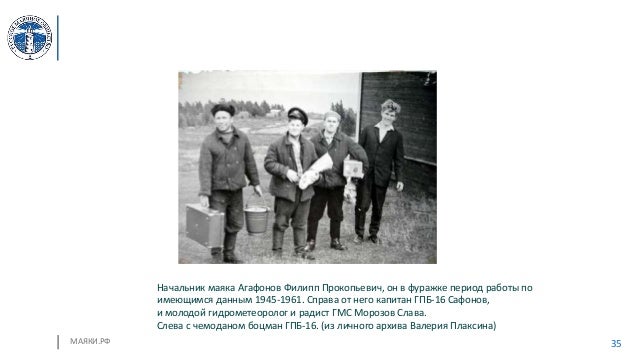
- 36. MAYAKI.RF 36 are the same (as in Photo 1) and Agafonov’s wife Anna, driving in the stern Plaksin Anatoly Grigorievich since 1954 - technician of the Zhuzhmuy lighthouse, after retirement in 1962 Agafonova F.P. beginning lighthouse and until November 1966 Died November 17, 1966 (from the personal archive of Plaksin V.)

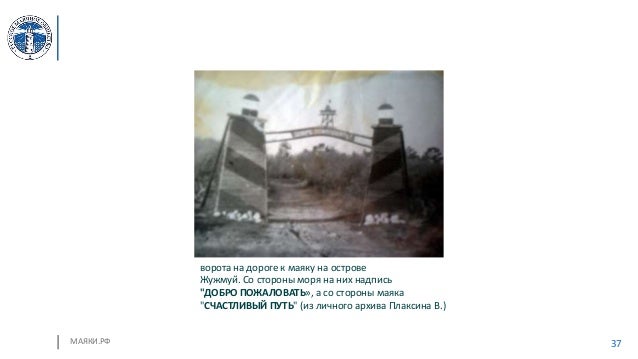
- 37. LIGHTHOUSES.RF Gate 37 on the road to the lighthouse on Zhuzhmuy Island. From the sea side they have the inscription “WELCOME”, and from the lighthouse side “HAPPY WAY” (from the personal archive of Plaksin V.)
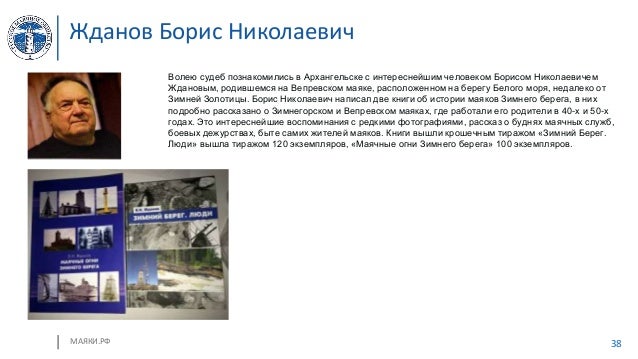
- 38. MAYAKI.RF 38 Zhdanov Boris Nikolaevich By the will of fate, we met in Arkhangelsk an interesting person, Boris Nikolaevich Zhdanov, born at the Veprevsky lighthouse, located on the shores of the White Sea, not far from Zimnyaya Zolotitsa. Boris Nikolaevich wrote two books about the history of the Zimny Coast lighthouses; they tell in detail about the Zimnegorsky and Veprevsky lighthouses, where his parents worked in the 40s and 50s. These are the most interesting memories with rare photographs, a story about the everyday life of lighthouse services, combat duty, and the life of the lighthouse residents themselves. The books were published in a tiny edition “Winter Coast. People" was published in 120 copies, "Lighthouse Lights of the Winter Coast" - 100 copies.
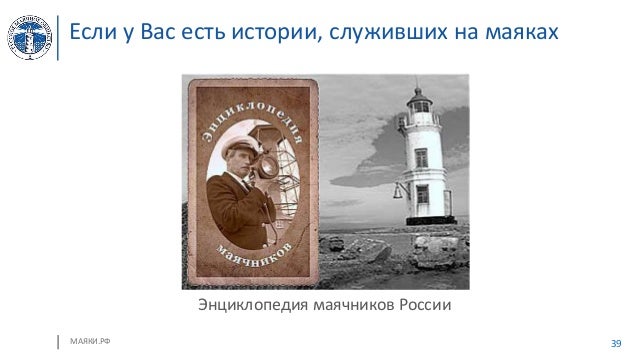
- 39. LIGHTHOUSES.RF 39 If you have stories of people who served in lighthouses Encyclopedia of Russian Lighthouses
- 40. MAYAKI.RF How dynasties are interrupted

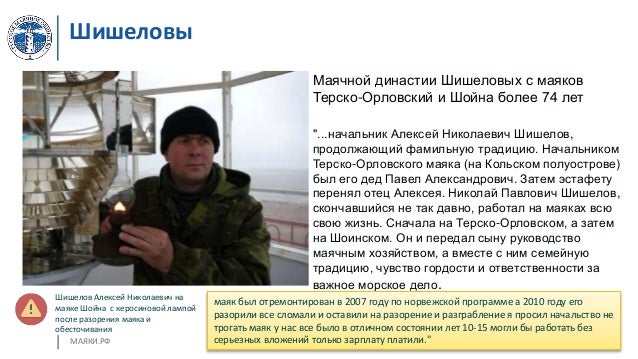
- 41. LIGHTHOUSES.RF 41 Shishelovs of the Shishelov lighthouse dynasty from the Tersko-Orlovsky and Shoina lighthouses more than 74 years "...the boss Alexey Nikolaevich Shishelov, who continues the family tradition. The head of the Tersko-Orlovsky lighthouse (on the Kola Peninsula) was his grandfather Pavel Alexandrovich. Then Alexey's father took over the baton. Nikolai Pavlovich Shishelov, who died not so long ago, worked at lighthouses all his life. First at the Tersko-Orlovsky, and then at Shoinsky. He passed it on to his son management of the lighthouse, and with it a family tradition, a sense of pride and responsibility for the important maritime business. Shishelov Alexey Nikolaevich at the Shoina lighthouse with a kerosene lamp after the destruction of the lighthouse and blackout, the lighthouse was repaired in 2007 according to the Norwegian program, and in 2010 it was destroyed, everything was broken and left for destruction and plunder, I asked the authorities not to touch the lighthouse, everything was in excellent condition, we could work for 10-15 years without serious investments, just pay salaries."
- 42. MAYAKI.RF The main thing is to survive!

- 43. LIGHTHOUSES.RF 43 Kurbatov Lighthouse Location: Kuril Islands, Shumshu Island, Sea of Okhotsk, Pacific Ocean - 1st Kuril Strait. Year of construction of the tower: 1956 What happened before 2006
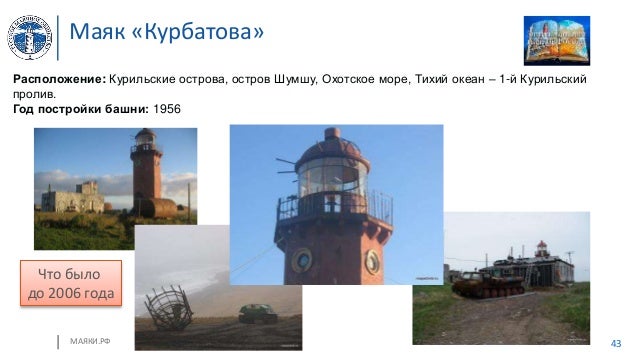
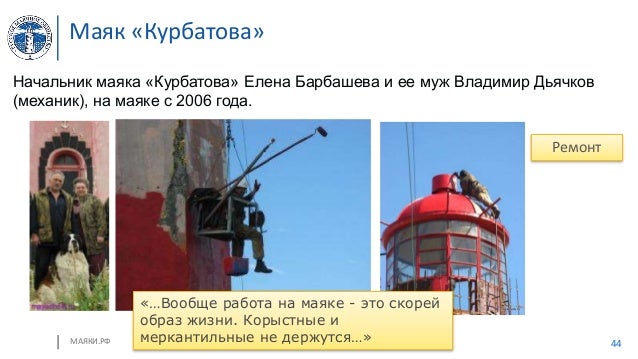
- 44. LIGHTHOUSES.RF 44 Lighthouse "Kurbatova" Head of the lighthouse "Kurbatova" Elena Barbasheva and her husband Vladimir Dyachkov (mechanic), at the lighthouse since 2006. Repair “...In general, working at a lighthouse is more of a way of life. Those who are selfish and mercantile do not hold on..."
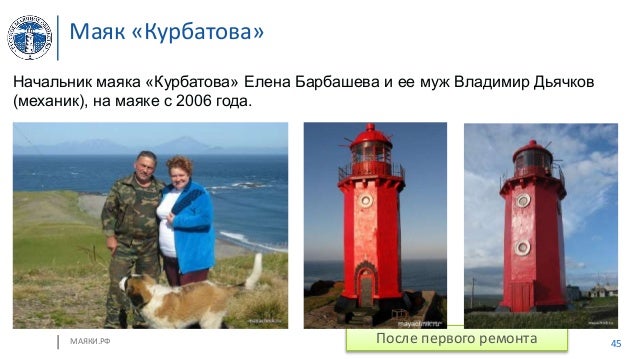
- 45. LIGHTHOUSES.RF 45 Lighthouse "Kurbatova" Head of the lighthouse "Kurbatova" Elena Barbasheva and her husband Vladimir Dyachkov (mechanic), at the lighthouse since 2006. After the first repair
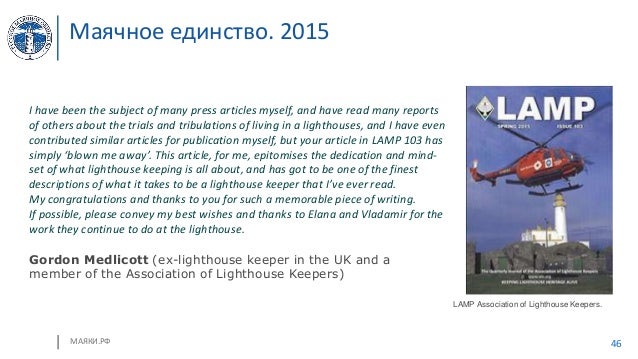
- 46. MAYAKI.RF 46 Lighthouse unity. 2015 LAMP Association of Lighthouse Keepers. I have been the subject of many press articles myself, and have read many reports of others about the trials and tribulations of living in a lighthouses, and I have even contributed similar articles for publication myself, but your article in LAMP 103 has simply ‘blown me away’. This article, for me, epitomizes the dedication and mind- set of what lighthouse keeping is all about, and has got to be one of the finest descriptions of what it takes to be a lighthouse keeper that I’ve ever read. My congratulations and thanks to you for such a memorable piece of writing. If possible, please convey my best wishes and thanks to Elana and Vladamir for the work they continue to do at the lighthouse. Gordon Medlicott (ex-lighthouse keeper in the UK and a member of the Association of Lighthouse Keepers)
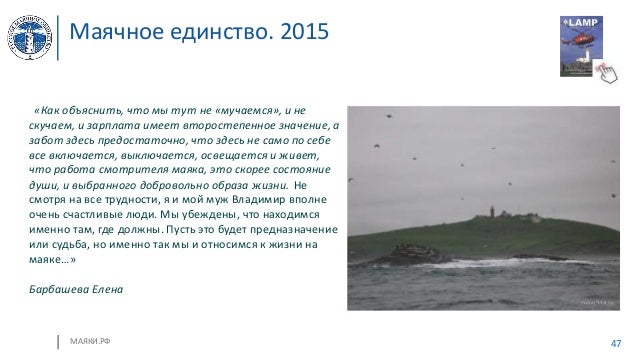
- 47. MAYAKI.RF 47 Lighthouse Unity. 2015 “How can we explain that we are not “suffering” here and are not bored, and salary is of secondary importance, and there are plenty of worries here, that everything here does not turn on, turn off, light up and live on its own, that the work of a lighthouse keeper is rather a state of mind and a voluntarily chosen way of life. Despite all the difficulties, my husband Vladimir and I are very happy people. We are confident that we are exactly where we need to be. Let it be destiny or fate, but this is exactly how we approach life at the lighthouse...” Elena Barbasheva
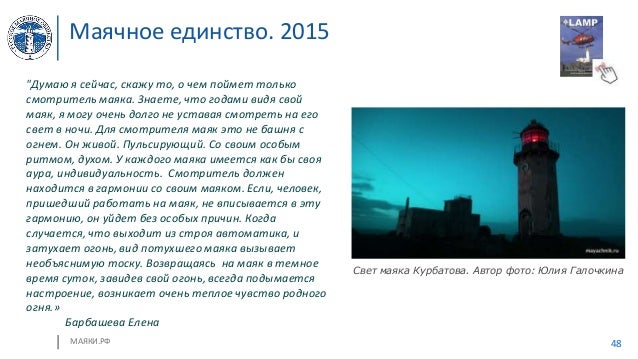
- 48. MAYAKI.RF 48 Lighthouse Unity. 2015 "I think now, I will say something that only a lighthouse keeper will understand. You know, having seen my lighthouse for years, I can look at its light in the night for a very long time without getting tired. For a keeper, a lighthouse is not a tower with fire. It is alive. Pulsating. With its own special rhythm, spirit. Each lighthouse has, as it were, its own aura, individuality. The keeper must be in harmony with his lighthouse. If, the person who came working at the lighthouse does not fit into this harmony, he will leave without any particular reason. When it happens that the automation fails and the fire goes out, the sight of an extinguished lighthouse causes an inexplicable melancholy. Returning to the lighthouse in the dark, seeing your fire, your mood always rises, a very warm feeling of native fire arises.” Barbasheva Elena The light of the Kurbatov lighthouse. Photo by: Yulia Galochkina
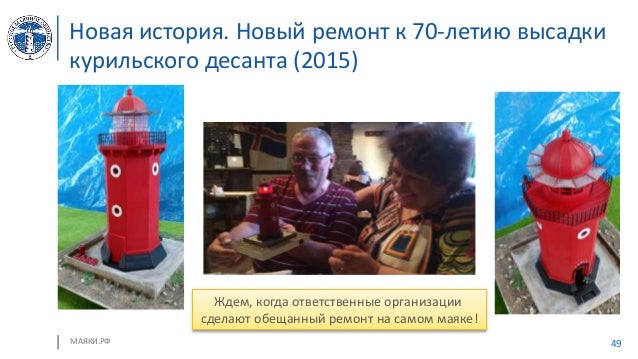
- 49. MAYAKI.RF 49 New history. New repairs for the 70th anniversary of the Kuril landing (2015) We are waiting for the responsible organizations to make the promised repairs on the lighthouse itself!
- 51. MAYAKI.RF 51 Modern lighthouses Vasiliev Mikhail Yakovlevich. Head of the Taran lighthouse Alexey Stepkov. Lighthouse Basargin Sergey Mityanin. Lighthouse Rotary
- 52. MAYAKI.RF 52 Who wants to become a lighthouse maker? How to become a lighthouse keeper or lighthouse keeper Good afternoon to everyone who is interested in lighthouses and the people who service them. At several lighthouses in the Gulf of Finland, vacancies have appeared for service personnel positions. You will be provided with a place to live, food provision for the whole year, very low wages, but you will be given the opportunity to personally touch the history of lighthouses and write your name into it. Basic requirements for candidates: skill in working with diesel generators, their minor repairs, ability to work independently, readiness to live in some isolation from society (from November to April only a helicopter and then only when absolutely necessary), age up to 50 years. Preference is given to married couples. If you are interested, call or write to me. Contacts. PS: Yes, fishing all year round, mushrooms, berries, etc. in unlimited quantities. Vacancy dated July 19, 2016
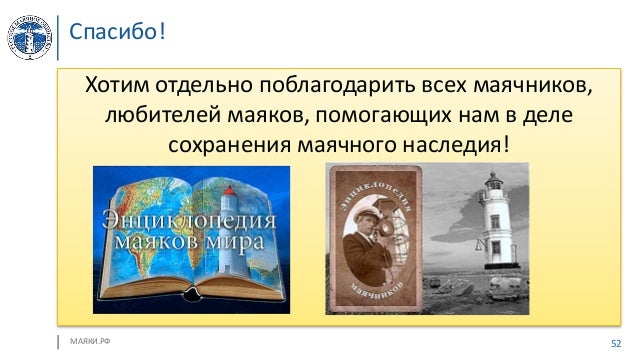
- 53. MAYAKI.RF 53 Thank you! We would like to especially thank all the lighthouse workers and lighthouse lovers who help us in preserving the lighthouse heritage!
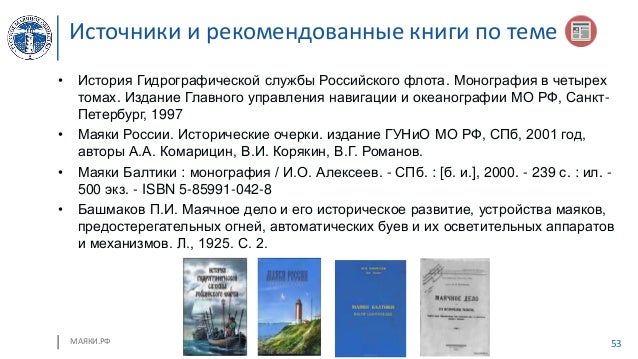
- 54. MAYAKI.RF 54 Sources and recommended books on the topic • History of the Hydrographic Service of the Russian Fleet. Monograph in four volumes. Publication of the Main Directorate of Navigation and Oceanography of the Ministry of Defense of the Russian Federation, St. Petersburg, 1997 • Lighthouses of Russia. Historical essays. publication of GUNIO MO RF, St. Petersburg, 2001, authors A.A. Komaritsin, V.I. Koryakin, V.G. Romanov. • Lighthouses of the Baltic: monograph / I.O. Alekseev. - St. Petersburg. : [b. i.], 2000. - 239 p. : ill. - 500 copies. - ISBN 5-85991-042-8 • Bashmakov P.I. Lighthouse business and its historical development, construction of beacons, warning lights, automatic buoys and their lighting apparatus and mechanisms. L., 1925. S. 2.
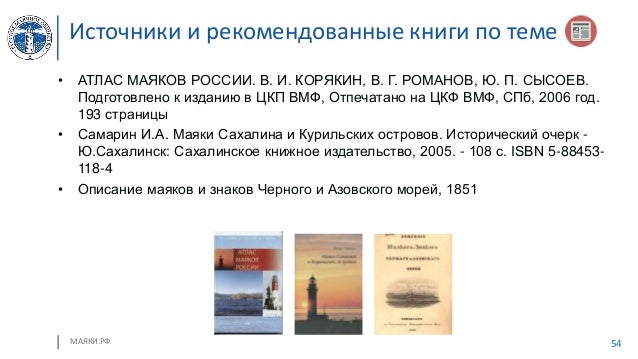
- 55. LIGHTHOUSES.RF 55 Sources and recommended books on the topic • ATLAS OF LIGHTHOUSES IN RUSSIA. V. I. KORYAKIN, V. G. ROMANOV, Y. P. SYSOEV. Prepared for publication at the Navy Central Commission for Use, Printed at the Navy Central Commission for Use, St. Petersburg, 2006. 193 pages • Samarin I.A. Lighthouses of Sakhalin and the Kuril Islands. Historical essay - Yu. Sakhalinsk: Sakhalin Book Publishing House, 2005. - 108 p. ISBN 5-88453- 118-4 • Description of lighthouses and signs of the Black and Azov Seas, 1851
- 56. Thank you for your attention! e-mail: [email protected] MAYAKI.RF | mayachnik.ru Vasily Korablev President of the Foundation for Support of Lighthouses and Lighthouses "Russian Lighthouse Society" Head of the project "Lighthouse. Lighthouses of Russia and the World"
Lighthouse keeper in the 21st century. Foundation "Russian Lighthouse Society" from Vasily Korablev
Video "Lighthouse Keeper in the 21st Century - Lecture at the 2016 Lighthouse Festival."
The lecture took place as part of the Maritime Festival in St. Petersburg on August 14, 2016. The Russian Lighthouse Society Foundation, together with other lighthouse enthusiasts, presented an exhibition of models in the World of Lighthouses pavilion at the first Lighthouse Festival! Speaker Vasily Korablev
This description is machine-translated and has not yet been reviewed.
Lighthouse Keeper in the 21st Century
More presentations from Mayachnik
Script:
- Speaker: Vasily Korablev President of the Foundation for Support of Lighthouses and Lighthouses "Russian Lighthouse Society" Head of the project "Lighthouse. Lighthouses of Russia and the world" "Lighthouse. Lighthouses of Russia and the world"
- 2. MAYAKI.RF Foundation for the support of lighthouses and lighthouses "Russian Lighthouse Society" Project "Lighthouse. Lighthouses of Russia and the world". • Encyclopedia of lighthouses in Russia, the world, lighthouse makers • Models of lighthouses • Forum about lighthouses and lighthouse makers http://mayaki.ru/ • Communities on social networks “Lighthouse Lovers Club” Our projects Founded: July 1, 2016 Founded: 2008 mayachnik.ru MAYAKI.RF
- 3. LIGHTHOUSES.RF The main focus of our projects is aimed at popularizing and preserving Russian lighthouses. Any story about lighthouses would not be complete without mentioning the lighthouse keepers. Lighthouse maker is not a profession, but a way of life. Work in any weather, in any bad weather, at any time... There are many known cases of heroic deeds of lighthouse workers in the name of helping sailors. Unfortunately, for a long time ordinary people knew little about the life and work of lighthouses. “Lighthouses are shrines of the seas. They belong to everyone and are inviolable, like the plenipotentiaries of the powers" Konstantin Paustovsky
- 4. MAYAKI.RF Lighthouse history. Lighthouses and beacons For a large number of people, lighthouses are a symbol of light, hope and a clear path. Despite the fact that the profession of a lighthouse keeper is becoming a thing of the past, the lighthouses themselves are still capable of bringing a lot of benefits.
- 5. MAYAKI.RF 5 Lighthouse - one who works at the lighthouse (lighthouse staff), including the Lighthouse Keeper. Lighthouse 'Efremova's Explanatory Dictionary' m. The one who works at the lighthouse. Mayachnik 'Ozhegov's Explanatory Dictionary' -a, m. Lighthouse Keeper Mayachnik 'Dictionary of synonyms' lighthouse noun, number of synonyms: (1) • ↑keeper (20) Dictionary of synonyms ASIS, Trishin V.N., 2010
- 6. LIGHTHOUSES.RF 6 How many lighthouses are there in the world? If you go by the numbering from the List of Lights, then there are more than 34 thousand lights and signs. It is clear that not all of them are elegant architectural structures, however, the scale for study is significant.
- 7. MAYAKI.RF 7 What is the role of lighthouses now? 1- Navigation The lighthouses themselves are also being improved. More and more beacons operate in fully automatic modes and are complex complexes of light-optical, electronic, sound-signaling equipment and power supply systems. The light-optical system automatically turns on at dusk and turns off at dawn. Also, light sources that are out and under construction are automatically switched to backup ones. Automated monitoring and control systems allow you to remotely control the characteristics of automatic beacon lights from the dispatch console. Increasingly, halogen, laser and LED lamps are used as light sources.
- 8. LIGHTHOUSES.RF 8 At all times, the lighthouse keeper performed many functions at the same time. In the twentieth century, he had to perform the functions of a mechanic, lighting technician and guard, who always had something to watch. The work of lighthouses is invisible to most people, but often it is a constant feat and overcoming difficulties, especially in Russia. Proverb: “The most desirable light for a sailor is the fire of his native lighthouse.”
- 9. MAYAKI.RF 9 Change of watch at sea
- 10. LIGHTHOUSES.RF 10 With the advent of GPS, Glonass in many countries, the need as such for lighthouses has disappeared and the profession of a lighthouse keeper (lighthouse) began to gradually become a thing of the past. Some lighthouses have already ceased to be used. Satellite navigation leaves no chance for lighthouses, but this does not mean that history should simply be forgotten. Abroad, lighthouse keepers are more the custodians of lighthouse traditions and supervise the operation of modern navigation aids.
- 11. LIGHTHOUSES.RF 11 Lighthouse - an object of cultural heritage Many lighthouses become objects of cultural heritage and tourism, mainly abroad. Lighthouses are dedicated to museums and converted into museums, and former keepers often serve as tour guides, although these people tend to combine a wide variety of responsibilities in their activities. Maine Lighthouse Museum Norman MacLeod Cape North Lighthouse
- 12. LIGHTHOUSE.RF 12 Lighthouse - cultural heritage site New Canal Lighthouse museum and training center
- 13. LIGHTHOUSES.RF 13 In order to preserve these magnificent buildings, lighthouse protection societies are being created around the world, in which former keepers also participate. Some lighthouse buildings are used scientists who observe the behavior of whales. In addition, lighthouses often help ornithologists.
- 14. MAYAKI.RF 14 What is the role of lighthouses now? Many foreign lighthouses began to operate as hotels. This service has become very popular among romantics who want to taste all the colors of the life of a lighthouse keeper. Typically, the money that tourists pay, thanks to the efforts of lighthouse preservation societies, is used to maintain lighthouses in good condition. Unfortunately, Russian lighthouses cannot yet boast of such an opportunity. You shouldn’t expect any official hotel or tourist services at lighthouses. One of the famous and architecturally original German lighthouses, “Scarlet Sand” (Roter Sand), stands in the sea and has a history of more than 125 years, and is also open as a hotel. The hotel has six spartan rooms with modest “camping” food - canned food, bread, vegetables, fruits. There is no alcohol at all, and to get to the toilet you need to climb 70 steps. However, under such conditions it is almost impossible to book a hotel room. And this is at a rather low cost of living of 556 euros
- 15. MAYAKI.RF 15 Modern lighthousemen connect times, eras and generations the Malygin family hereditary lighthousemen in the third generation in the Northern Fleet Evgeny Malygin, his great-grandfather, grandfather and father - all lighthouse workers. We worked on o. Sosnowiec metro station Kanin Nos. In his area of responsibility there are three lighthouses: Cape Barmin, Timan Island and Cape Svyatoy Nose, Cheshsky Lighthouse
- 16. MAYAKI.RF Famous people in lighthouse history
- 17. MAYAKI.RF 17 Leonty Vasilievich Spafarev (05/19/1766—01/25/1847) Lieutenant General. KFSh, transformer of lighthouse business in Russia. The lighthouse business originated in Russia in the 17th-18th centuries, brought to life by the reform activities of Peter I. However, only after the formation of the Lighthouse Directorate in the Ministry of Military Maritime Forces in 1807, headed by L.V. Spafariev formed the lighthouse business as a single effective economic system. L. V. Spafarev
- 18. MAYAKI.RF 18 Leonty Vasilyevich Spafarev (1766-1847) In 1803 in rank of cap. 2 r. appointed keeper of the Baltic lighthouses. Since 1807 - director of the lighthouses of the Finnish Hall. He made many technical changes in the field of lighthouse technology in Russia. All the old lighthouses of the Finnish and Riga Gulfs were rebuilt, the lighting of the lighthouses with coal and firewood was replaced with oil, a reflective lighting method was introduced, new methods were proposed for fencing fairways, narrows and skerry areas through sector and corner lighting, etc. In 1814 for the completion of the construction of lighthouses in the Finnish Hall. and the installation of a telegraph between Revel and Odensholm (Suur-Pakri) was awarded the Order of St. Anne, 2nd degree. The English merchant class, as a sign of great merit in ensuring the safety of navigation, in 1814 presented him with a silver vase with the inscription “Pro utile” (“For benefit”). L. V. Spafarev
- 19. MAYAKI.RF 19 Leonty Vasilievich Spafarev (1766-1847) Thanks to energetic and tireless activity Spafarev, by 1820, all the old lighthouses of the Gulf of Finland and Riga were rebuilt and 19 new ones were built, of which 13 were stone and 6 wooden. During the same period, the first floating lighthouses were built and began to operate, in particular, off the London Shoal (lighthouse ship Nordstern). By the time Spafariev began his activities in Russia, there were no regulatory documents that determined the operating hours of lighthouses. They were lit, as a rule, “with the onset of darkness” and extinguished “with the onset of daylight,” and these moments were interpreted differently by everyone, which often led to misunderstandings. For the first time in Russia, Spafariev calculated the time of sunset and sunrise for each lighthouse and compiled the corresponding tables. He also established the operating time of the beacons depending on the time of year. L. V. Spafarev
- 20. MAYAKI.RF 20 Leonty Vasilyevich Spafarev (1766-1847) Published the first in Russia at his own expense Atlas of the Finnish Hall. indicating all the lighthouses from Kronstadt to Luzerort. In 1817 he was promoted to major general. In 1825-1837 was commander of the Revel port (since 1829 with the rank of lieutenant general) while maintaining his previous position. In 1830 he was enrolled in the KFS. Two years later, for “excellently diligent” service, he was awarded the Order of St. Vladimir, 2nd degree. In 1834, at his suggestion, the publication of the Description of Lighthouses and Towers of the Russian Empire began. In 1838, he was “appointed to serve in the Naval Ministry.” He died in St. Petersburg and was buried at the Volkovskoye Orthodox Cemetery. An island in Tauiskaya Bay and a bay on the Alaska Peninsula (Chukchi Sea) are named after him. Main work: “Description of the lighthouses of the Gulf of Finland and Riga” (1820). L. V. Spafarev
- 21. MAYAKI.RF 21 Bazhenov Roman Ivanovich Years of life (4.05.1823—1.09.1904), senior adm., beginning GSU. 1 Jan 1865 Promoted to Cap. 1 rub. and appointed Art. pom. Director of lighthouses and pilotage of the Baltic Sea, in 1874 received the title of Candidate of Adm. and became director of lighthouses. Having been at the head of the management of the lighthouses of the Baltic Sea for more than 20 years, he brought this service to an exemplary state: in most of the Baltic lighthouses the catoptric lighting system was replaced by a dioptric lighting system, 15 new lighthouses were built, the first electric lighthouse and the first steam siren on the Baltic Sea were installed, the Moonsund Strait was fenced with coastal lights and luminous buoys. etc. For distinguished service in 1885, he was promoted to senior adm. and a year later the beginning was appointed. GSU and Chairman of the Marine Scientific Committee. Over the next two and a half years, he reviewed and revised the regulations on the workshop of nautical instruments, charters and regulations on the Naval Cadet Corps, established a compass unit at the State University and actively worked in the commission for the revision of pilot charters. Thanks to his persistence and energy, the publication of the journal began in 1887.
magazine "Zap. according to hydr." In May 1888, in accordance with the provisions on the maritime qualifications based on the age limit (65 years), he was “dismissed from service.” After retiring, he settled in Luga, where he soon equipped a rescue station. He died in Luga and was buried in the local cemetery at the Smeshinskaya Assumption Church. Main work: “Lighthouses, their lighting equipment and sound devices” (1884). Bazhenov Roman Ivanovich
- 22. MAYAKI.RF 22 Bashmakov Pavel Ivanovich Years of life (January 1890–1942). Arctic hydrographer, specialist in lighthouses and navigation aids. Born into a large family of a servant of the Zhuzmuy lighthouse in Onega Bay. In 1904 he entered the nautical department of the Arkhangelsk Trade and Maritime School. After the death of the father, the family found itself in a very difficult financial situation. The mother was forced to submit a petition for financial assistance to her son. Despite all the difficulties, Bashmakov, thanks to his will and enormous capacity for work, successfully completed his studies in 1909 and began serving in hydrographic organizations. He devoted more than 30 years to the hydrographic fencing of the White, Barents and Kara Seas. Since 1933, Bashmakov headed the Arkhangelsk and Novaya Zemlya hydrographic departments, during 1921–1940. combined work with teaching at the Arkhangelsk Maritime College, where he taught courses in navigation, pilotage, meteorology and astronomy. Bashmakov published a number of books and articles on hydrography, the history of the development of the Northern Sea Route, wrote reviews of
books about the Arctic and articles in the Great and Small Soviet Encyclopedias, and was the author of several inventions in the field of hydrography. His name was widely known in maritime circles. In 1924, he was awarded a sextant, on the cover of which, on a silver plate, was engraved an extract from the order of the Maritime Department: “Awarded with the approval of the Revolutionary Council of the USSR... hydrographer Pavel Ivanovich Bashmakov for tireless work aimed at improving navigation conditions in the White and Barents Seas and for developing a number of guidelines for navigation in these waters.” In 1924, the cruiser "Aurora" and the training ship "Komsomolets" made a voyage along the route Kronstadt - Arkhangelsk - Kronstadt for the first time in the history of the Soviet Navy. In this campaign, Bashmakov, an expert on the northern seas, was entrusted with escorting ships on the Murmansk-Arkhangelsk stage. Died in Arkhangelsk. He was buried at the Solombala cemetery. . Bashmakov Pavel Ivanovich
- 23. MAYAKI.RF 23 Bashmakov Pavel Ivanovich • Bashmakov P.I. Lighthouse business and its historical development, construction of beacons, warning lights, automatic buoys and their lighting apparatus and mechanisms. L., 1925. S. 2.
- 24. MAYAKI.RF Lighthouse romance
- [25. ]. the sailor determines a place in the ocean. William Shakespeare
- 26. MAYAKI.RF 26 The theme of love goes side by side with lighthouses. Thus, one of the famous lighthouses, Minot's Ledge Light, located in the USA in the state of Massachusetts, is famous for being called the “Lover’s Light” lighthouse or the “I-Love-You” lighthouse because of the light code 1-4-3. (the number of flashes corresponds to the number of letters in the words of the phrase I Love You).
- 27. MAYAKI.RF 27 Lighthouse Unity Paula the Lighthouse Keeper - FINLAND
- 28. MAYAKI.RF 28 As for creative people or just lovers of lonely thoughts, lighthouses are just perfect for them. The spirit and romance of lighthouses attracts many people around the world. A large number of literary works are dedicated to lighthouses. At the same time, many famous people connected their fate with lighthouses in one way or another. The poet Joseph Brodsky was supposedly a lighthouse keeper at the exit from the Leningrad port in 1958. True, in his words: “It ended very badly: the fireman there loved the naval order, and we didn’t get along with him.” Robert Stevenson (the famous writer's grandfather) was a famous lighthouse builder. Joseph Brodsky
- 29. MAYAKI.RF Modern lighthouses
- 30. LIGHTHOUSES.RF 30 TYURIN Yuri Ivanovich (Aytodor Lighthouse) b. 10/24/1927, cap. 2 rubles, hydrograph. Born in the Gorky (Nizhny Novgorod) region. After graduating from the Gorky Naval Preparatory School in 1945, he entered the hydrographic department of the VVMU named after. M. V. Frunze. After graduating from college in 1949, he served at the Pacific Fleet in various units of the Civil War. Participated in geodetic work and marine sounding in the Far East seas, as well as in work on the development of the aid to navigation network on Sakhalin and the Kuril Islands. In 1957 he was transferred to the Black Sea Fleet, where he served until his transfer to the reserve in 1977 as chief. Sevastopol district GS. A big lighthouse enthusiast. Made a significant contribution to the improvement and development of the aid to navigation network in the north-west. parts of the Black Sea. Currently is the beginning. Aytodor lighthouse in Crimea. Founded a museum of lighthouse service and round-the-world Antarctic expeditions at the lighthouse (unfortunately, not available for free visits). Yuri Ivanovich Tyurin
- 31. MAYAKI.RF So that history is not distorted
- 32. MAYAKI.RF 32 Despite the long history of lighthouse business in Russia, there is very little information about lighthouses in open sources, usually something there are about modern ones, and very little about their predecessors. It is often quite difficult to restore the correct chronology for each lighthouse. One example is the Zhuzmuysky lighthouse
- 33. MAYAKI.RF 33 Zhuzhmuysky since 1871 After the exhibition in Arkhangelsk in 2015, it became clear that the statement was wrong, that “the Ageev dynasty monitored the lighthouse for 130 years and the only break was for 12 years, when Natalya Kokova and Alexey Akulov monitored the lighthouse. He was written off from the lighthouse for embezzlement. Nikolai Ageev and his family came to replace him. Nikolai monitored the lighthouse until it was decommissioned (around 2010).”
- 34. MAYAKI.RF 34 Zhuzhmuysky since 1871 Zhuzhmuysky some of the smotels: Chronology approximate chronology caretakers, guardians told by Valery Plaksin: 1. let's start with Bashmakov - apparently the end of the 19th and beginning of the 20th century, 2. then most likely there was Serebryanikov - then he was arrested. 3. Great-grandfather Katarin A. - worked until 1940, I don’t know his position, I know that he served at the lighthouse and was buried there, 4. then - Agafonov Philip Prokopievich, either from 1940, or from 1945 to 1961. 5. Plaksin Anatoly Grigorievich since 1954 technician and since 1961 Chief. lighthouse until November 1966 He was buried in Arkhangelsk in Solombala, and later F.P. Agafonov was buried there. 6. Then the lighthouse was taken over by Popov Nikolay Prokopyevich (before that the head of the State Migration Service) 7. And now I don’t remember, but I didn’t ask anyone, in about 1970-71, Ageev Anatoly Grigorievich came to work at the lighthouse, 8. and further on the list Akulov for 12 years 9. then Ageev Nikolay Anatolyevich until the closure of the lighthouse.
- 35. MAYAKI.RF 35 Head of the lighthouse Agafonov Philip Prokopyevich, he is wearing a cap during the period of work according to available data 1945-1961. To his right is the captain of GPB-16 Safonov, and the young hydrometeorologist and radio operator of the HMS Morozov Slava. On the left with a suitcase is the boatswain GPB-16. (from the personal archive of Valery Plaksin)
- 36. MAYAKI.RF 36 are the same (as in Photo 1) and Agafonov’s wife Anna, driving in the stern Plaksin Anatoly Grigorievich since 1954 - technician of the Zhuzhmuy lighthouse, after retirement in 1962 Agafonova F.P. beginning lighthouse and until November 1966 Died November 17, 1966 (from the personal archive of Plaksin V.)
- 37. LIGHTHOUSES.RF Gate 37 on the road to the lighthouse on Zhuzhmuy Island. From the sea side they have the inscription “WELCOME”, and from the lighthouse side “HAPPY WAY” (from the personal archive of Plaksin V.)
- 38. MAYAKI.RF 38 Zhdanov Boris Nikolaevich By the will of fate, we met in Arkhangelsk an interesting person, Boris Nikolaevich Zhdanov, born at the Veprevsky lighthouse, located on the shores of the White Sea, not far from Zimnyaya Zolotitsa. Boris Nikolaevich wrote two books about the history of the Zimny Coast lighthouses; they tell in detail about the Zimnegorsky and Veprevsky lighthouses, where his parents worked in the 40s and 50s. These are the most interesting memories with rare photographs, a story about the everyday life of lighthouse services, combat duty, and the life of the lighthouse residents themselves. The books were published in a tiny edition “Winter Coast. People" was published in 120 copies, "Lighthouse Lights of the Winter Coast" - 100 copies.
- 39. LIGHTHOUSES.RF 39 If you have stories of people who served in lighthouses Encyclopedia of Russian Lighthouses
- 40. MAYAKI.RF How dynasties are interrupted
- 41. LIGHTHOUSES.RF 41 Shishelovs of the Shishelov lighthouse dynasty from the Tersko-Orlovsky and Shoina lighthouses more than 74 years "...the boss Alexey Nikolaevich Shishelov, who continues the family tradition. The head of the Tersko-Orlovsky lighthouse (on the Kola Peninsula) was his grandfather Pavel Alexandrovich. Then Alexey's father took over the baton. Nikolai Pavlovich Shishelov, who died not so long ago, worked at lighthouses all his life. First at the Tersko-Orlovsky, and then at Shoinsky. He passed it on to his son management of the lighthouse, and with it a family tradition, a sense of pride and responsibility for the important maritime business. Shishelov Alexey Nikolaevich at the Shoina lighthouse with a kerosene lamp after the destruction of the lighthouse and blackout, the lighthouse was repaired in 2007 according to the Norwegian program, and in 2010 it was destroyed, everything was broken and left for destruction and plunder, I asked the authorities not to touch the lighthouse, everything was in excellent condition, we could work for 10-15 years without serious investments, just pay salaries."
- 42. MAYAKI.RF The main thing is to survive!
- 43. LIGHTHOUSES.RF 43 Kurbatov Lighthouse Location: Kuril Islands, Shumshu Island, Sea of Okhotsk, Pacific Ocean - 1st Kuril Strait. Year of construction of the tower: 1956 What happened before 2006
- 44. LIGHTHOUSES.RF 44 Lighthouse "Kurbatova" Head of the lighthouse "Kurbatova" Elena Barbasheva and her husband Vladimir Dyachkov (mechanic), at the lighthouse since 2006. Repair “...In general, working at a lighthouse is more of a way of life. Those who are selfish and mercantile do not hold on..."
- 45. LIGHTHOUSES.RF 45 Lighthouse "Kurbatova" Head of the lighthouse "Kurbatova" Elena Barbasheva and her husband Vladimir Dyachkov (mechanic), at the lighthouse since 2006. After the first repair
- 46. MAYAKI.RF 46 Lighthouse unity. 2015 LAMP Association of Lighthouse Keepers. I have been the subject of many press articles myself, and have read many reports of others about the trials and tribulations of living in a lighthouses, and I have even contributed similar articles for publication myself, but your article in LAMP 103 has simply ‘blown me away’. This article, for me, epitomizes the dedication and mind- set of what lighthouse keeping is all about, and has got to be one of the finest descriptions of what it takes to be a lighthouse keeper that I’ve ever read. My congratulations and thanks to you for such a memorable piece of writing. If possible, please convey my best wishes and thanks to Elana and Vladamir for the work they continue to do at the lighthouse. Gordon Medlicott (ex-lighthouse keeper in the UK and a member of the Association of Lighthouse Keepers)
- 47. MAYAKI.RF 47 Lighthouse Unity. 2015 “How can we explain that we are not “suffering” here and are not bored, and salary is of secondary importance, and there are plenty of worries here, that everything here does not turn on, turn off, light up and live on its own, that the work of a lighthouse keeper is rather a state of mind and a voluntarily chosen way of life. Despite all the difficulties, my husband Vladimir and I are very happy people. We are confident that we are exactly where we need to be. Let it be destiny or fate, but this is exactly how we approach life at the lighthouse...” Elena Barbasheva
- 48. MAYAKI.RF 48 Lighthouse Unity. 2015 "I think now, I will say something that only a lighthouse keeper will understand. You know, having seen my lighthouse for years, I can look at its light in the night for a very long time without getting tired. For a keeper, a lighthouse is not a tower with fire. It is alive. Pulsating. With its own special rhythm, spirit. Each lighthouse has, as it were, its own aura, individuality. The keeper must be in harmony with his lighthouse. If, the person who came working at the lighthouse does not fit into this harmony, he will leave without any particular reason. When it happens that the automation fails and the fire goes out, the sight of an extinguished lighthouse causes an inexplicable melancholy. Returning to the lighthouse in the dark, seeing your fire, your mood always rises, a very warm feeling of native fire arises.” Barbasheva Elena The light of the Kurbatov lighthouse. Photo by: Yulia Galochkina
- 49. MAYAKI.RF 49 New history. New repairs for the 70th anniversary of the Kuril landing (2015) We are waiting for the responsible organizations to make the promised repairs on the lighthouse itself!
- 51. MAYAKI.RF 51 Modern lighthouses Vasiliev Mikhail Yakovlevich. Head of the Taran lighthouse Alexey Stepkov. Lighthouse Basargin Sergey Mityanin. Lighthouse Rotary
- 52. MAYAKI.RF 52 Who wants to become a lighthouse maker? How to become a lighthouse keeper or lighthouse keeper Good afternoon to everyone who is interested in lighthouses and the people who service them. At several lighthouses in the Gulf of Finland, vacancies have appeared for service personnel positions. You will be provided with a place to live, food provision for the whole year, very low wages, but you will be given the opportunity to personally touch the history of lighthouses and write your name into it. Basic requirements for candidates: skill in working with diesel generators, their minor repairs, ability to work independently, readiness to live in some isolation from society (from November to April only a helicopter and then only when absolutely necessary), age up to 50 years. Preference is given to married couples. If you are interested, call or write to me. Contacts. PS: Yes, fishing all year round, mushrooms, berries, etc. in unlimited quantities. Vacancy dated July 19, 2016
- 53. MAYAKI.RF 53 Thank you! We would like to especially thank all the lighthouse workers and lighthouse lovers who help us in preserving the lighthouse heritage!
- 54. MAYAKI.RF 54 Sources and recommended books on the topic • History of the Hydrographic Service of the Russian Fleet. Monograph in four volumes. Publication of the Main Directorate of Navigation and Oceanography of the Ministry of Defense of the Russian Federation, St. Petersburg, 1997 • Lighthouses of Russia. Historical essays. publication of GUNIO MO RF, St. Petersburg, 2001, authors A.A. Komaritsin, V.I. Koryakin, V.G. Romanov. • Lighthouses of the Baltic: monograph / I.O. Alekseev. - St. Petersburg. : [b. i.], 2000. - 239 p. : ill. - 500 copies. - ISBN 5-85991-042-8 • Bashmakov P.I. Lighthouse business and its historical development, construction of beacons, warning lights, automatic buoys and their lighting apparatus and mechanisms. L., 1925. S. 2.
- 55. LIGHTHOUSES.RF 55 Sources and recommended books on the topic • ATLAS OF LIGHTHOUSES IN RUSSIA. V. I. KORYAKIN, V. G. ROMANOV, Y. P. SYSOEV. Prepared for publication at the Navy Central Commission for Use, Printed at the Navy Central Commission for Use, St. Petersburg, 2006. 193 pages • Samarin I.A. Lighthouses of Sakhalin and the Kuril Islands. Historical essay - Yu. Sakhalinsk: Sakhalin Book Publishing House, 2005. - 108 p. ISBN 5-88453- 118-4 • Description of lighthouses and signs of the Black and Azov Seas, 1851
- 56. Thank you for your attention! e-mail: [email protected] MAYAKI.RF | mayachnik.ru Vasily Korablev President of the Foundation for Support of Lighthouses and Lighthouses "Russian Lighthouse Society" Head of the project "Lighthouse. Lighthouses of Russia and the World"
Lighthouse keeper in the 21st century. Foundation "Russian Lighthouse Society" from Vasily Korablev
Video "Lighthouse Keeper in the 21st Century - Lecture at the 2016 Lighthouse Festival."
The lecture took place as part of the Maritime Festival in St. Petersburg on August 14, 2016. The Russian Lighthouse Society Foundation, together with other lighthouse enthusiasts, presented an exhibition of models in the World of Lighthouses pavilion at the first Lighthouse Festival! Speaker Vasily Korablev
This description is machine-translated and has not yet been reviewed.
Lighthouse Keeper in the 21st Century
More presentations from Mayachnik
Script:
- Speaker: Vasily Korablev President of the Foundation for Support of Lighthouses and Lighthouses "Russian Lighthouse Society" Head of the project "Lighthouse. Lighthouses of Russia and the world" "Lighthouse. Lighthouses of Russia and the world"
- 2. MAYAKI.RF Foundation for the support of lighthouses and lighthouses "Russian Lighthouse Society" Project "Lighthouse. Lighthouses of Russia and the world". • Encyclopedia of lighthouses in Russia, the world, lighthouse makers • Models of lighthouses • Forum about lighthouses and lighthouse makers http://mayaki.ru/ • Communities on social networks “Lighthouse Lovers Club” Our projects Founded: July 1, 2016 Founded: 2008 mayachnik.ru MAYAKI.RF
- 3. LIGHTHOUSES.RF The main focus of our projects is aimed at popularizing and preserving Russian lighthouses. Any story about lighthouses would not be complete without mentioning the lighthouse keepers. Lighthouse maker is not a profession, but a way of life. Work in any weather, in any bad weather, at any time... There are many known cases of heroic deeds of lighthouse workers in the name of helping sailors. Unfortunately, for a long time ordinary people knew little about the life and work of lighthouses. “Lighthouses are shrines of the seas. They belong to everyone and are inviolable, like the plenipotentiaries of the powers" Konstantin Paustovsky
- 4. MAYAKI.RF Lighthouse history. Lighthouses and beacons For a large number of people, lighthouses are a symbol of light, hope and a clear path. Despite the fact that the profession of a lighthouse keeper is becoming a thing of the past, the lighthouses themselves are still capable of bringing a lot of benefits.
- 5. MAYAKI.RF 5 Lighthouse - one who works at the lighthouse (lighthouse staff), including the Lighthouse Keeper. Lighthouse 'Efremova's Explanatory Dictionary' m. The one who works at the lighthouse. Mayachnik 'Ozhegov's Explanatory Dictionary' -a, m. Lighthouse Keeper Mayachnik 'Dictionary of synonyms' lighthouse noun, number of synonyms: (1) • ↑keeper (20) Dictionary of synonyms ASIS, Trishin V.N., 2010
- 6. LIGHTHOUSES.RF 6 How many lighthouses are there in the world? If you go by the numbering from the List of Lights, then there are more than 34 thousand lights and signs. It is clear that not all of them are elegant architectural structures, however, the scale for study is significant.
- 7. MAYAKI.RF 7 What is the role of lighthouses now? 1- Navigation The lighthouses themselves are also being improved. More and more beacons operate in fully automatic modes and are complex complexes of light-optical, electronic, sound-signaling equipment and power supply systems. The light-optical system automatically turns on at dusk and turns off at dawn. Also, light sources that are out and under construction are automatically switched to backup ones. Automated monitoring and control systems allow you to remotely control the characteristics of automatic beacon lights from the dispatch console. Increasingly, halogen, laser and LED lamps are used as light sources.
- 8. LIGHTHOUSES.RF 8 At all times, the lighthouse keeper performed many functions at the same time. In the twentieth century, he had to perform the functions of a mechanic, lighting technician and guard, who always had something to watch. The work of lighthouses is invisible to most people, but often it is a constant feat and overcoming difficulties, especially in Russia. Proverb: “The most desirable light for a sailor is the fire of his native lighthouse.”
- 9. MAYAKI.RF 9 Change of watch at sea
- 10. LIGHTHOUSES.RF 10 With the advent of GPS, Glonass in many countries, the need as such for lighthouses has disappeared and the profession of a lighthouse keeper (lighthouse) began to gradually become a thing of the past. Some lighthouses have already ceased to be used. Satellite navigation leaves no chance for lighthouses, but this does not mean that history should simply be forgotten. Abroad, lighthouse keepers are more the custodians of lighthouse traditions and supervise the operation of modern navigation aids.
- 11. LIGHTHOUSES.RF 11 Lighthouse - an object of cultural heritage Many lighthouses become objects of cultural heritage and tourism, mainly abroad. Lighthouses are dedicated to museums and converted into museums, and former keepers often serve as tour guides, although these people tend to combine a wide variety of responsibilities in their activities. Maine Lighthouse Museum Norman MacLeod Cape North Lighthouse
- 12. LIGHTHOUSE.RF 12 Lighthouse - cultural heritage site New Canal Lighthouse museum and training center
- 13. LIGHTHOUSES.RF 13 In order to preserve these magnificent buildings, lighthouse protection societies are being created around the world, in which former keepers also participate. Some lighthouse buildings are used scientists who observe the behavior of whales. In addition, lighthouses often help ornithologists.
- 14. MAYAKI.RF 14 What is the role of lighthouses now? Many foreign lighthouses began to operate as hotels. This service has become very popular among romantics who want to taste all the colors of the life of a lighthouse keeper. Typically, the money that tourists pay, thanks to the efforts of lighthouse preservation societies, is used to maintain lighthouses in good condition. Unfortunately, Russian lighthouses cannot yet boast of such an opportunity. You shouldn’t expect any official hotel or tourist services at lighthouses. One of the famous and architecturally original German lighthouses, “Scarlet Sand” (Roter Sand), stands in the sea and has a history of more than 125 years, and is also open as a hotel. The hotel has six spartan rooms with modest “camping” food - canned food, bread, vegetables, fruits. There is no alcohol at all, and to get to the toilet you need to climb 70 steps. However, under such conditions it is almost impossible to book a hotel room. And this is at a rather low cost of living of 556 euros
- 15. MAYAKI.RF 15 Modern lighthousemen connect times, eras and generations the Malygin family hereditary lighthousemen in the third generation in the Northern Fleet Evgeny Malygin, his great-grandfather, grandfather and father - all lighthouse workers. We worked on o. Sosnowiec metro station Kanin Nos. In his area of responsibility there are three lighthouses: Cape Barmin, Timan Island and Cape Svyatoy Nose, Cheshsky Lighthouse
- 16. MAYAKI.RF Famous people in lighthouse history
- 17. MAYAKI.RF 17 Leonty Vasilievich Spafarev (05/19/1766—01/25/1847) Lieutenant General. KFSh, transformer of lighthouse business in Russia. The lighthouse business originated in Russia in the 17th-18th centuries, brought to life by the reform activities of Peter I. However, only after the formation of the Lighthouse Directorate in the Ministry of Military Maritime Forces in 1807, headed by L.V. Spafariev formed the lighthouse business as a single effective economic system. L. V. Spafarev
- 18. MAYAKI.RF 18 Leonty Vasilyevich Spafarev (1766-1847) In 1803 in rank of cap. 2 r. appointed keeper of the Baltic lighthouses. Since 1807 - director of the lighthouses of the Finnish Hall. He made many technical changes in the field of lighthouse technology in Russia. All the old lighthouses of the Finnish and Riga Gulfs were rebuilt, the lighting of the lighthouses with coal and firewood was replaced with oil, a reflective lighting method was introduced, new methods were proposed for fencing fairways, narrows and skerry areas through sector and corner lighting, etc. In 1814 for the completion of the construction of lighthouses in the Finnish Hall. and the installation of a telegraph between Revel and Odensholm (Suur-Pakri) was awarded the Order of St. Anne, 2nd degree. The English merchant class, as a sign of great merit in ensuring the safety of navigation, in 1814 presented him with a silver vase with the inscription “Pro utile” (“For benefit”). L. V. Spafarev
- 19. MAYAKI.RF 19 Leonty Vasilievich Spafarev (1766-1847) Thanks to energetic and tireless activity Spafarev, by 1820, all the old lighthouses of the Gulf of Finland and Riga were rebuilt and 19 new ones were built, of which 13 were stone and 6 wooden. During the same period, the first floating lighthouses were built and began to operate, in particular, off the London Shoal (lighthouse ship Nordstern). By the time Spafariev began his activities in Russia, there were no regulatory documents that determined the operating hours of lighthouses. They were lit, as a rule, “with the onset of darkness” and extinguished “with the onset of daylight,” and these moments were interpreted differently by everyone, which often led to misunderstandings. For the first time in Russia, Spafariev calculated the time of sunset and sunrise for each lighthouse and compiled the corresponding tables. He also established the operating time of the beacons depending on the time of year. L. V. Spafarev
- 20. MAYAKI.RF 20 Leonty Vasilyevich Spafarev (1766-1847) Published the first in Russia at his own expense Atlas of the Finnish Hall. indicating all the lighthouses from Kronstadt to Luzerort. In 1817 he was promoted to major general. In 1825-1837 was commander of the Revel port (since 1829 with the rank of lieutenant general) while maintaining his previous position. In 1830 he was enrolled in the KFS. Two years later, for “excellently diligent” service, he was awarded the Order of St. Vladimir, 2nd degree. In 1834, at his suggestion, the publication of the Description of Lighthouses and Towers of the Russian Empire began. In 1838, he was “appointed to serve in the Naval Ministry.” He died in St. Petersburg and was buried at the Volkovskoye Orthodox Cemetery. An island in Tauiskaya Bay and a bay on the Alaska Peninsula (Chukchi Sea) are named after him. Main work: “Description of the lighthouses of the Gulf of Finland and Riga” (1820). L. V. Spafarev
- 21. MAYAKI.RF 21 Bazhenov Roman Ivanovich Years of life (4.05.1823—1.09.1904), senior adm., beginning GSU. 1 Jan 1865 Promoted to Cap. 1 rub. and appointed Art. pom. Director of lighthouses and pilotage of the Baltic Sea, in 1874 received the title of Candidate of Adm. and became director of lighthouses. Having been at the head of the management of the lighthouses of the Baltic Sea for more than 20 years, he brought this service to an exemplary state: in most of the Baltic lighthouses the catoptric lighting system was replaced by a dioptric lighting system, 15 new lighthouses were built, the first electric lighthouse and the first steam siren on the Baltic Sea were installed, the Moonsund Strait was fenced with coastal lights and luminous buoys. etc. For distinguished service in 1885, he was promoted to senior adm. and a year later the beginning was appointed. GSU and Chairman of the Marine Scientific Committee. Over the next two and a half years, he reviewed and revised the regulations on the workshop of nautical instruments, charters and regulations on the Naval Cadet Corps, established a compass unit at the State University and actively worked in the commission for the revision of pilot charters. Thanks to his persistence and energy, the publication of the journal began in 1887.
magazine "Zap. according to hydr." In May 1888, in accordance with the provisions on the maritime qualifications based on the age limit (65 years), he was “dismissed from service.” After retiring, he settled in Luga, where he soon equipped a rescue station. He died in Luga and was buried in the local cemetery at the Smeshinskaya Assumption Church. Main work: “Lighthouses, their lighting equipment and sound devices” (1884). Bazhenov Roman Ivanovich
- 22. MAYAKI.RF 22 Bashmakov Pavel Ivanovich Years of life (January 1890–1942). Arctic hydrographer, specialist in lighthouses and navigation aids. Born into a large family of a servant of the Zhuzmuy lighthouse in Onega Bay. In 1904 he entered the nautical department of the Arkhangelsk Trade and Maritime School. After the death of the father, the family found itself in a very difficult financial situation. The mother was forced to submit a petition for financial assistance to her son. Despite all the difficulties, Bashmakov, thanks to his will and enormous capacity for work, successfully completed his studies in 1909 and began serving in hydrographic organizations. He devoted more than 30 years to the hydrographic fencing of the White, Barents and Kara Seas. Since 1933, Bashmakov headed the Arkhangelsk and Novaya Zemlya hydrographic departments, during 1921–1940. combined work with teaching at the Arkhangelsk Maritime College, where he taught courses in navigation, pilotage, meteorology and astronomy. Bashmakov published a number of books and articles on hydrography, the history of the development of the Northern Sea Route, wrote reviews of
books about the Arctic and articles in the Great and Small Soviet Encyclopedias, and was the author of several inventions in the field of hydrography. His name was widely known in maritime circles. In 1924, he was awarded a sextant, on the cover of which, on a silver plate, was engraved an extract from the order of the Maritime Department: “Awarded with the approval of the Revolutionary Council of the USSR... hydrographer Pavel Ivanovich Bashmakov for tireless work aimed at improving navigation conditions in the White and Barents Seas and for developing a number of guidelines for navigation in these waters.” In 1924, the cruiser "Aurora" and the training ship "Komsomolets" made a voyage along the route Kronstadt - Arkhangelsk - Kronstadt for the first time in the history of the Soviet Navy. In this campaign, Bashmakov, an expert on the northern seas, was entrusted with escorting ships on the Murmansk-Arkhangelsk stage. Died in Arkhangelsk. He was buried at the Solombala cemetery. . Bashmakov Pavel Ivanovich
- 23. MAYAKI.RF 23 Bashmakov Pavel Ivanovich • Bashmakov P.I. Lighthouse business and its historical development, construction of beacons, warning lights, automatic buoys and their lighting apparatus and mechanisms. L., 1925. S. 2.
- 24. MAYAKI.RF Lighthouse romance
- [25. ]. the sailor determines a place in the ocean. William Shakespeare
- 26. MAYAKI.RF 26 The theme of love goes side by side with lighthouses. Thus, one of the famous lighthouses, Minot's Ledge Light, located in the USA in the state of Massachusetts, is famous for being called the “Lover’s Light” lighthouse or the “I-Love-You” lighthouse because of the light code 1-4-3. (the number of flashes corresponds to the number of letters in the words of the phrase I Love You).
- 27. MAYAKI.RF 27 Lighthouse Unity Paula the Lighthouse Keeper - FINLAND
- 28. MAYAKI.RF 28 As for creative people or just lovers of lonely thoughts, lighthouses are just perfect for them. The spirit and romance of lighthouses attracts many people around the world. A large number of literary works are dedicated to lighthouses. At the same time, many famous people connected their fate with lighthouses in one way or another. The poet Joseph Brodsky was supposedly a lighthouse keeper at the exit from the Leningrad port in 1958. True, in his words: “It ended very badly: the fireman there loved the naval order, and we didn’t get along with him.” Robert Stevenson (the famous writer's grandfather) was a famous lighthouse builder. Joseph Brodsky
- 29. MAYAKI.RF Modern lighthouses
- 30. LIGHTHOUSES.RF 30 TYURIN Yuri Ivanovich (Aytodor Lighthouse) b. 10/24/1927, cap. 2 rubles, hydrograph. Born in the Gorky (Nizhny Novgorod) region. After graduating from the Gorky Naval Preparatory School in 1945, he entered the hydrographic department of the VVMU named after. M. V. Frunze. After graduating from college in 1949, he served at the Pacific Fleet in various units of the Civil War. Participated in geodetic work and marine sounding in the Far East seas, as well as in work on the development of the aid to navigation network on Sakhalin and the Kuril Islands. In 1957 he was transferred to the Black Sea Fleet, where he served until his transfer to the reserve in 1977 as chief. Sevastopol district GS. A big lighthouse enthusiast. Made a significant contribution to the improvement and development of the aid to navigation network in the north-west. parts of the Black Sea. Currently is the beginning. Aytodor lighthouse in Crimea. Founded a museum of lighthouse service and round-the-world Antarctic expeditions at the lighthouse (unfortunately, not available for free visits). Yuri Ivanovich Tyurin
- 31. MAYAKI.RF So that history is not distorted
- 32. MAYAKI.RF 32 Despite the long history of lighthouse business in Russia, there is very little information about lighthouses in open sources, usually something there are about modern ones, and very little about their predecessors. It is often quite difficult to restore the correct chronology for each lighthouse. One example is the Zhuzmuysky lighthouse
- 33. MAYAKI.RF 33 Zhuzhmuysky since 1871 After the exhibition in Arkhangelsk in 2015, it became clear that the statement was wrong, that “the Ageev dynasty monitored the lighthouse for 130 years and the only break was for 12 years, when Natalya Kokova and Alexey Akulov monitored the lighthouse. He was written off from the lighthouse for embezzlement. Nikolai Ageev and his family came to replace him. Nikolai monitored the lighthouse until it was decommissioned (around 2010).”
- 34. MAYAKI.RF 34 Zhuzhmuysky since 1871 Zhuzhmuysky some of the smotels: Chronology approximate chronology caretakers, guardians told by Valery Plaksin: 1. let's start with Bashmakov - apparently the end of the 19th and beginning of the 20th century, 2. then most likely there was Serebryanikov - then he was arrested. 3. Great-grandfather Katarin A. - worked until 1940, I don’t know his position, I know that he served at the lighthouse and was buried there, 4. then - Agafonov Philip Prokopievich, either from 1940, or from 1945 to 1961. 5. Plaksin Anatoly Grigorievich since 1954 technician and since 1961 Chief. lighthouse until November 1966 He was buried in Arkhangelsk in Solombala, and later F.P. Agafonov was buried there. 6. Then the lighthouse was taken over by Popov Nikolay Prokopyevich (before that the head of the State Migration Service) 7. And now I don’t remember, but I didn’t ask anyone, in about 1970-71, Ageev Anatoly Grigorievich came to work at the lighthouse, 8. and further on the list Akulov for 12 years 9. then Ageev Nikolay Anatolyevich until the closure of the lighthouse.
- 35. MAYAKI.RF 35 Head of the lighthouse Agafonov Philip Prokopyevich, he is wearing a cap during the period of work according to available data 1945-1961. To his right is the captain of GPB-16 Safonov, and the young hydrometeorologist and radio operator of the HMS Morozov Slava. On the left with a suitcase is the boatswain GPB-16. (from the personal archive of Valery Plaksin)
- 36. MAYAKI.RF 36 are the same (as in Photo 1) and Agafonov’s wife Anna, driving in the stern Plaksin Anatoly Grigorievich since 1954 - technician of the Zhuzhmuy lighthouse, after retirement in 1962 Agafonova F.P. beginning lighthouse and until November 1966 Died November 17, 1966 (from the personal archive of Plaksin V.)
- 37. LIGHTHOUSES.RF Gate 37 on the road to the lighthouse on Zhuzhmuy Island. From the sea side they have the inscription “WELCOME”, and from the lighthouse side “HAPPY WAY” (from the personal archive of Plaksin V.)
- 38. MAYAKI.RF 38 Zhdanov Boris Nikolaevich By the will of fate, we met in Arkhangelsk an interesting person, Boris Nikolaevich Zhdanov, born at the Veprevsky lighthouse, located on the shores of the White Sea, not far from Zimnyaya Zolotitsa. Boris Nikolaevich wrote two books about the history of the Zimny Coast lighthouses; they tell in detail about the Zimnegorsky and Veprevsky lighthouses, where his parents worked in the 40s and 50s. These are the most interesting memories with rare photographs, a story about the everyday life of lighthouse services, combat duty, and the life of the lighthouse residents themselves. The books were published in a tiny edition “Winter Coast. People" was published in 120 copies, "Lighthouse Lights of the Winter Coast" - 100 copies.
- 39. LIGHTHOUSES.RF 39 If you have stories of people who served in lighthouses Encyclopedia of Russian Lighthouses
- 40. MAYAKI.RF How dynasties are interrupted
- 41. LIGHTHOUSES.RF 41 Shishelovs of the Shishelov lighthouse dynasty from the Tersko-Orlovsky and Shoina lighthouses more than 74 years "...the boss Alexey Nikolaevich Shishelov, who continues the family tradition. The head of the Tersko-Orlovsky lighthouse (on the Kola Peninsula) was his grandfather Pavel Alexandrovich. Then Alexey's father took over the baton. Nikolai Pavlovich Shishelov, who died not so long ago, worked at lighthouses all his life. First at the Tersko-Orlovsky, and then at Shoinsky. He passed it on to his son management of the lighthouse, and with it a family tradition, a sense of pride and responsibility for the important maritime business. Shishelov Alexey Nikolaevich at the Shoina lighthouse with a kerosene lamp after the destruction of the lighthouse and blackout, the lighthouse was repaired in 2007 according to the Norwegian program, and in 2010 it was destroyed, everything was broken and left for destruction and plunder, I asked the authorities not to touch the lighthouse, everything was in excellent condition, we could work for 10-15 years without serious investments, just pay salaries."
- 42. MAYAKI.RF The main thing is to survive!
- 43. LIGHTHOUSES.RF 43 Kurbatov Lighthouse Location: Kuril Islands, Shumshu Island, Sea of Okhotsk, Pacific Ocean - 1st Kuril Strait. Year of construction of the tower: 1956 What happened before 2006
- 44. LIGHTHOUSES.RF 44 Lighthouse "Kurbatova" Head of the lighthouse "Kurbatova" Elena Barbasheva and her husband Vladimir Dyachkov (mechanic), at the lighthouse since 2006. Repair “...In general, working at a lighthouse is more of a way of life. Those who are selfish and mercantile do not hold on..."
- 45. LIGHTHOUSES.RF 45 Lighthouse "Kurbatova" Head of the lighthouse "Kurbatova" Elena Barbasheva and her husband Vladimir Dyachkov (mechanic), at the lighthouse since 2006. After the first repair
- 46. MAYAKI.RF 46 Lighthouse unity. 2015 LAMP Association of Lighthouse Keepers. I have been the subject of many press articles myself, and have read many reports of others about the trials and tribulations of living in a lighthouses, and I have even contributed similar articles for publication myself, but your article in LAMP 103 has simply ‘blown me away’. This article, for me, epitomizes the dedication and mind- set of what lighthouse keeping is all about, and has got to be one of the finest descriptions of what it takes to be a lighthouse keeper that I’ve ever read. My congratulations and thanks to you for such a memorable piece of writing. If possible, please convey my best wishes and thanks to Elana and Vladamir for the work they continue to do at the lighthouse. Gordon Medlicott (ex-lighthouse keeper in the UK and a member of the Association of Lighthouse Keepers)
- 47. MAYAKI.RF 47 Lighthouse Unity. 2015 “How can we explain that we are not “suffering” here and are not bored, and salary is of secondary importance, and there are plenty of worries here, that everything here does not turn on, turn off, light up and live on its own, that the work of a lighthouse keeper is rather a state of mind and a voluntarily chosen way of life. Despite all the difficulties, my husband Vladimir and I are very happy people. We are confident that we are exactly where we need to be. Let it be destiny or fate, but this is exactly how we approach life at the lighthouse...” Elena Barbasheva
- 48. MAYAKI.RF 48 Lighthouse Unity. 2015 "I think now, I will say something that only a lighthouse keeper will understand. You know, having seen my lighthouse for years, I can look at its light in the night for a very long time without getting tired. For a keeper, a lighthouse is not a tower with fire. It is alive. Pulsating. With its own special rhythm, spirit. Each lighthouse has, as it were, its own aura, individuality. The keeper must be in harmony with his lighthouse. If, the person who came working at the lighthouse does not fit into this harmony, he will leave without any particular reason. When it happens that the automation fails and the fire goes out, the sight of an extinguished lighthouse causes an inexplicable melancholy. Returning to the lighthouse in the dark, seeing your fire, your mood always rises, a very warm feeling of native fire arises.” Barbasheva Elena The light of the Kurbatov lighthouse. Photo by: Yulia Galochkina
- 49. MAYAKI.RF 49 New history. New repairs for the 70th anniversary of the Kuril landing (2015) We are waiting for the responsible organizations to make the promised repairs on the lighthouse itself!
- 51. MAYAKI.RF 51 Modern lighthouses Vasiliev Mikhail Yakovlevich. Head of the Taran lighthouse Alexey Stepkov. Lighthouse Basargin Sergey Mityanin. Lighthouse Rotary
- 52. MAYAKI.RF 52 Who wants to become a lighthouse maker? How to become a lighthouse keeper or lighthouse keeper Good afternoon to everyone who is interested in lighthouses and the people who service them. At several lighthouses in the Gulf of Finland, vacancies have appeared for service personnel positions. You will be provided with a place to live, food provision for the whole year, very low wages, but you will be given the opportunity to personally touch the history of lighthouses and write your name into it. Basic requirements for candidates: skill in working with diesel generators, their minor repairs, ability to work independently, readiness to live in some isolation from society (from November to April only a helicopter and then only when absolutely necessary), age up to 50 years. Preference is given to married couples. If you are interested, call or write to me. Contacts. PS: Yes, fishing all year round, mushrooms, berries, etc. in unlimited quantities. Vacancy dated July 19, 2016
- 53. MAYAKI.RF 53 Thank you! We would like to especially thank all the lighthouse workers and lighthouse lovers who help us in preserving the lighthouse heritage!
- 54. MAYAKI.RF 54 Sources and recommended books on the topic • History of the Hydrographic Service of the Russian Fleet. Monograph in four volumes. Publication of the Main Directorate of Navigation and Oceanography of the Ministry of Defense of the Russian Federation, St. Petersburg, 1997 • Lighthouses of Russia. Historical essays. publication of GUNIO MO RF, St. Petersburg, 2001, authors A.A. Komaritsin, V.I. Koryakin, V.G. Romanov. • Lighthouses of the Baltic: monograph / I.O. Alekseev. - St. Petersburg. : [b. i.], 2000. - 239 p. : ill. - 500 copies. - ISBN 5-85991-042-8 • Bashmakov P.I. Lighthouse business and its historical development, construction of beacons, warning lights, automatic buoys and their lighting apparatus and mechanisms. L., 1925. S. 2.
- 55. LIGHTHOUSES.RF 55 Sources and recommended books on the topic • ATLAS OF LIGHTHOUSES IN RUSSIA. V. I. KORYAKIN, V. G. ROMANOV, Y. P. SYSOEV. Prepared for publication at the Navy Central Commission for Use, Printed at the Navy Central Commission for Use, St. Petersburg, 2006. 193 pages • Samarin I.A. Lighthouses of Sakhalin and the Kuril Islands. Historical essay - Yu. Sakhalinsk: Sakhalin Book Publishing House, 2005. - 108 p. ISBN 5-88453- 118-4 • Description of lighthouses and signs of the Black and Azov Seas, 1851
- 56. Thank you for your attention! e-mail: [email protected] MAYAKI.RF | mayachnik.ru Vasily Korablev President of the Foundation for Support of Lighthouses and Lighthouses "Russian Lighthouse Society" Head of the project "Lighthouse. Lighthouses of Russia and the World"
Lighthouse keeper in the 21st century. Foundation "Russian Lighthouse Society" from Vasily Korablev
Video "Lighthouse Keeper in the 21st Century - Lecture at the 2016 Lighthouse Festival."
The lecture took place as part of the Maritime Festival in St. Petersburg on August 14, 2016. The Russian Lighthouse Society Foundation, together with other lighthouse enthusiasts, presented an exhibition of models in the World of Lighthouses pavilion at the first Lighthouse Festival! Speaker Vasily Korablev
Смотритель маяка в 21 веке
Скрипт:
- Докладчик: Василий Кораблев Президент Фонда поддержки маяков и маячников «Русское маячное общество» Руководитель проекта "Маячник. Маяки России и мира" "Маячник. Маяки России и мира"
- 2. МАЯКИ.РФ Фонд поддержки маяков и маячников "Русское маячное общество" Проект "Маячник. Маяки России и мира". • Энциклопедия маяков России, мира, маячников • Модели маяков • Форум о маяках и маячниках http://mayaki.ru/ • Сообщества в социальных сетях "Клуб любителей маяков" Наши проекты Основан: 1 июля 2016г. Основан: 2008г. mayachnik.ru МАЯКИ.РФ
- 3. МАЯКИ.РФ Основной фокус наших проектов направлен на популяризацию и сохранение маяков России. Любой рассказ о маяках был бы не полон без упоминания о маячниках – смотрителях маяков. Маячник не профессия, а образ жизни. Работа в любую погоду, в любое ненастье, в любое время... Известно много случаев героических поступков маячников во имя оказания помощи морякам. К сожалению, долгое время о жизни и работе маячников обычным людям было мало, что известно. «Маяки – святыни морей. Они принадлежат всем и неприкосновенны, как полпреды держав» Константин Паустовский
- 4. МАЯКИ.РФ Маячная история. Маячники и маяки Для большого количества людей маяки – это символ света, надежды и ясного пути. Не смотря, на то, что профессия смотрителя маяка уходит в прошлое, сами маяки всё ещё способны приносить массу пользы.
- 5. МАЯКИ.РФ 5 Маячник – тот, кто работает на маяке (персонал маяков), в том числе Смотритель маяка. Маячник`Толковый словарь Ефремовой` м. разг. Тот, кто работает на маяке. Маячник`Толковый словарь Ожегова` -а, м. Смотритель маяка Маячник`Словарь синонимов` маячник сущ., кол-во синонимов: (1) • ↑смотритель (20) Словарь синонимов ASIS, Тришин В.Н., 2010
- 6. МАЯКИ.РФ 6 Сколько в мире маяков? Если ориентироваться на нумерацию из List of Lights, то более 34 тысяч огней и знаков. Понятно, что не все они представляют собой изящные архитектурные сооружения, тем не менее масштаб для изучения значительный.
- 7. МАЯКИ.РФ 7 В какой роли сейчас маяки? 1- Навигация Совершенствуются и сами маяки. Все больше маяков работают в полностью автоматических режимах и представляют из себя сложные комплексы светооптического, электронного, звукосигнального оборудования и систем электропитания. Светооптическая система автоматически включается с наступлением сумерек и выключается с рассветом. Также автоматически переключаются вышедшие и строя источники света на резервные. Автоматизированные системы контроля и управления позволяют удаленно с диспетчерского пульта управлять характеристиками огней автоматических маяков. Все чаще в качестве источников света используют галогенные, лазерные и светодиодные светильники.
- 8. МАЯКИ.РФ 8 Во все времена смотритель маяка исполнил многие функции одновременно. В ХХ веке ему пришлось исполнять функции механика, светотехника и постового, которому всегда есть, за чем наблюдать. Работа маячников, для большинства людей незаметна, но зачастую это постоянный подвиг и преодоление трудностей, особенно в России. Пословица "Самый желанный свет для моряка - огонь родного маяка".
- 9. МАЯКИ.РФ 9 Смена вахты в море
- 10. МАЯКИ.РФ 10 С появлением GPS, Глонасс во многих странах необходимость, как таковая в маяках отпала и профессия смотрителя маяка (маячника) начала постепенно уходить в прошлое. Некоторые маяки уже перестали использоваться. Спутниковая навигация не оставляет шансов маякам, но это не значит, что историю нужно просто забыть. За границей маячники это больше хранители маячных традиций и осуществляют надзор за работой современных средств навигации.
- 11. МАЯКИ.РФ 11 Маяк – объект культурного наследия Многие маяки становятся объектами культурного наследия и туризма, в основном зарубежом. Маякам посвящают музеи и переоборудуют в музеи, а бывшие смотрители зачастую выполняют функции экскурсоводов, хотя этим людям свойственно совмещать в своей деятельности самые разнообразные обязанности. Музей маяков в штате Мэн Норман Маклауд Cape North Lighthouse
- 12. МАЯКИ.РФ 12 Маяк – объект культурного наследия New Canal Lighthouse музей и учебный центр
- 13. МАЯКИ.РФ 13 С целью сохранения этих великолепных зданий по всему миру создаются общества охраны маяков, в которых в том числе участвуют бывшие смотрители Некоторые здания маяков используют учёные, которые наблюдают за поведением китов. Кроме этого, маяки нередко помогают орнитологам.
- 14. МАЯКИ.РФ 14 В какой роли сейчас маяки? Много зарубежных маяков стали работать, как отели. Данная услуга стала очень популярной среди романтиков, желающих вкусить все краски жизни смотрителя маяка. Обычно деньги, которые платят туристы, благодаря усилиям обществ охраны маяков, направляются на поддержание маяков в хорошем состоянии. К сожалению, российские маяки пока похвастаться такой возможностью не могут. Ожидать какого-то официального отельного или туристического сервиса на маяках не приходится. Один из известных и оригинальных по архитектуре немецких маяков «Алый песок» (Roter Sand), стоит в море и насчитывает уже более чем 125 летнюю историю, а также открыт как отель. В отеле шесть спартанских номеров со скромным «походным» питанием – консервы, хлеб, овощи, фрукты. Алкоголя нет вообще, а чтобы попасть в туалет нужно преодолеть 70 ступенек. Тем не менее при таких условиях забронировать номер в отеле практически невозможно. И это при не малой стоимости проживания в 556 евро
- 15. МАЯКИ.РФ 15 Современные маячники осуществляют связь времен, эпох и поколений семья Малыгиных потомственные маячники в третьем поколении на Северном флоте Евгений Малыгин, его прадед, дед отец - все маячники. Работали на о. Сосновец м. Канин нос. В зоне его ответственности три маяка мыс Бармин, остров Тимане и мыс Святой нос маяк Чёшский
- 16. МАЯКИ.РФ Известные люди в маячной истории
- 17. МАЯКИ.РФ 17 Леонтий Васильевич Спафарьев (19.05.1766—25.01.1847) ген.-лейт. КФШ, преобразователь маячного дела в России. Маячное дело зарождалось в России в XVII—XVIII веках, вызванное к жизни реформаторской деятельностью Петра I. Однако только после образования в 1807 году в Министерстве военных морских сил Управления маяков во главе с Л.В. Спафарьевым маячное дело сформировалось как единая эффективная хозяйственная система. Л. В. Спафарьев
- 18. МАЯКИ.РФ 18 Леонтий Васильевич Спафарьев (1766—1847) В 1803 г. в чине кап. 2 р. назначен смотрителем Балтийских маяков. С 1807 г. —директор маяков Финского зал. Внес много технических преобразований в область маячной техники в России. Были перестроены все старые маяки Финского и Рижского зал., освещение маяков углем и дровами заменено на масляное, введен отражательный способ освещения, предложены новые методы ограждения фарватеров, узкостей и шхерных районов посредством секторного и углового освещения и т.д. В 1814 г. за окончание строительства маяков в Финском зал. и устройство телеграфа между Ревелем и Оденсгольмом (Суур- Пакри) награжден орденом Св. Анны 2 степени. Английское торговое сословие в знак больших заслуг по обеспечению безопасности мореплавания в 1814 г. преподнесло ему серебряную вазу с надписью «Pro utile» («За пользу»). Л. В. Спафарьев
- 19. МАЯКИ.РФ 19 Леонтий Васильевич Спафарьев (1766—1847) Благодаря энергичной и неутомимой деятельности Спафарьева к 1820 г. были перестроены все старые маяки Финского и Рижского заливов и построено 19 новых, из которых 13 были каменные и 6 деревянные. В этот же период были построены и начали действовать первые плавучие маяки, в частности, у Лондонской мели (маячное судно «Нордштерн») К моменту начала деятельности Спафарьева в России не было никаких регламентирующих документов, определявших время работы маяков. Зажигались они, как правило, «с наступлением темноты» и гасились «с наступлением светлого времени», причем моменты эти трактовались всеми по-разному, что приводило нередко к недоразумениям. Спафарьев впервые в России рассчитал для каждого маяка время захода и восхода солнца и составил соответствующие таблицы. Установил он и время действия маяков в зависимости от времени года. Л. В. Спафарьев
- 20. МАЯКИ.РФ 20 Леонтий Васильевич Спафарьев (1766—1847) За свой счет издал первый в России атлас Финского зал. с указанием всех маяков от Кронштадта до Люзерорта. В 1817 г. произведен в ген.-майоры. В 1825—1837 гг. был командиром Ревельского порта (с 1829 г. в чине ген.-лейт.) с сохранением прежней должности. В 1830 г. зачислен в КФШ. Через два года за «отлично усердную» службу награжден орденом Св. Владимира 2 степени. В 1834 г. по его предложению начато издание Описания маяков и башен Российской Империи. В 1838 г. «назначен состоять по Морскому министерству». Умер в С.-Петербурге, похоронен на Волковском православном кладбище. Его именем названы остров в Тауйской губе и бухта на п-ове Аляска (Чукотское море). Основной труд: «Описание маяков Финского и Рижского заливов» (1820). Л. В. Спафарьев
- 21. МАЯКИ.РФ 21 Баженов Роман Иванович Годы жизни (4.05.1823— 1.09.1904), в.-адм., нач. ГГУ. 1 янв. 1865 г. произведен в кап. 1 р. и назначен ст. пом. директора маяков и лоции Балтийского моря, в 1874 г. получил звание к.-адм. и стал директором маяков. Находясь более 20 лет во главе управления маяками Балтийского моря, привел эту службу в образцовое состояние: на большей части балтийских маяков катоптрическая система освещения была заменена диоптрической, построено 15 новых маяков, установлен первый электрический маяк и первая на Балтийском море паровая сирена, огражден береговыми огнями и светящими буями Моонзундский прол. и т. д. За отличие по службе в 1885 г. произведен в в.-адм. и через год назначен нач. ГГУ и председателем Морского ученого комитета. В течение последующих двух с половиной лет пересмотрел и переработал положение о мастерской мореходных инструментов, уставы и положение о Морском кадетском корпусе, учредил при ГГУ компасную часть и активно работал в комиссии по пересмотру лоцманских уставов. Благодаря его настойчивости и энергии с 1887 г. начато издание журнала «Зап. по гидр.». В мае 1888 г. в соответствии с положением о морском цензе по предельному возрасту (65 лет) был «уволен от службы». Выйдя в отставку, поселился в Луге, где вскоре оборудовал спасательную станцию. Умер в Луге, похоронен на местном кладбище при Смешинской Успенской церкви. Основной труд: «Маяки, их осветительная аппаратура и звуковые приборы» (1884). Баженов Роман Иванович
- 22. МАЯКИ.РФ 22 Башмаков Павел Иванович Годы жизни (январь 1890–1942). Арктический гидрограф, специалист по маякам и средствам навигационного ограждения. Родился в многодетной семье служителя Жужмуйского маяка в Онежском заливе. В 1904 году поступил на мореходное отделение Архангельского торгово-мореходного училища. После смерти отца семья оказалась в очень тяжелом материальном положении. Мать была вынуждена подать прошение об оказании сыну материальной помощи. Несмотря на все трудности, Башмаков, благодаря своей воле и огромной работоспособности, в 1909 году успешно завершил обучение и начал службу в гидрографических организациях. Более 30 лет посвятил он гидрографическому ограждению Белого, Баренцева и Карского морей. С 1933 года Башмаков возглавлял Архангельский и Новоземельский гидрографические отделы, в течение 1921–1940 гг. совмещал работу с преподаванием в Архангельском морском техникуме, где вел курсы навигации, лоции, метеорологии и астрономии. Башмаков опубликовал целый ряд книг и статей по гидрографии, истории освоения Северного морского пути, писал рецензии на книги об Арктике и на статьи в Большой и Малой Советских энциклопедиях, являлся автором нескольких изобретений в области гидрографии. Его имя было широко известно в морских кругах. В 1924 году его наградили секстаном, на крышке которого на серебряной пластинке была выгравирована выписка из приказа по Морскому ведомству: «Награждается с утверждения Революционного Совета СССР… гидрограф Башмаков Павел Иванович за неустанные труды, направленные к улучшению условий мореплавания на Белом и Баренцевом морях и за разработку ряда руководств для плавания в указанных водах». В 1924 году крейсер «Аврора» и учебное судно «Комсомолец» впервые в истории советского ВМФ совершили поход по маршруту Кронштадт – Архангельск – Кронштадт. В этом походе Башмакову, знатоку северных морей, была доверена проводка кораблей на этапе Мурманск – Архангельск. Умер в Архангельске. Похоронен на Соломбальском кладбище. . Башмаков Павел Иванович
- 23. МАЯКИ.РФ 23 Башмаков Павел Иванович • Башмаков П.И. Маячное дело и его историческое развитие, устройства маяков, предостерегательных огней, автоматических буев и их осветительных аппаратов и механизмов. Л., 1925. С. 2.
- 24. МАЯКИ.РФ Маячная романтика
- 25. МАЯКИ.РФ 25 «Любовь — над бурей поднятый маяк, не меркнущий во мраке и тумане, Любовь — звезда, которою моряк определяет место в океане. Вильям Шекспир
- 26. МАЯКИ.РФ 26 Тема любви идет бок о бок с маяками. Так один из известных маяков Minot's Ledge Light, находящихся в США в штате Массачусетс и знаменит тем, что его называют маяком влюбленных ("Lover’s Light") или маяк «I-Love-You» из-за светового кода 1-4-3. (количество вспышек соответствует количеству букв в словах фразы I Love You).
- 27. МАЯКИ.РФ 27 Маячное единство Paula the Lighthouse Keeper - FINLAND
- 28. МАЯКИ.РФ 28 Что же касается творческих людей или просто любителей одиноких раздумий, то маяки им подходят просто идеально. Дух и романтика маяков привлекают множество людей по всему миру. Большое количество литературных произведений посвящено маякам. При этом немало известных людей так или иначе связывали свою судьбу с маяками. Поэт Иосиф Бродский предположительно в 1958 году был смотрителем маяка на выходе из ленинградского порта. Правда по его словам: «Кончилось это весьма плачевно: там кочегар обожал морской порядочек, и мы с ним не поладили». Роберт Стивенсон (дед знаменитого писателя) был известным строителем маяков. Иосиф Бродский
- 29. МАЯКИ.РФ Современные маячники
- 30. МАЯКИ.РФ 30 ТЮРИН Юрий Иванович (Айтодорский маяк) род. 24.10.1927, кап. 2 р., гидрограф. Родился в Горьковской (Нижегородской) обл. Окончив в 1945 г. Горьковское военно-морское подготовительное училище, поступил на гидрографический факультет ВВМУ им. М. В. Фрунзе. После окончания училища в 1949 г. служил на ТОФ в различных подразделениях ГС. Участвовал в геодезических работах и морском промере в морях ДВ, а также в работах по развитию сети СНО на Сахалине и Курильских о-вах. В 1957 г. переведен на ЧФ, где служил до увольнения в запас в 1977 г. в должности нач. Севастопольского р-на ГС. Большой энтузиаст маячного дела. Внес заметный вклад в совершенствование и развитие сети СНО в сев.-зап. части Черного моря. В настоящее время является нач. Айтодорского маяка в Крыму. Основал при маяке музей маячной службы и кругосветных антарктических экспедиций (к сожалению, недоступен для свободного посещения).Тюрин Юрий Иванович
- 31. МАЯКИ.РФ Чтобы историю не искажали
- 32. МАЯКИ.РФ 32 Не смотря, на длительную историю маячного дела в России, о маячниках в открытых источников очень мало информации, как правило, что-то есть о современных, и очень мало о их предшественниках. Восстановить верную хронологию по каждому маяку зачастую достаточно сложно. Один из примеров – маяк Жужмуйский
- 33. МАЯКИ.РФ 33 Жужмуйский с 1871 После выставки в Архангельске в 2015 году выяснилась ошибочность утверждения, что "династия Агеевых 130 лет следила за маяком и единственный перерыв был на 12 лет, когда Наталья Кокова и Алексей Акулов следили за маяком. Списан с маяка за растрату. На смену ему приехал Николай Агеев с семьей. Николай следил за маяком до момента вывода его из эксплуатации (около 2010 года).".
- 34. МАЯКИ.РФ 34 Жужмуйский с 1871 Жужмуйский некоторые из смотителей: Хронология примерная хронология смотрителей, хранителей рассказана Валерием Плаксиным: 1. начнем с Башмакова - видимо конец 19-начало 20 века, 2. далее скорее всего был Серебряников - потом он был арестован. 3. Прадед Катарин А.-работал до 1940г, должности его не знаю, знаю,что служил на маяке, там и похоронен, 4. дальше - Агафонов Филипп Прокопьевич то ли с 1940, то ли с 1945г по 1961г. 5. Плаксин Анатолий Григорьевич с 1954г техник и с 1961г Нач. маяка по ноябрь 1966г. Похоронен в Архангелеске в Соломбале, позднее там же похоронен и Агафонов Ф.П. 6. Далее маяк принял Попов Николай Прокопьевич (до этого нач.ГМС) 7. И сейчас не помню, а спросить не у кого-примерно году в 1970- 71 на маяк пришел работать Агеев Анатолий Григорьевич, 8. ну и далее по списку Акулов 12 лет 9. потом Агеев Николай Анатольевич вплоть до закрытия маяка.
- 35. МАЯКИ.РФ 35 Начальник маяка Агафонов Филипп Прокопьевич, он в фуражке период работы по имеющимся данным 1945-1961. Справа от него капитан ГПБ-16 Сафонов, и молодой гидрометеоролог и радист ГМС Морозов Слава. Слева с чемоданом боцман ГПБ-16. (из личного архива Валерия Плаксина)
- 36. МАЯКИ.РФ 36 те же (что и на Фото 1) и жена Агафонова Анна, за рулем на корме Плаксин Анатолий Григорьевич с 1954г- техник Жужмуйского маяка, после выхода на пенсию в 1962г Агафонова Ф.П. нач. маяка и по ноябрь 1966г. Умер 17 ноября 1966г. (из личного архива Плаксина В.)
- 37. МАЯКИ.РФ 37 ворота на дороге к маяку на острове Жужмуй. Со стороны моря на них надпись "ДОБРО ПОЖАЛОВАТЬ», а со стороны маяка "СЧАСТЛИВЫЙ ПУТЬ" (из личного архива Плаксина В.)
- 38. МАЯКИ.РФ 38 Жданов Борис Николаевич Волею судеб познакомились в Архангельске с интереснейшим человеком Борисом Николаевичем Ждановым, родившемся на Вепревском маяке, расположенном на берегу Белого моря, недалеко от Зимней Золотицы. Борис Николаевич написал две книги об истории маяков Зимнего берега, в них подробно рассказано о Зимнегорском и Вепревском маяках, где работали его родители в 40-х и 50-х годах. Это интереснейшие воспоминания с редкими фотографиями, рассказ о буднях маячных служб, боевых дежурствах, быте самих жителей маяков. Книги вышли крошечным тиражом «Зимний Берег. Люди» вышла тиражом 120 экземпляров, «Маячные огни Зимнего берега» 100 экземпляров.
- 39. МАЯКИ.РФ 39 Если у Вас есть истории, служивших на маяках Энциклопедия маячников России
- 40. МАЯКИ.РФ Как прерывают династии
- 41. МАЯКИ.РФ 41 Шишеловы Маячной династии Шишеловых с маяков Терско-Орловский и Шойна более 74 лет "...начальник Алексей Николаевич Шишелов, продолжающий фамильную традицию. Начальником Терско-Орловского маяка (на Кольском полуострове) был его дед Павел Александрович. Затем эстафету перенял отец Алексея. Николай Павлович Шишелов, скончавшийся не так давно, работал на маяках всю свою жизнь. Сначала на Терско-Орловском, а затем на Шоинском. Он и передал сыну руководство маячным хозяйством, а вместе с ним семейную традицию, чувство гордости и ответственности за важное морское дело. Шишелов Алексей Николаевич на маяке Шойна с керосиновой лампой после разорения маяка и обесточивания маяк был отремонтирован в 2007 году по норвежской программе а 2010 году его разорили все сломали и оставили на разорение и разграбление я просил начальство не трогать маяк у нас все было в отличном состоянии лет 10-15 могли бы работать без серьезных вложений только зарплату платили."
- 42. МАЯКИ.РФ Главное выжить!
- 43. МАЯКИ.РФ 43 Маяк «Курбатова» Расположение: Курильские острова, остров Шумшу, Охотское море, Тихий океан – 1-й Курильский пролив. Год постройки башни: 1956 Что было до 2006 года
- 44. МАЯКИ.РФ 44 Маяк «Курбатова» Начальник маяка «Курбатова» Елена Барбашева и ее муж Владимир Дьячков (механик), на маяке с 2006 года. Ремонт «…Вообще работа на маяке - это скорей образ жизни. Корыстные и меркантильные не держутся…»
- 45. МАЯКИ.РФ 45 Маяк «Курбатова» Начальник маяка «Курбатова» Елена Барбашева и ее муж Владимир Дьячков (механик), на маяке с 2006 года. После первого ремонта
- 46. МАЯКИ.РФ 46 Маячное единство. 2015 LAMP Association of Lighthouse Keepers. I have been the subject of many press articles myself, and have read many reports of others about the trials and tribulations of living in a lighthouses, and I have even contributed similar articles for publication myself, but your article in LAMP 103 has simply ‘blown me away’. This article, for me, epitomises the dedication and mind- set of what lighthouse keeping is all about, and has got to be one of the finest descriptions of what it takes to be a lighthouse keeper that I’ve ever read. My congratulations and thanks to you for such a memorable piece of writing. If possible, please convey my best wishes and thanks to Elana and Vladamir for the work they continue to do at the lighthouse. Gordon Medlicott (ex-lighthouse keeper in the UK and a member of the Association of Lighthouse Keepers)
- 47. МАЯКИ.РФ 47 Маячное единство. 2015 «Как объяснить, что мы тут не «мучаемся», и не скучаем, и зарплата имеет второстепенное значение, а забот здесь предостаточно, что здесь не само по себе все включается, выключается, освещается и живет, что работа смотрителя маяка, это скорее состояние души, и выбранного добровольно образа жизни. Не смотря на все трудности, я и мой муж Владимир вполне очень счастливые люди. Мы убеждены, что находимся именно там, где должны. Пусть это будет предназначение или судьба, но именно так мы и относимся к жизни на маяке…» Барбашева Елена
- 48. МАЯКИ.РФ 48 Маячное единство. 2015 "Думаю я сейчас, скажу то, о чем поймет только смотритель маяка. Знаете, что годами видя свой маяк, я могу очень долго не уставая смотреть на его свет в ночи. Для смотрителя маяк это не башня с огнем. Он живой. Пульсирующий. Со своим особым ритмом, духом. У каждого маяка имеется как бы своя аура, индивидуальность. Смотритель должен находится в гармонии со своим маяком. Если, человек, пришедший работать на маяк, не вписывается в эту гармонию, он уйдет без особых причин. Когда случается, что выходит из строя автоматика, и затухает огонь, вид потухшего маяка вызывает необъяснимую тоску. Возвращаясь на маяк в темное время суток, завидев свой огонь, всегда подымается настроение, возникает очень теплое чувство родного огня.» Барбашева Елена Свет маяка Курбатова. Автор фото: Юлия Галочкина
- 49. МАЯКИ.РФ 49 Новая история. Новый ремонт к 70-летию высадки курильского десанта (2015) Ждем, когда ответственные организации сделают обещанный ремонт на самом маяке!
- 51. МАЯКИ.РФ 51 Современные маячники Васильев Михаил Яковлевич. начальник маяка Таран Алексей Степков. Маяк Басаргин Сергей Митянин. Маяк Поворотный
- 52. МАЯКИ.РФ 52 Кто хочет стать маячником? Как стать смотрителем маяка или маячником Добрый день всем кого интересуют маяки и люди их обслуживающие. На нескольких маяках в Финском заливе появились вакантные места на должности обслуживающего персонала. Вам будет предоставлено место проживания, обеспечение продовольствием на весь год, очееень низкая заработная плата, но зато предоставлена возможность лично прикоснуться к истории маяков и вписать в неё своё имя. Основные требования к кандидатам: навык работы с дизельгенераторами, их мелкий ремонт, умение работать самостоятельно, готовность к жизни в некоторой изоляции от общества (с ноября по апрель только вертолёт и то по крайней необходимости), возраст до 50 лет. Предпочтение отдаётся семейным парам. Если Вам стало интересно звоните или пишите мне. Контакты. PS: Да рыбалка круглый год, грибы, ягоды и т.п. в неограниченных количествах. Вакансия от 19 июля 2016
- 53. МАЯКИ.РФ 53 Спасибо! Хотим отдельно поблагодарить всех маячников, любителей маяков, помогающих нам в деле сохранения маячного наследия!
- 54. МАЯКИ.РФ 54 Источники и рекомендованные книги по теме • История Гидрографической службы Российского флота. Монография в четырех томах. Издание Главного управления навигации и океанографии МО РФ, Санкт- Петербург, 1997 • Маяки России. Исторические очерки. издание ГУНиО МО РФ, СПб, 2001 год, авторы А.А. Комарицин, В.И. Корякин, В.Г. Романов. • Маяки Балтики : монография / И.О. Алексеев. - СПб. : [б. и.], 2000. - 239 с. : ил. - 500 экз. - ISBN 5-85991-042-8 • Башмаков П.И. Маячное дело и его историческое развитие, устройства маяков, предостерегательных огней, автоматических буев и их осветительных аппаратов и механизмов. Л., 1925. С. 2.
- 55. МАЯКИ.РФ 55 Источники и рекомендованные книги по теме • АТЛАС МАЯКОВ РОССИИ. В. И. КОРЯКИН, В. Г. РОМАНОВ, Ю. П. СЫСОЕВ. Подготовлено к изданию в ЦКП ВМФ, Отпечатано на ЦКФ ВМФ, СПб, 2006 год. 193 страницы • Самарин И.А. Маяки Сахалина и Курильских островов. Исторический очерк - Ю.Сахалинск: Сахалинское книжное издательство, 2005. - 108 с. ISBN 5-88453- 118-4 • Описание маяков и знаков Черного и Азовского морей, 1851
- 56. Спасибо за внимание! e-mail: [email protected] МАЯКИ.РФ | mayachnik.ru Василий Кораблев Президент Фонда поддержки маяков и маячников «Русское маячное общество» Руководитель проекта "Маячник. Маяки России и мира"

Видео "Смотритель маяка в 21-м веке - лекция на Маячном фестивале 2016".
Лекция проходила в рамках Морского фестиваля в Санкт-Петербурге 14 августа 2016г. Фонд "Русское маячное общество" совместно с другими интузиастами маячного дела представил выставку моделей в павильоне "Мир маяков" на первом Маячном фестивале! Докладчик Василий Кораблев
This description is machine-translated and has not yet been reviewed.
Lighthouse Keeper in the 21st Century
More presentations from Mayachnik
Script:
- Speaker: Vasily Korablev President of the Foundation for Support of Lighthouses and Lighthouses "Russian Lighthouse Society" Head of the project "Lighthouse. Lighthouses of Russia and the world" "Lighthouse. Lighthouses of Russia and the world"
- 2. MAYAKI.RF Foundation for the support of lighthouses and lighthouses "Russian Lighthouse Society" Project "Lighthouse. Lighthouses of Russia and the world". • Encyclopedia of lighthouses in Russia, the world, lighthouse makers • Models of lighthouses • Forum about lighthouses and lighthouse makers http://mayaki.ru/ • Communities on social networks “Lighthouse Lovers Club” Our projects Founded: July 1, 2016 Founded: 2008 mayachnik.ru MAYAKI.RF
- 3. LIGHTHOUSES.RF The main focus of our projects is aimed at popularizing and preserving Russian lighthouses. Any story about lighthouses would not be complete without mentioning the lighthouse keepers. Lighthouse maker is not a profession, but a way of life. Work in any weather, in any bad weather, at any time... There are many known cases of heroic deeds of lighthouse workers in the name of helping sailors. Unfortunately, for a long time ordinary people knew little about the life and work of lighthouses. “Lighthouses are shrines of the seas. They belong to everyone and are inviolable, like the plenipotentiaries of the powers" Konstantin Paustovsky
- 4. MAYAKI.RF Lighthouse history. Lighthouses and beacons For a large number of people, lighthouses are a symbol of light, hope and a clear path. Despite the fact that the profession of a lighthouse keeper is becoming a thing of the past, the lighthouses themselves are still capable of bringing a lot of benefits.
- 5. MAYAKI.RF 5 Lighthouse - one who works at the lighthouse (lighthouse staff), including the Lighthouse Keeper. Lighthouse 'Efremova's Explanatory Dictionary' m. The one who works at the lighthouse. Mayachnik 'Ozhegov's Explanatory Dictionary' -a, m. Lighthouse Keeper Mayachnik 'Dictionary of synonyms' lighthouse noun, number of synonyms: (1) • ↑keeper (20) Dictionary of synonyms ASIS, Trishin V.N., 2010
- 6. LIGHTHOUSES.RF 6 How many lighthouses are there in the world? If you go by the numbering from the List of Lights, then there are more than 34 thousand lights and signs. It is clear that not all of them are elegant architectural structures, however, the scale for study is significant.
- 7. MAYAKI.RF 7 What is the role of lighthouses now? 1- Navigation The lighthouses themselves are also being improved. More and more beacons operate in fully automatic modes and are complex complexes of light-optical, electronic, sound-signaling equipment and power supply systems. The light-optical system automatically turns on at dusk and turns off at dawn. Also, light sources that are out and under construction are automatically switched to backup ones. Automated monitoring and control systems allow you to remotely control the characteristics of automatic beacon lights from the dispatch console. Increasingly, halogen, laser and LED lamps are used as light sources.
- 8. LIGHTHOUSES.RF 8 At all times, the lighthouse keeper performed many functions at the same time. In the twentieth century, he had to perform the functions of a mechanic, lighting technician and guard, who always had something to watch. The work of lighthouses is invisible to most people, but often it is a constant feat and overcoming difficulties, especially in Russia. Proverb: “The most desirable light for a sailor is the fire of his native lighthouse.”
- 9. MAYAKI.RF 9 Change of watch at sea
- 10. LIGHTHOUSES.RF 10 With the advent of GPS, Glonass in many countries, the need as such for lighthouses has disappeared and the profession of a lighthouse keeper (lighthouse) began to gradually become a thing of the past. Some lighthouses have already ceased to be used. Satellite navigation leaves no chance for lighthouses, but this does not mean that history should simply be forgotten. Abroad, lighthouse keepers are more the custodians of lighthouse traditions and supervise the operation of modern navigation aids.
- 11. LIGHTHOUSES.RF 11 Lighthouse - an object of cultural heritage Many lighthouses become objects of cultural heritage and tourism, mainly abroad. Lighthouses are dedicated to museums and converted into museums, and former keepers often serve as tour guides, although these people tend to combine a wide variety of responsibilities in their activities. Maine Lighthouse Museum Norman MacLeod Cape North Lighthouse
- 12. LIGHTHOUSE.RF 12 Lighthouse - cultural heritage site New Canal Lighthouse museum and training center
- 13. LIGHTHOUSES.RF 13 In order to preserve these magnificent buildings, lighthouse protection societies are being created around the world, in which former keepers also participate. Some lighthouse buildings are used scientists who observe the behavior of whales. In addition, lighthouses often help ornithologists.
- 14. MAYAKI.RF 14 What is the role of lighthouses now? Many foreign lighthouses began to operate as hotels. This service has become very popular among romantics who want to taste all the colors of the life of a lighthouse keeper. Typically, the money that tourists pay, thanks to the efforts of lighthouse preservation societies, is used to maintain lighthouses in good condition. Unfortunately, Russian lighthouses cannot yet boast of such an opportunity. You shouldn’t expect any official hotel or tourist services at lighthouses. One of the famous and architecturally original German lighthouses, “Scarlet Sand” (Roter Sand), stands in the sea and has a history of more than 125 years, and is also open as a hotel. The hotel has six spartan rooms with modest “camping” food - canned food, bread, vegetables, fruits. There is no alcohol at all, and to get to the toilet you need to climb 70 steps. However, under such conditions it is almost impossible to book a hotel room. And this is at a rather low cost of living of 556 euros
- 15. MAYAKI.RF 15 Modern lighthousemen connect times, eras and generations the Malygin family hereditary lighthousemen in the third generation in the Northern Fleet Evgeny Malygin, his great-grandfather, grandfather and father - all lighthouse workers. We worked on o. Sosnowiec metro station Kanin Nos. In his area of responsibility there are three lighthouses: Cape Barmin, Timan Island and Cape Svyatoy Nose, Cheshsky Lighthouse
- 16. MAYAKI.RF Famous people in lighthouse history
- 17. MAYAKI.RF 17 Leonty Vasilievich Spafarev (05/19/1766—01/25/1847) Lieutenant General. KFSh, transformer of lighthouse business in Russia. The lighthouse business originated in Russia in the 17th-18th centuries, brought to life by the reform activities of Peter I. However, only after the formation of the Lighthouse Directorate in the Ministry of Military Maritime Forces in 1807, headed by L.V. Spafariev formed the lighthouse business as a single effective economic system. L. V. Spafarev
- 18. MAYAKI.RF 18 Leonty Vasilyevich Spafarev (1766-1847) In 1803 in rank of cap. 2 r. appointed keeper of the Baltic lighthouses. Since 1807 - director of the lighthouses of the Finnish Hall. He made many technical changes in the field of lighthouse technology in Russia. All the old lighthouses of the Finnish and Riga Gulfs were rebuilt, the lighting of the lighthouses with coal and firewood was replaced with oil, a reflective lighting method was introduced, new methods were proposed for fencing fairways, narrows and skerry areas through sector and corner lighting, etc. In 1814 for the completion of the construction of lighthouses in the Finnish Hall. and the installation of a telegraph between Revel and Odensholm (Suur-Pakri) was awarded the Order of St. Anne, 2nd degree. The English merchant class, as a sign of great merit in ensuring the safety of navigation, in 1814 presented him with a silver vase with the inscription “Pro utile” (“For benefit”). L. V. Spafarev
- 19. MAYAKI.RF 19 Leonty Vasilievich Spafarev (1766-1847) Thanks to energetic and tireless activity Spafarev, by 1820, all the old lighthouses of the Gulf of Finland and Riga were rebuilt and 19 new ones were built, of which 13 were stone and 6 wooden. During the same period, the first floating lighthouses were built and began to operate, in particular, off the London Shoal (lighthouse ship Nordstern). By the time Spafariev began his activities in Russia, there were no regulatory documents that determined the operating hours of lighthouses. They were lit, as a rule, “with the onset of darkness” and extinguished “with the onset of daylight,” and these moments were interpreted differently by everyone, which often led to misunderstandings. For the first time in Russia, Spafariev calculated the time of sunset and sunrise for each lighthouse and compiled the corresponding tables. He also established the operating time of the beacons depending on the time of year. L. V. Spafarev
- 20. MAYAKI.RF 20 Leonty Vasilyevich Spafarev (1766-1847) Published the first in Russia at his own expense Atlas of the Finnish Hall. indicating all the lighthouses from Kronstadt to Luzerort. In 1817 he was promoted to major general. In 1825-1837 was commander of the Revel port (since 1829 with the rank of lieutenant general) while maintaining his previous position. In 1830 he was enrolled in the KFS. Two years later, for “excellently diligent” service, he was awarded the Order of St. Vladimir, 2nd degree. In 1834, at his suggestion, the publication of the Description of Lighthouses and Towers of the Russian Empire began. In 1838, he was “appointed to serve in the Naval Ministry.” He died in St. Petersburg and was buried at the Volkovskoye Orthodox Cemetery. An island in Tauiskaya Bay and a bay on the Alaska Peninsula (Chukchi Sea) are named after him. Main work: “Description of the lighthouses of the Gulf of Finland and Riga” (1820). L. V. Spafarev
- 21. MAYAKI.RF 21 Bazhenov Roman Ivanovich Years of life (4.05.1823—1.09.1904), senior adm., beginning GSU. 1 Jan 1865 Promoted to Cap. 1 rub. and appointed Art. pom. Director of lighthouses and pilotage of the Baltic Sea, in 1874 received the title of Candidate of Adm. and became director of lighthouses. Having been at the head of the management of the lighthouses of the Baltic Sea for more than 20 years, he brought this service to an exemplary state: in most of the Baltic lighthouses the catoptric lighting system was replaced by a dioptric lighting system, 15 new lighthouses were built, the first electric lighthouse and the first steam siren on the Baltic Sea were installed, the Moonsund Strait was fenced with coastal lights and luminous buoys. etc. For distinguished service in 1885, he was promoted to senior adm. and a year later the beginning was appointed. GSU and Chairman of the Marine Scientific Committee. Over the next two and a half years, he reviewed and revised the regulations on the workshop of nautical instruments, charters and regulations on the Naval Cadet Corps, established a compass unit at the State University and actively worked in the commission for the revision of pilot charters. Thanks to his persistence and energy, the publication of the journal began in 1887.
magazine "Zap. according to hydr." In May 1888, in accordance with the provisions on the maritime qualifications based on the age limit (65 years), he was “dismissed from service.” After retiring, he settled in Luga, where he soon equipped a rescue station. He died in Luga and was buried in the local cemetery at the Smeshinskaya Assumption Church. Main work: “Lighthouses, their lighting equipment and sound devices” (1884). Bazhenov Roman Ivanovich
- 22. MAYAKI.RF 22 Bashmakov Pavel Ivanovich Years of life (January 1890–1942). Arctic hydrographer, specialist in lighthouses and navigation aids. Born into a large family of a servant of the Zhuzmuy lighthouse in Onega Bay. In 1904 he entered the nautical department of the Arkhangelsk Trade and Maritime School. After the death of the father, the family found itself in a very difficult financial situation. The mother was forced to submit a petition for financial assistance to her son. Despite all the difficulties, Bashmakov, thanks to his will and enormous capacity for work, successfully completed his studies in 1909 and began serving in hydrographic organizations. He devoted more than 30 years to the hydrographic fencing of the White, Barents and Kara Seas. Since 1933, Bashmakov headed the Arkhangelsk and Novaya Zemlya hydrographic departments, during 1921–1940. combined work with teaching at the Arkhangelsk Maritime College, where he taught courses in navigation, pilotage, meteorology and astronomy. Bashmakov published a number of books and articles on hydrography, the history of the development of the Northern Sea Route, wrote reviews of
books about the Arctic and articles in the Great and Small Soviet Encyclopedias, and was the author of several inventions in the field of hydrography. His name was widely known in maritime circles. In 1924, he was awarded a sextant, on the cover of which, on a silver plate, was engraved an extract from the order of the Maritime Department: “Awarded with the approval of the Revolutionary Council of the USSR... hydrographer Pavel Ivanovich Bashmakov for tireless work aimed at improving navigation conditions in the White and Barents Seas and for developing a number of guidelines for navigation in these waters.” In 1924, the cruiser "Aurora" and the training ship "Komsomolets" made a voyage along the route Kronstadt - Arkhangelsk - Kronstadt for the first time in the history of the Soviet Navy. In this campaign, Bashmakov, an expert on the northern seas, was entrusted with escorting ships on the Murmansk-Arkhangelsk stage. Died in Arkhangelsk. He was buried at the Solombala cemetery. . Bashmakov Pavel Ivanovich
- 23. MAYAKI.RF 23 Bashmakov Pavel Ivanovich • Bashmakov P.I. Lighthouse business and its historical development, construction of beacons, warning lights, automatic buoys and their lighting apparatus and mechanisms. L., 1925. S. 2.
- 24. MAYAKI.RF Lighthouse romance
- [25. ]. the sailor determines a place in the ocean. William Shakespeare
- 26. MAYAKI.RF 26 The theme of love goes side by side with lighthouses. Thus, one of the famous lighthouses, Minot's Ledge Light, located in the USA in the state of Massachusetts, is famous for being called the “Lover’s Light” lighthouse or the “I-Love-You” lighthouse because of the light code 1-4-3. (the number of flashes corresponds to the number of letters in the words of the phrase I Love You).
- 27. MAYAKI.RF 27 Lighthouse Unity Paula the Lighthouse Keeper - FINLAND
- 28. MAYAKI.RF 28 As for creative people or just lovers of lonely thoughts, lighthouses are just perfect for them. The spirit and romance of lighthouses attracts many people around the world. A large number of literary works are dedicated to lighthouses. At the same time, many famous people connected their fate with lighthouses in one way or another. The poet Joseph Brodsky was supposedly a lighthouse keeper at the exit from the Leningrad port in 1958. True, in his words: “It ended very badly: the fireman there loved the naval order, and we didn’t get along with him.” Robert Stevenson (the famous writer's grandfather) was a famous lighthouse builder. Joseph Brodsky
- 29. MAYAKI.RF Modern lighthouses
- 30. LIGHTHOUSES.RF 30 TYURIN Yuri Ivanovich (Aytodor Lighthouse) b. 10/24/1927, cap. 2 rubles, hydrograph. Born in the Gorky (Nizhny Novgorod) region. After graduating from the Gorky Naval Preparatory School in 1945, he entered the hydrographic department of the VVMU named after. M. V. Frunze. After graduating from college in 1949, he served at the Pacific Fleet in various units of the Civil War. Participated in geodetic work and marine sounding in the Far East seas, as well as in work on the development of the aid to navigation network on Sakhalin and the Kuril Islands. In 1957 he was transferred to the Black Sea Fleet, where he served until his transfer to the reserve in 1977 as chief. Sevastopol district GS. A big lighthouse enthusiast. Made a significant contribution to the improvement and development of the aid to navigation network in the north-west. parts of the Black Sea. Currently is the beginning. Aytodor lighthouse in Crimea. Founded a museum of lighthouse service and round-the-world Antarctic expeditions at the lighthouse (unfortunately, not available for free visits). Yuri Ivanovich Tyurin
- 31. MAYAKI.RF So that history is not distorted
- 32. MAYAKI.RF 32 Despite the long history of lighthouse business in Russia, there is very little information about lighthouses in open sources, usually something there are about modern ones, and very little about their predecessors. It is often quite difficult to restore the correct chronology for each lighthouse. One example is the Zhuzmuysky lighthouse
- 33. MAYAKI.RF 33 Zhuzhmuysky since 1871 After the exhibition in Arkhangelsk in 2015, it became clear that the statement was wrong, that “the Ageev dynasty monitored the lighthouse for 130 years and the only break was for 12 years, when Natalya Kokova and Alexey Akulov monitored the lighthouse. He was written off from the lighthouse for embezzlement. Nikolai Ageev and his family came to replace him. Nikolai monitored the lighthouse until it was decommissioned (around 2010).”
- 34. MAYAKI.RF 34 Zhuzhmuysky since 1871 Zhuzhmuysky some of the smotels: Chronology approximate chronology caretakers, guardians told by Valery Plaksin: 1. let's start with Bashmakov - apparently the end of the 19th and beginning of the 20th century, 2. then most likely there was Serebryanikov - then he was arrested. 3. Great-grandfather Katarin A. - worked until 1940, I don’t know his position, I know that he served at the lighthouse and was buried there, 4. then - Agafonov Philip Prokopievich, either from 1940, or from 1945 to 1961. 5. Plaksin Anatoly Grigorievich since 1954 technician and since 1961 Chief. lighthouse until November 1966 He was buried in Arkhangelsk in Solombala, and later F.P. Agafonov was buried there. 6. Then the lighthouse was taken over by Popov Nikolay Prokopyevich (before that the head of the State Migration Service) 7. And now I don’t remember, but I didn’t ask anyone, in about 1970-71, Ageev Anatoly Grigorievich came to work at the lighthouse, 8. and further on the list Akulov for 12 years 9. then Ageev Nikolay Anatolyevich until the closure of the lighthouse.
- 35. MAYAKI.RF 35 Head of the lighthouse Agafonov Philip Prokopyevich, he is wearing a cap during the period of work according to available data 1945-1961. To his right is the captain of GPB-16 Safonov, and the young hydrometeorologist and radio operator of the HMS Morozov Slava. On the left with a suitcase is the boatswain GPB-16. (from the personal archive of Valery Plaksin)
- 36. MAYAKI.RF 36 are the same (as in Photo 1) and Agafonov’s wife Anna, driving in the stern Plaksin Anatoly Grigorievich since 1954 - technician of the Zhuzhmuy lighthouse, after retirement in 1962 Agafonova F.P. beginning lighthouse and until November 1966 Died November 17, 1966 (from the personal archive of Plaksin V.)
- 37. LIGHTHOUSES.RF Gate 37 on the road to the lighthouse on Zhuzhmuy Island. From the sea side they have the inscription “WELCOME”, and from the lighthouse side “HAPPY WAY” (from the personal archive of Plaksin V.)
- 38. MAYAKI.RF 38 Zhdanov Boris Nikolaevich By the will of fate, we met in Arkhangelsk an interesting person, Boris Nikolaevich Zhdanov, born at the Veprevsky lighthouse, located on the shores of the White Sea, not far from Zimnyaya Zolotitsa. Boris Nikolaevich wrote two books about the history of the Zimny Coast lighthouses; they tell in detail about the Zimnegorsky and Veprevsky lighthouses, where his parents worked in the 40s and 50s. These are the most interesting memories with rare photographs, a story about the everyday life of lighthouse services, combat duty, and the life of the lighthouse residents themselves. The books were published in a tiny edition “Winter Coast. People" was published in 120 copies, "Lighthouse Lights of the Winter Coast" - 100 copies.
- 39. LIGHTHOUSES.RF 39 If you have stories of people who served in lighthouses Encyclopedia of Russian Lighthouses
- 40. MAYAKI.RF How dynasties are interrupted
- 41. LIGHTHOUSES.RF 41 Shishelovs of the Shishelov lighthouse dynasty from the Tersko-Orlovsky and Shoina lighthouses more than 74 years "...the boss Alexey Nikolaevich Shishelov, who continues the family tradition. The head of the Tersko-Orlovsky lighthouse (on the Kola Peninsula) was his grandfather Pavel Alexandrovich. Then Alexey's father took over the baton. Nikolai Pavlovich Shishelov, who died not so long ago, worked at lighthouses all his life. First at the Tersko-Orlovsky, and then at Shoinsky. He passed it on to his son management of the lighthouse, and with it a family tradition, a sense of pride and responsibility for the important maritime business. Shishelov Alexey Nikolaevich at the Shoina lighthouse with a kerosene lamp after the destruction of the lighthouse and blackout, the lighthouse was repaired in 2007 according to the Norwegian program, and in 2010 it was destroyed, everything was broken and left for destruction and plunder, I asked the authorities not to touch the lighthouse, everything was in excellent condition, we could work for 10-15 years without serious investments, just pay salaries."
- 42. MAYAKI.RF The main thing is to survive!
- 43. LIGHTHOUSES.RF 43 Kurbatov Lighthouse Location: Kuril Islands, Shumshu Island, Sea of Okhotsk, Pacific Ocean - 1st Kuril Strait. Year of construction of the tower: 1956 What happened before 2006
- 44. LIGHTHOUSES.RF 44 Lighthouse "Kurbatova" Head of the lighthouse "Kurbatova" Elena Barbasheva and her husband Vladimir Dyachkov (mechanic), at the lighthouse since 2006. Repair “...In general, working at a lighthouse is more of a way of life. Those who are selfish and mercantile do not hold on..."
- 45. LIGHTHOUSES.RF 45 Lighthouse "Kurbatova" Head of the lighthouse "Kurbatova" Elena Barbasheva and her husband Vladimir Dyachkov (mechanic), at the lighthouse since 2006. After the first repair
- 46. MAYAKI.RF 46 Lighthouse unity. 2015 LAMP Association of Lighthouse Keepers. I have been the subject of many press articles myself, and have read many reports of others about the trials and tribulations of living in a lighthouses, and I have even contributed similar articles for publication myself, but your article in LAMP 103 has simply ‘blown me away’. This article, for me, epitomizes the dedication and mind- set of what lighthouse keeping is all about, and has got to be one of the finest descriptions of what it takes to be a lighthouse keeper that I’ve ever read. My congratulations and thanks to you for such a memorable piece of writing. If possible, please convey my best wishes and thanks to Elana and Vladamir for the work they continue to do at the lighthouse. Gordon Medlicott (ex-lighthouse keeper in the UK and a member of the Association of Lighthouse Keepers)
- 47. MAYAKI.RF 47 Lighthouse Unity. 2015 “How can we explain that we are not “suffering” here and are not bored, and salary is of secondary importance, and there are plenty of worries here, that everything here does not turn on, turn off, light up and live on its own, that the work of a lighthouse keeper is rather a state of mind and a voluntarily chosen way of life. Despite all the difficulties, my husband Vladimir and I are very happy people. We are confident that we are exactly where we need to be. Let it be destiny or fate, but this is exactly how we approach life at the lighthouse...” Elena Barbasheva
- 48. MAYAKI.RF 48 Lighthouse Unity. 2015 "I think now, I will say something that only a lighthouse keeper will understand. You know, having seen my lighthouse for years, I can look at its light in the night for a very long time without getting tired. For a keeper, a lighthouse is not a tower with fire. It is alive. Pulsating. With its own special rhythm, spirit. Each lighthouse has, as it were, its own aura, individuality. The keeper must be in harmony with his lighthouse. If, the person who came working at the lighthouse does not fit into this harmony, he will leave without any particular reason. When it happens that the automation fails and the fire goes out, the sight of an extinguished lighthouse causes an inexplicable melancholy. Returning to the lighthouse in the dark, seeing your fire, your mood always rises, a very warm feeling of native fire arises.” Barbasheva Elena The light of the Kurbatov lighthouse. Photo by: Yulia Galochkina
- 49. MAYAKI.RF 49 New history. New repairs for the 70th anniversary of the Kuril landing (2015) We are waiting for the responsible organizations to make the promised repairs on the lighthouse itself!
- 51. MAYAKI.RF 51 Modern lighthouses Vasiliev Mikhail Yakovlevich. Head of the Taran lighthouse Alexey Stepkov. Lighthouse Basargin Sergey Mityanin. Lighthouse Rotary
- 52. MAYAKI.RF 52 Who wants to become a lighthouse maker? How to become a lighthouse keeper or lighthouse keeper Good afternoon to everyone who is interested in lighthouses and the people who service them. At several lighthouses in the Gulf of Finland, vacancies have appeared for service personnel positions. You will be provided with a place to live, food provision for the whole year, very low wages, but you will be given the opportunity to personally touch the history of lighthouses and write your name into it. Basic requirements for candidates: skill in working with diesel generators, their minor repairs, ability to work independently, readiness to live in some isolation from society (from November to April only a helicopter and then only when absolutely necessary), age up to 50 years. Preference is given to married couples. If you are interested, call or write to me. Contacts. PS: Yes, fishing all year round, mushrooms, berries, etc. in unlimited quantities. Vacancy dated July 19, 2016
- 53. MAYAKI.RF 53 Thank you! We would like to especially thank all the lighthouse workers and lighthouse lovers who help us in preserving the lighthouse heritage!
- 54. MAYAKI.RF 54 Sources and recommended books on the topic • History of the Hydrographic Service of the Russian Fleet. Monograph in four volumes. Publication of the Main Directorate of Navigation and Oceanography of the Ministry of Defense of the Russian Federation, St. Petersburg, 1997 • Lighthouses of Russia. Historical essays. publication of GUNIO MO RF, St. Petersburg, 2001, authors A.A. Komaritsin, V.I. Koryakin, V.G. Romanov. • Lighthouses of the Baltic: monograph / I.O. Alekseev. - St. Petersburg. : [b. i.], 2000. - 239 p. : ill. - 500 copies. - ISBN 5-85991-042-8 • Bashmakov P.I. Lighthouse business and its historical development, construction of beacons, warning lights, automatic buoys and their lighting apparatus and mechanisms. L., 1925. S. 2.
- 55. LIGHTHOUSES.RF 55 Sources and recommended books on the topic • ATLAS OF LIGHTHOUSES IN RUSSIA. V. I. KORYAKIN, V. G. ROMANOV, Y. P. SYSOEV. Prepared for publication at the Navy Central Commission for Use, Printed at the Navy Central Commission for Use, St. Petersburg, 2006. 193 pages • Samarin I.A. Lighthouses of Sakhalin and the Kuril Islands. Historical essay - Yu. Sakhalinsk: Sakhalin Book Publishing House, 2005. - 108 p. ISBN 5-88453- 118-4 • Description of lighthouses and signs of the Black and Azov Seas, 1851
- 56. Thank you for your attention! e-mail: [email protected] MAYAKI.RF | mayachnik.ru Vasily Korablev President of the Foundation for Support of Lighthouses and Lighthouses "Russian Lighthouse Society" Head of the project "Lighthouse. Lighthouses of Russia and the World"
Lighthouse keeper in the 21st century. Foundation "Russian Lighthouse Society" from Vasily Korablev
Video "Lighthouse Keeper in the 21st Century - Lecture at the 2016 Lighthouse Festival."
The lecture took place as part of the Maritime Festival in St. Petersburg on August 14, 2016. The Russian Lighthouse Society Foundation, together with other lighthouse enthusiasts, presented an exhibition of models in the World of Lighthouses pavilion at the first Lighthouse Festival! Speaker Vasily Korablev
Bibliographic sources
Reusable book/publication references cited by this record. These are page-level references, not field-level evidence unless a claim cites them separately.
- Маяки России (исторические очерки)А.А. Комарицин, В.И. Корякин, В.Г. Романов · 2001
- Маяки Сахалина и Курильских островов. Исторический очеркИ.А. Самарин · 2005
- Атлас маяков РоссииВ.И. Корякин, В.Г. Романов, Ю.П. Сысоев · 2006
Rights & Attribution
Content License
Original editorial content on this page: Creative Commons Attribution-NonCommercial-ShareAlike 4.0 International. See Rights & Reuse.
Media Rights
No published media with documented rights on this record.
Attribution
"Lighthouse keeper in the 21st century" · © LUX143 · Creative Commons Attribution-NonCommercial-ShareAlike 4.0 International · https://light.lux143.org/node/1364/
Citation
LUX Light Archive, Archive record: "Lighthouse keeper in the 21st century", , https://light.lux143.org/node/1364/, accessed 2026-09-24, archive v0.24.572.
Legacy archive provenance
This object now uses its LUX identity as the public record. The original Drupal node is preserved as migration provenance and a compatibility route.
- Canonical LUX ID
- node:1364
- Legacy node
- node:1364
- Legacy URL
- /node/1364/
- Drupal source type
- book
- Source system
- drupal_migration
- Source path
- /node/1364
Record identifiers
- Node
- 1364
- Source type
- book
- Created
- 20/01/2017 08:11:20 UTC
- Changed
- 01/03/2018 08:57:40 UTC
- Source path
- /node/1364