About the history and development of lighthouse business in Russia
No public image is available for this record.
This description is machine-translated and has not yet been reviewed.
About the history and development of the lighthouse...
More presentations from Mayachnik
Script
- 1. LIGHTHOUSES.RF Foundation "Russian Lighthouse Society" On the history and development of lighthouse business in Russia Speaker: Vasily Korablev President of the Foundation for Support of Lighthouses and Lighthousemen "Russian Lighthouse Society" Head of the project "Lighthouse. Lighthouses of Russia and the world" "Lighthouse. Lighthouses of Russia and the world"
- 2. MAYAKI.RF The main focus of our projects is aimed at popularizing and preserving Russian lighthouses, because this interesting topic with a rich history is practically inaccessible to the general public in Russia, and even more so to lighthouse lovers from abroad who are interested in Russian lighthouses “Lighthouses are the shrines of the seas. They belong to everyone and are inviolable, like the plenipotentiaries of the powers" Konstantin Paustovsky
- 3. MAYAKI.RF Foundation for the support of lighthouses and lighthouses "Russian Lighthouse Society" Project "Lighthouse. Lighthouses of Russia and the world." • Encyclopedia of lighthouses in Russia, the world, lighthouse makers • Models of lighthouses • Forum about lighthouses and lighthouse makers http://mayaki.ru/ • Communities on social networks “Lighthouse Lovers Club” Our projects Founded: July 1, 2016 Founded: 2008 mayachnik.ru MAYAKI.RF
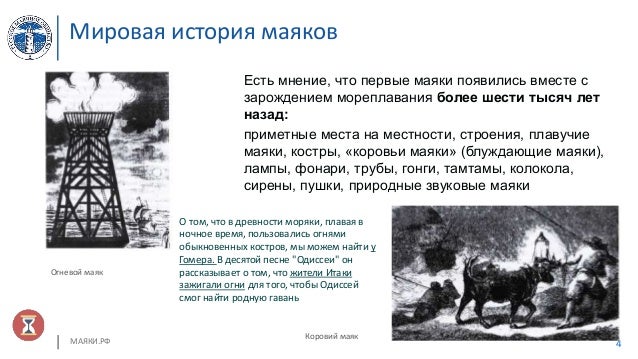
- 4. LIGHTHOUSES.RF 4 World history of lighthouses There is an opinion that the first lighthouses appeared along with the birth of navigation more than six thousand years ago: noticeable places in the area, buildings, floating lighthouses, bonfires, “cow beacons” (wandering beacons), lamps, lanterns, trumpets, gongs, tom-toms, bells, sirens, cannons, natural sound beacons Cow lighthouse Fire beacon We can find in Homer that in ancient times sailors, sailing at night, used the lights of ordinary bonfires. In the tenth song of the Odyssey, he talks about how the inhabitants of Ithaca lit fires so that Odysseus could find his native harbor
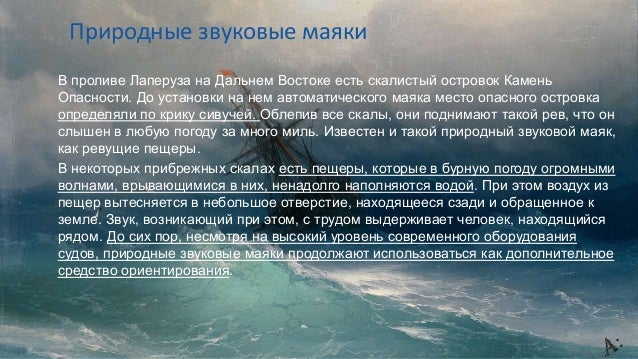
- 5. MAYAKI.RF 5 Natural sound beacons In the La Perouse Strait in the Far East there is a rocky island called Stone of Danger. Before installing an automatic beacon on it, the location of a dangerous island was determined by the cry of sea lions. Having stuck to all the rocks, they raise such a roar that it can be heard for many miles in any weather. Such a natural sound beacon as roaring caves is also known. In some coastal cliffs there are caves that, in stormy weather, are filled with water for a short time with huge waves breaking into them. In this case, the air from the caves is forced into a small hole located at the back and facing the ground. The sound that arises in this case can hardly be tolerated by the person nearby. Until now, despite the high level of modern equipment on ships, natural sound beacons continue to be used as an additional means of orientation.
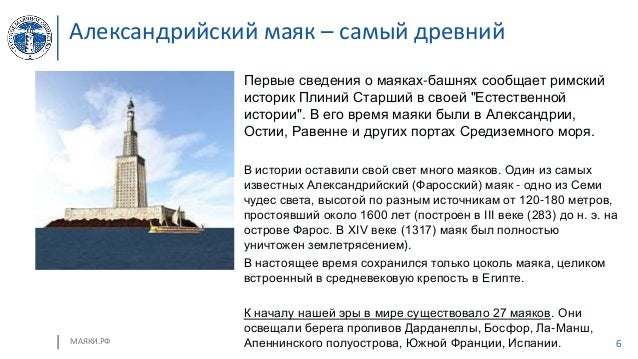
- 6. LIGHTHOUSES.RF 6 The Alexandria Lighthouse is the oldest. The first information about lighthouse towers is reported by the Roman historian Pliny the Elder in his “Natural History”. In his time, there were lighthouses in Alexandria, Ostia, Ravenna and other ports of the Mediterranean Sea. Many beacons have left their light in history. One of the most famous Alexandria (Pharos) lighthouse is one of the Seven Wonders of the World, with a height of 120-180 meters according to various sources, which stood for about 1600 years (built in the 3rd century (283) BC on the island of Pharos. In the 14th century (1317) the lighthouse was completely destroyed by an earthquake). Currently, only the base of the lighthouse has been preserved, completely built into a medieval fortress in Egypt. By the beginning of our era, there were 27 lighthouses in the world. They illuminated the shores of the Dardanelles, Bosphorus, English Channel, Apennine Peninsula, Southern France, and Spain.
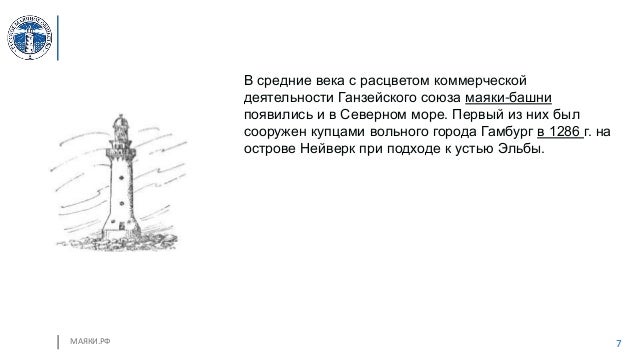
- 7. LIGHTHOUSES.RF 7 In the Middle Ages, with the flourishing of the commercial activities of the Hanseatic League, lighthouse towers appeared in the North Sea. The first of them was built by merchants of the free city of Hamburg in 1286 on the island of Neuwerk at the approach to the mouth of the Elbe.
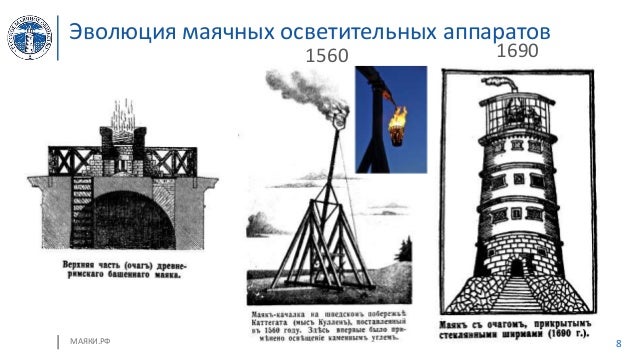
- 8. MAYAKI.RF 8 Evolution of lighthouse lighting devices 16901560
- 9. MAYAKI.RF 9 Evolution of lighthouse lighting devices 1791 (1765)1759
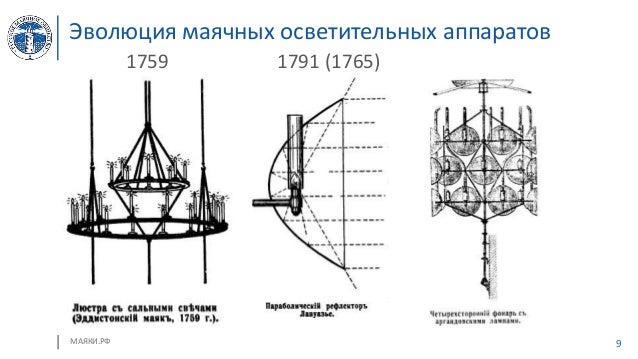
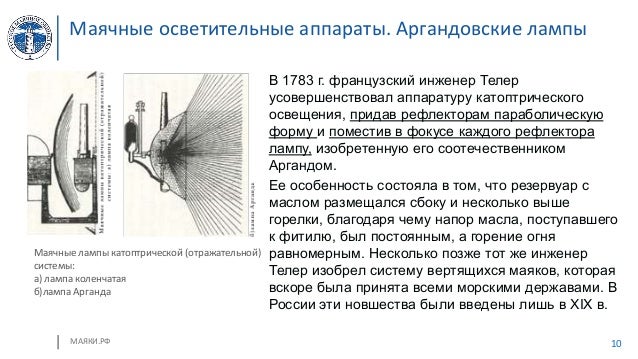
- 10. MAYAKI.RF 10 Lighthouse lighting devices. Argand lamps In 1783, the French engineer Theler improved the equipment for catoptric lighting, giving the reflectors a parabolic shape and placing a lamp invented by his compatriot Argand at the focus of each reflector. Its peculiarity was that the oil reservoir was located on the side and slightly above the burner, due to which the pressure of the oil flowing to the wick was constant and the combustion of the fire was uniform. Somewhat later, the same engineer Teler invented a system of revolving lighthouses, which was soon adopted by all maritime powers. In Russia, these innovations were introduced only in the 19th century. Lighthouse lamps of the catoptric (reflective) system: a) cranked lamp b) Argand lamp
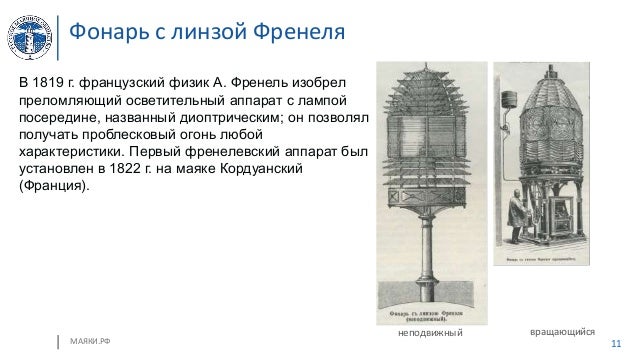
- 11. MAYAKI.RF 11 Lantern with a Fresnel lens stationary rotating In 1819, the French physicist A. Fresnel invented a refractive a lighting apparatus with a lamp in the middle, called dioptric; it made it possible to obtain a flashing light of any characteristic. The first Fresnel apparatus was installed in 1822 at the Corduan lighthouse (France).
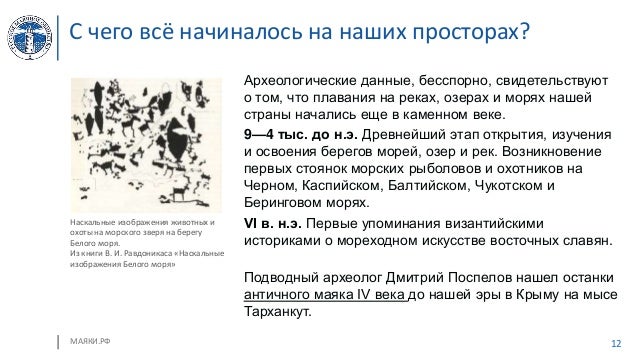
- 12. MAYAKI.RF 12 How did it all begin in our open spaces? Archaeological data undoubtedly indicate that navigation on the rivers, lakes and seas of our country began in the Stone Age. 9-4 thousand BC The oldest stage of discovery, study and development of the shores of seas, lakes and rivers. The emergence of the first stops of sea fishermen and hunters in the Black, Caspian, Baltic, Chukchi and Bering seas. VI century AD The first mentions by Byzantine historians of the seafaring art of the Eastern Slavs. Underwater archaeologist Dmitry Pospelov found the remains of an ancient lighthouse of the 4th century BC in Crimea at Cape Tarkhankut. Rock paintings of animals and hunting sea animals on the shores of the White Sea. From the book by V. I. Ravdonikas “Rock Carvings of the White Sea”
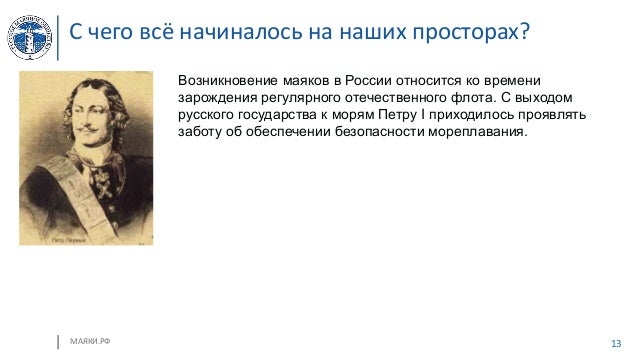
- 13. MAYAKI.RF 13 The emergence of lighthouses in Russia dates back to the birth of the regular domestic fleet. With the access of the Russian state to the seas, Peter I had to take care of ensuring the safety of navigation. How did it all begin in our open spaces?
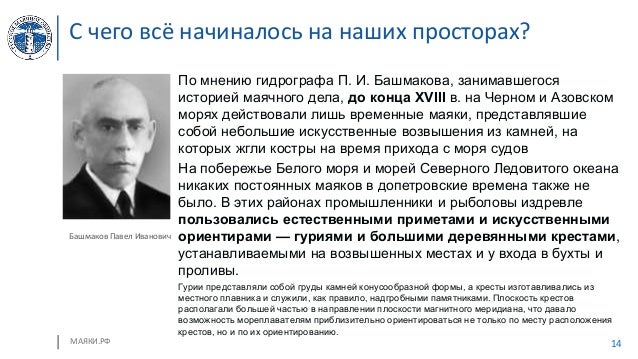
- 14. MAYAKI.RF 14 How did it all begin in our open spaces? According to hydrographer P.I. Bashmakov, who studied the history of lighthouses, until the end of the 18th century. On the Black and Azov Seas, only temporary lighthouses operated, which were small artificial elevations made of stones, on which fires were burned for the time of ships arriving from the sea. On the coast of the White Sea and the seas of the Arctic Ocean, there were also no permanent lighthouses in pre-Petrine times. In these areas, industrialists and fishermen have since ancient times used natural signs and artificial landmarks - houris and large wooden crosses installed on elevated places and at the entrance to bays and straits. Gurias were piles of cone-shaped stones, and crosses were made from local driftwood and served, as a rule, as gravestones. The plane of the crosses was located mostly in the direction of the plane of the magnetic meridian, which made it possible for navigators to roughly navigate not only by the location of the crosses, but also by their orientation. Bashmakov Pavel Ivanovich
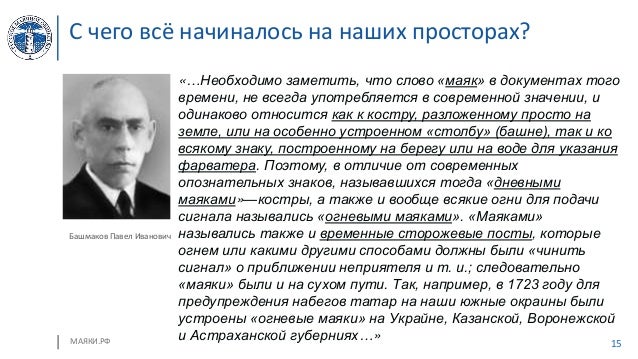
- 15. MAYAKI.RF 15 How did it all begin in our open spaces? “...It should be noted that the word “lighthouse” in documents of that time is not always used in its modern meaning, and refers equally to a fire laid simply on the ground, or on a specially constructed “pillar” (tower), and to any sign built on the shore or on the water to indicate the fairway. Therefore, in contrast to modern identification signs, which were then called “daylight beacons,” bonfires, as well as all kinds of lights in general for giving a signal, were called “fire beacons.” “Beacons” were also called temporary guard posts, which by fire or some other means were supposed to “repair a signal” about the approach of the enemy, etc.; therefore, there were “lighthouses” on the dry route. So, for example, in 1723, to prevent Tatar raids on our southern outskirts, “fire beacons” were set up in Ukraine, Kazan, Voronezh and Astrakhan provinces...” Pavel Ivanovich Bashmakov
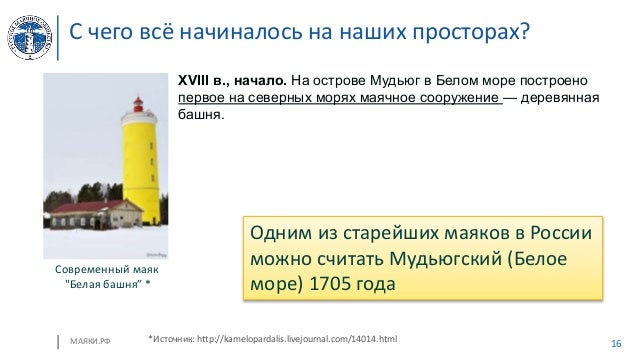
- 16. MAYAKI.RF 16 How did it all begin in our open spaces? XVIII century, beginning. On the island of Mudyug in the White Sea, the first lighthouse structure in the northern seas was built - a wooden tower. Source: http://kamelopardalis.livejournal.com/14014.html Modern lighthouse "White Tower" One of the oldest lighthouses in Russia can be considered Mudyugsky (White Sea) built in 1705
- 17. MAYAKI.RF 17 How did it all begin in our open spaces? 1700. On the Russian seas, specially made poles and “pilot barrels” began to be installed for the first time to fencing fairways. The original type of poles were poles with flags, then flags were replaced by wickerwork made of twigs.
- 18. MAYAKI.RF 18 How did it all begin in our open spaces? Simultaneously with the river navigation equipment, the construction of navigation signs began on the shores of the Azov Sea. In 1702, the first two lighthouses were built at the mouth of the Don River “to signal the passage of ships,” illuminated by firewood. Their structure was apparently very primitive, since already in 1704 they collapsed “from spring water.” The restoration of these lighthouses began in the same year, but no information about their further fate has been preserved.
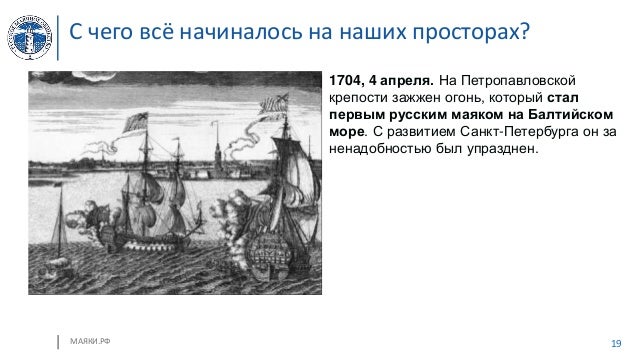
- 19. MAYAKI.RF 19 How did it all begin in our open spaces? 1704, April 4. A fire was lit at the Peter and Paul Fortress, which became the first Russian lighthouse on the Baltic Sea. With the development of St. Petersburg, it was abolished as unnecessary.
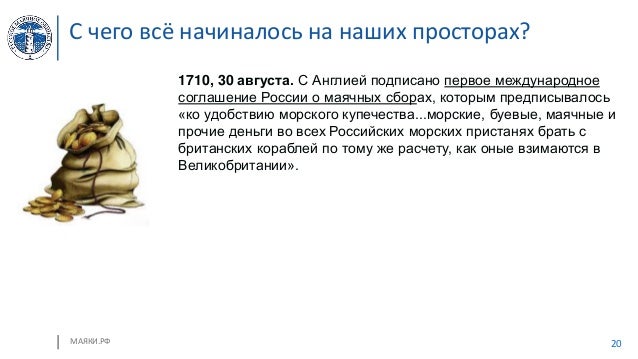
- 20. MAYAKI.RF 20 How did it all begin in our open spaces? 1710, August 30. Russia signed the first international agreement on lighthouse dues with England, which prescribed “for the convenience of maritime merchants...sea, buoy, lighthouse and other money in all Russian sea piers to be taken from British ships according to the same calculation as they are collected in Great Britain.”
- 21. MAYAKI.RF 21 The oldest lighthouse organizations In 2014, Trinity House (full name Corporation of Trinity House of Deptford Strond) celebrated its 500th anniversary. Trinity House has operated on a charitable basis since it was established by Henry VIII's royal charter on 20 May 1514. Around £4 million a year is donated to charity across its charities, which include training, the welfare of retired seafarers and the teaching of educational programs that develop maritime safety skills. The corporation's mission is to provide navigational aids for the safe passage of a huge variety of vessels through some of the world's busiest shipping lanes. To accomplish this task, an impressive array of over 600 navigation aids will be deployed, ranging from lighthouses to satellite navigation services. Organization website: http://www.trinityhouse.co.uk/
- 22. MAYAKI.RF 22 Hydrographic Service of Russia The official date of creation of the lighthouse service of Russia is considered to be June 8 (May 27), 1807, when the Emperor Alexander I approved the “Regulations on the maintenance of lighthouses and the staff of the lighthouse team.” The Regulations provided for the introduction of oil lighting and uniform staffing at all lighthouses (one keeper and five to eight maritime department servants at each lighthouse), and the position of director of the Baltic lighthouses was introduced. All issues of lighthouse construction in Russia, and then in the USSR, were dealt with by the Hydrographic Service of the Navy, formed in 1827. In 2017 it will be 190 years old.
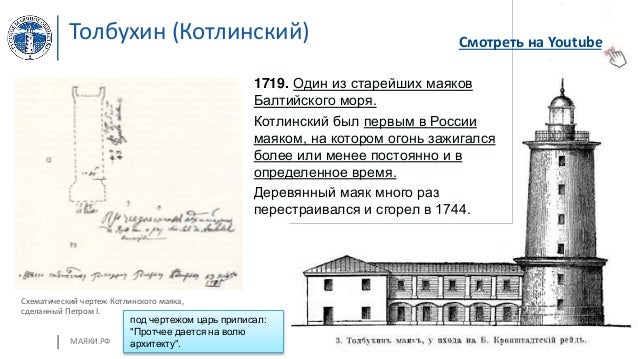
- 23. LIGHTHOUSES.RF 23 Tolbukhin (Kotlinsky) Schematic drawing of the Kotlin lighthouse, made by Peter I. 1719. One of the oldest lighthouses Baltic Sea. Kotlinsky was the first lighthouse in Russia in which the fire was lit more or less constantly and at a certain time. The wooden lighthouse was rebuilt many times and burned down in 1744. Watch on Youtube under the drawing, the king wrote: “The rest is left to the will of the architect.”
- 24. LIGHTHOUSES.RF 24 By the end of the reign of Peter I, several lighthouses - stone and wooden - were already operating on the Baltic Sea. Most of them were lit with wood, some with coal. Firewood was usually collected by peasants from nearby villages for 30 kopecks. per fathom, and a lot of them were required. For example, at the Dagerort lighthouse about 900 fathoms of wood were burned annually, and at the Gotland lighthouse - 250 fathoms of firewood and up to 1,500 pounds of “overseas” (Dutch) coal. After the death of Peter the Great on January 28 (February 8), 1725, much less attention was paid to maritime activities and, accordingly, to the lighthouse business.
- 25. LIGHTHOUSES.RF 25 Around 1730. Beginning of systematic work on the navigation fencing of the Baltic Sea, including maintenance of coastal lighthouses. For this purpose, two or three galliot pilots were appointed annually for the navigation period. 1737. From this year, navigators began to be appointed to the positions of lighthouse keepers, who were obliged to keep special logs, noting in them passing ships, weather and other information related to navigation safety. 1738. The first mention of a lighthouse on the Kamchatka Peninsula (a wooden frame with a flagpole on the roof). Each time when leaving for the lighthouse, those observing the lighting were given instructions, which always invariably ended with the instruction “to have diligent supervision, with great caution, so that [the lighthouses] are always maintained properly” and “the fire is burning great and high.”
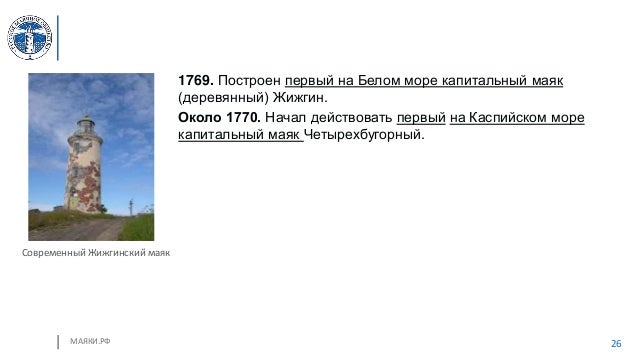
- 26. LIGHTHOUSES.RF 26 1769. The first permanent lighthouse (wooden) on the White Sea, Zhizhgin, was built. Around 1770. The first capital lighthouse on the Caspian Sea, Chetyrehbugorny, began to operate. Modern Zhizhginsky lighthouse
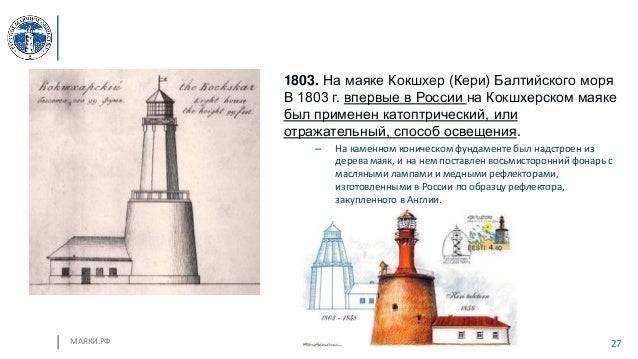
- 27. LIGHTHOUSES.RF 27 1803. At the Kokshkher (Keri) lighthouse of the Baltic Sea In 1803, for the first time in Russia on The catoptric, or reflective, method of lighting was used in the Kokshkher lighthouse. – A lighthouse was built on a stone conical foundation made of wood, and an eight-sided lantern with oil lamps and copper reflectors, made in Russia based on the model of a reflector purchased in England, was placed on it.
- 28. MAYAKI.RF 28 1807. All lighthouses of the Baltic Sea, with the exception of two Domesnes, were transferred from private management to the subordination of the maritime department. The right to build and maintain lighthouses at that time belonged not only to the government, but also to private individuals, so owners of coastal estates often built lighthouses for their needs and operated them partly on their own, partly by renting them out. Lighthouse fires, no different from the fires lit by the local population, often led to shipwrecks. However, the greatest inconvenience was associated with the fact that private owners were allowed to maintain lighthouse lights at their own expense. These owners, taking advantage of the ancient ruling of Coastal Law, which allowed them to take part of the value of a broken ship and its cargo, often deliberately extinguished the lighthouse fire or lit it in another place, contributing to shipwrecks. 1807, May 27. A new Regulation on lighthouses was approved, providing, in particular, for the introduction of oil lighting instead of coal and wood lighting and new states. The same provision established the position of director of Balt
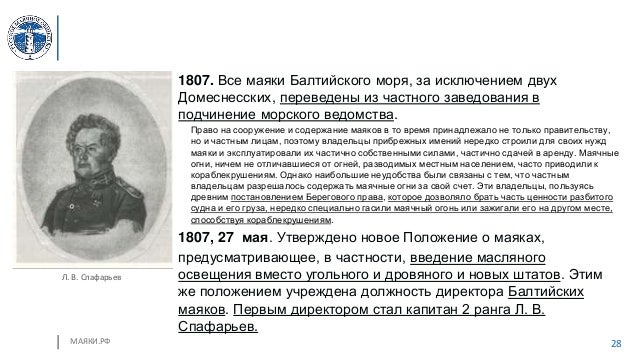
Iysky lighthouses. The first director was captain 2nd rank L.V. Spafariev. L. V. Spafarev
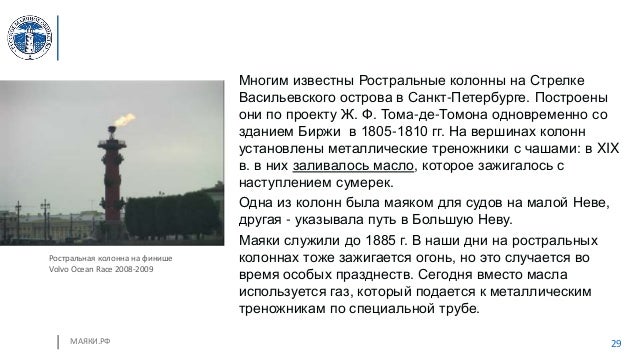
- 29. MAYAKI.RF 29 Many people know the Rostral columns on the Spit of Vasilyevsky Island in St. Petersburg. They were built according to the design of J. F. Thomas de Thomon simultaneously with the building of the Exchange in 1805-1810. At the tops of the columns there are metal tripods with bowls: in the 19th century. oil was poured into them, which was lit at dusk. One of the columns was a lighthouse for ships on the Malaya Neva, the other pointed the way to the Bolshaya Neva. The lighthouses served until 1885. Nowadays, fires are also lit on the rostral columns, but this only happens during special celebrations. Today, instead of oil, gas is used, which is supplied to metal tripods through a special pipe. Rostral column at the finish line of the Volvo Ocean Race 2008-2009
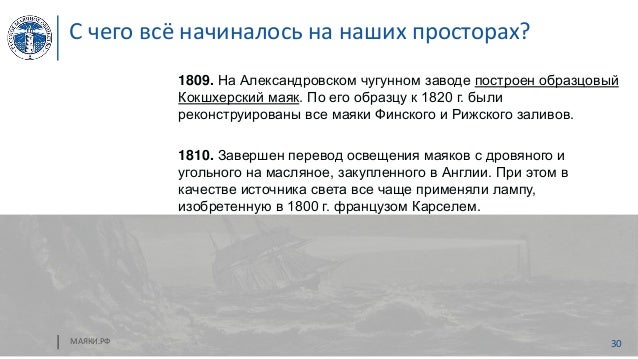
- 30. MAYAKI.RF 30 How did it all begin in our open spaces? 1809. The exemplary Kokshkhery lighthouse was built at the Aleksandrovsky cast iron plant. By 1820, all the lighthouses of the Gulf of Finland and Riga were reconstructed according to its model. 1810. The conversion of lighthouse lighting from wood and coal to oil, purchased in England, was completed. At the same time, a lamp, invented in 1800 by the Frenchman Carcel, was increasingly used as a light source.
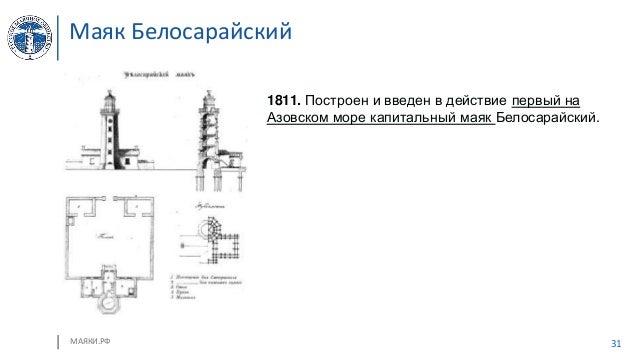
- 31. LIGHTHOUSES.RF 31 Belosaraysky Lighthouse 1811. The first capital Belosaraysky lighthouse on the Sea of Azov was built and put into operation.
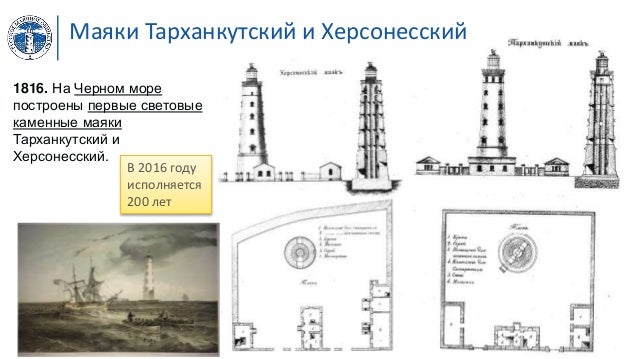
- 32. MAYAKI.RF 32 Lighthouses Tarkhankutsky and Chersonesos 1816. The first illuminated stone lighthouses were built on the Black Sea Tarkhankutsky and Chersonesos. 2016 marks 200 years
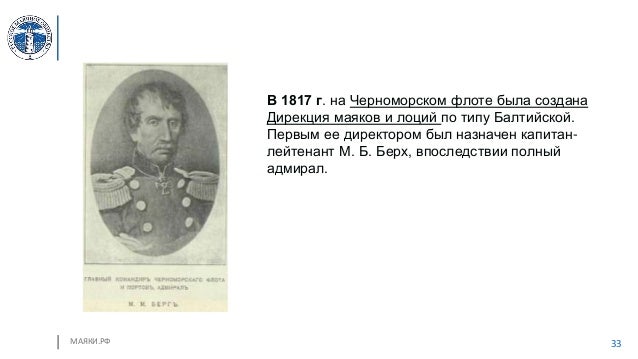
- 33. LIGHTHOUSES.RF 33 In 1817, the Directorate of lighthouses and sailing directions, similar to the Baltic one, was created in the Black Sea Fleet. Lieutenant-Commander M.B. Berkh, later a full admiral, was appointed its first director.
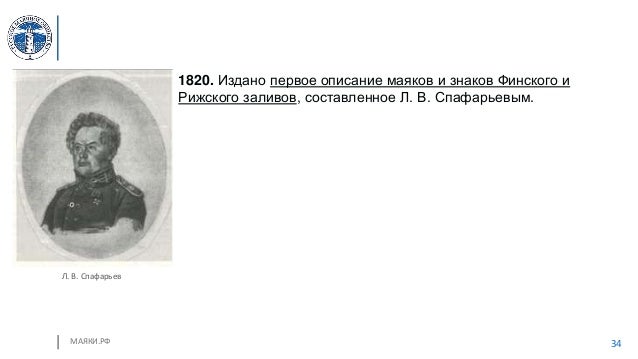
- 34. LIGHTHOUSES.RF 34 1820. The first description of lighthouses and signs of the Gulf of Finland and Riga, compiled by L.V. Spafariev, was published. L. V. Spafarev
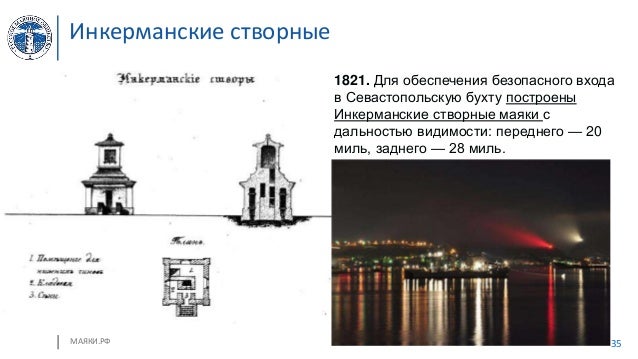
- 35. MAYAKI.RF 35 Inkerman folding lighthouses 1821. To ensure a safe entrance to Sevastopol Bay, Inkerman folding lighthouses were built with visibility range: front - 20 miles, rear - 28 miles.
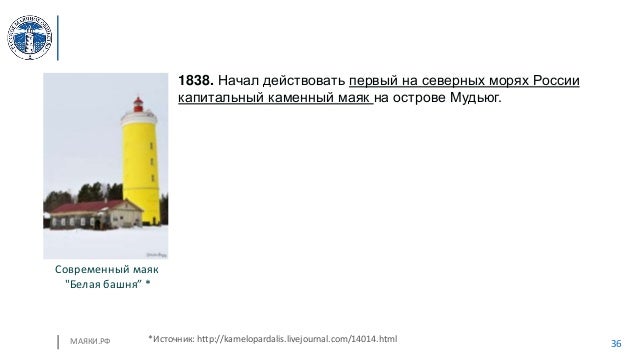
- 36. LIGHTHOUSES.RF 36 1838. The first permanent stone lighthouse in the northern seas of Russia began operating on Mudyug Island. Source: http://kamelopardalis.livejournal.com/14014.html Modern lighthouse "White Tower"
- 37. MAYAKI.RF 37 1840—1850. The first special hydrographic vessels on the Black Sea were built in Nikolaev, which were called pilot vessels, pilot boats, or simply pilot vessels. They were mainly used for servicing lighthouses, installing floating fencing, but sometimes also for taking soundings. If in the Baltic Sea there were no special problems with lighthouse construction - the difficulties were the same as in any European state, then in the seas of the North and Far East Russian hydrographers had to solve the most difficult problems.
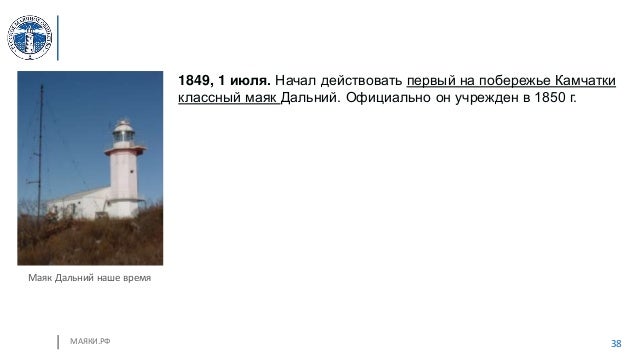
- 38. MAYAKI.RF 38 1849, July 1. The first cool lighthouse on the Kamchatka coast, Dalny, began operating. It was officially established in 1850. Dalniy Lighthouse in our time
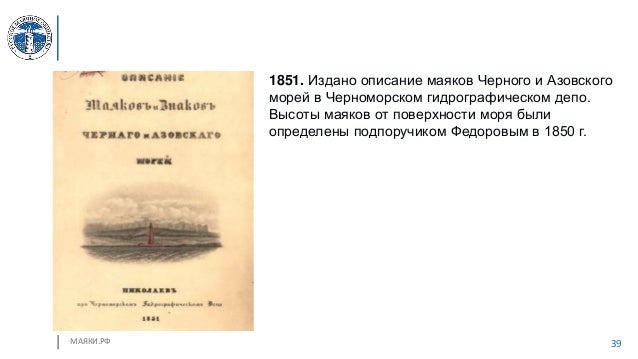
- 39. MAYAKI.RF 39 1851. A description of the lighthouses of the Black and Azov Seas in the Black Sea Hydrographic Depot was published. The heights of lighthouses from the sea surface were determined by Second Lieutenant Fedorov in 1850.
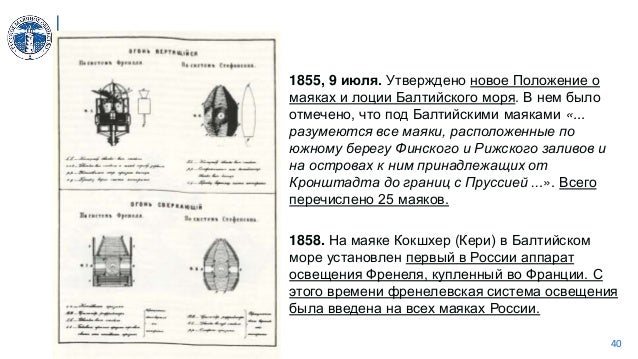
- 40. MAYAKI.RF 40 1855, July 9. A new Regulation on lighthouses and sailing directions of the Baltic Sea has been approved. It noted that the Baltic lighthouses “... mean all the lighthouses located along the southern coast of the Gulf of Finland and Riga and on the islands belonging to them from Kronstadt to the borders with Prussia...”. A total of 25 lighthouses are listed. 1858. At the Kokshkher (Keri) lighthouse in the Baltic Sea, the first Fresnel lighting apparatus in Russia, purchased in France, was installed. Since that time, the Fresnel lighting system has been introduced at all lighthouses in Russia.
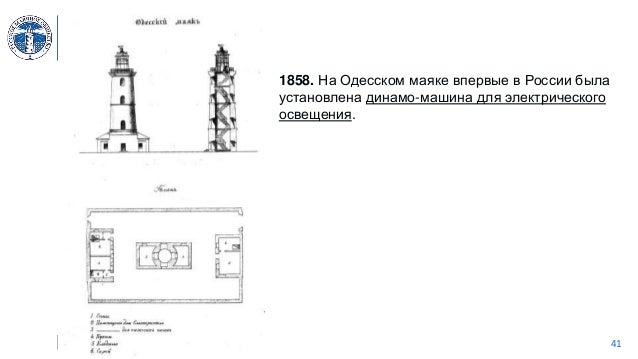
- 41. MAYAKI.RF 41 1858. For the first time in Russia, a dynamo for electric lighting was installed at the Odessa lighthouse.
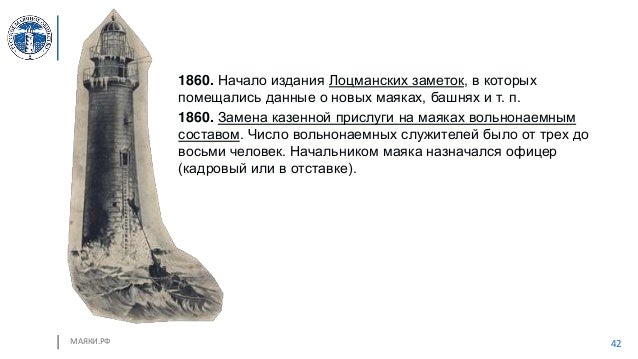
- 42. MAYAKI.RF 42 1860. Beginning of publication of Pilot’s Notes, which contained information about new lighthouses, towers, etc. 1860. Replacement of government servants at lighthouses with civilian personnel. The number of civilian servants ranged from three to eight people. An officer (career or retired) was appointed as the head of the lighthouse.
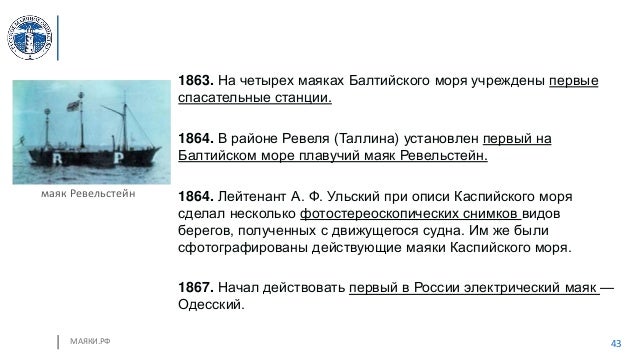
- 43. MAYAKI.RF 43 1863. The first rescue stations were established at four lighthouses of the Baltic Sea. 1864. The first lightship on the Baltic Sea, Revelstein, was installed in the area of Revel (Tallinn). 1864. Lieutenant A.F. Ulsky, while inventorying the Caspian Sea, took several photostereoscopic photographs of coastal views obtained from a moving ship. He also photographed the operating lighthouses of the Caspian Sea. 1867. The first electric lighthouse in Russia, Odessa, began operating. Revelstein lighthouse
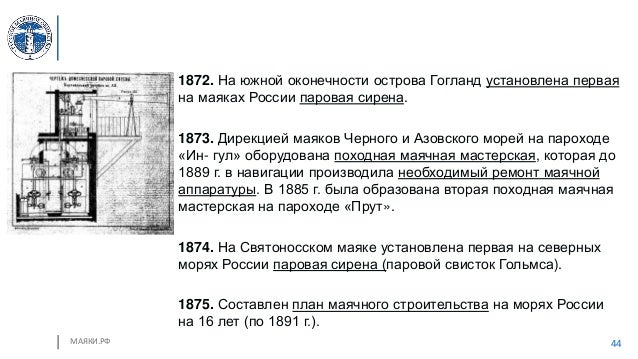
- 44. MAYAKI.RF 44 1872. The first steam siren in Russian lighthouses was installed on the southern tip of Gogland Island. 1873. The Directorate of Lighthouses of the Black and Azov Seas equipped a traveling lighthouse workshop on the steamship “Ingul”, which until 1889 carried out the necessary repairs of lighthouse equipment during navigation. In 1885, the second camp lighthouse workshop was formed on the steamship “Prut”. 1874. The first steam siren (Holmes steam whistle) in the northern seas of Russia was installed at the Svyatonossky lighthouse. 1875. A plan for lighthouse construction on the Russian seas was drawn up for 16 years (until 1891).
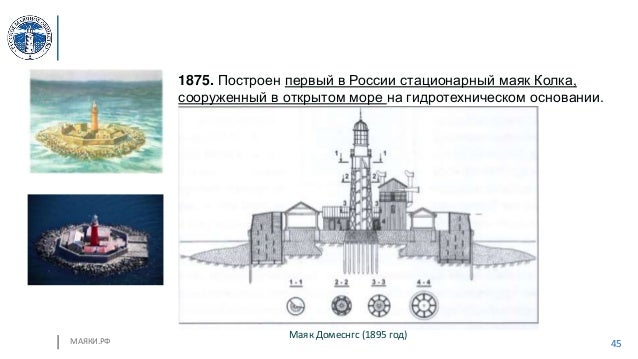
- 45. MAYAKI.RF 45 1875. The first stationary Kolka lighthouse in Russia was built, built in the open sea on a hydraulic foundation. Lighthouse Domesngs (1895)
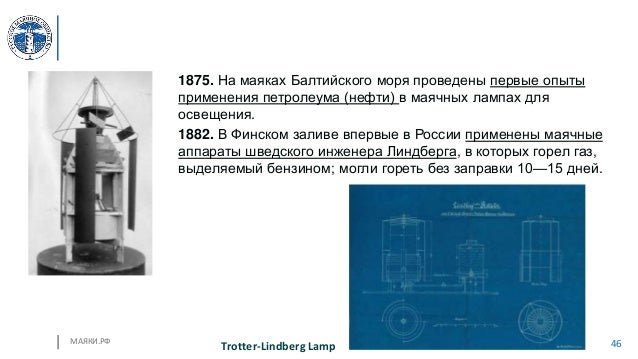
- 46. MAYAKI.RF 46 1875. The first experiments in the use of petroleum (oil) in lighthouse lamps for lighting. 1882. In the Gulf of Finland, for the first time in Russia, lighthouse apparatuses of the Swedish engineer Lindbergh were used, in which gas emitted by gasoline burned; could burn without refueling for 10-15 days. Trotter-Lindberg Lamp
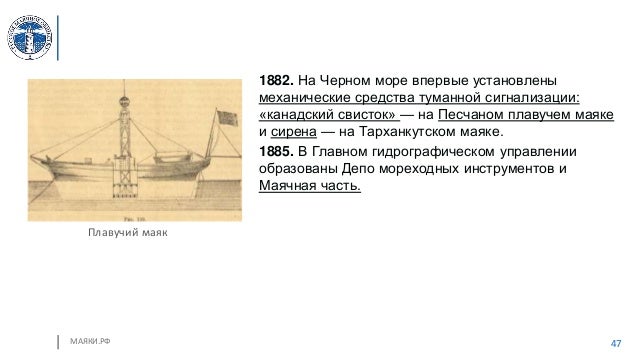
- 47. MAYAKI.RF 47 1882. Mechanical fog alarms were installed for the first time on the Black Sea: “Canadian whistle” - on the Sandy floating lighthouse and siren - at the Tarkhankut lighthouse. 1885. The Depot of Nautical Instruments and the Lighthouse Unit were established in the Main Hydrographic Directorate. floating lighthouse
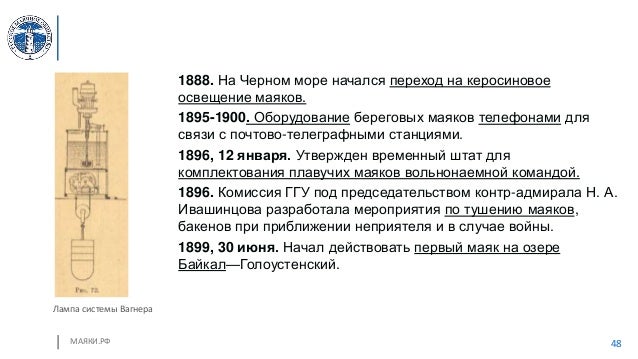
- 48. MAYAKI.RF 48 1888. The transition to kerosene lighting for lighthouses began on the Black Sea. 1895-1900. Equipping coastal lighthouses with telephones for communication with postal and telegraph stations. 1896, January 12. A temporary staff has been approved for manning lightships with a civilian crew. 1896. The GGU commission, chaired by Rear Admiral N.A. Ivashintsov, developed measures to extinguish beacons and buoys when the enemy approaches and in the event of war. 1899, June 30. The first lighthouse on Lake Baikal-Goloustensky began to operate. Wagner lamp
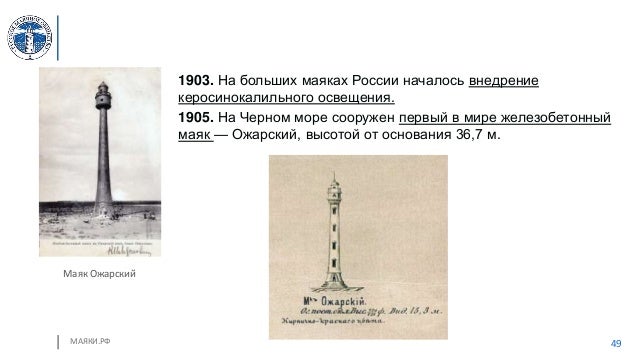
- 49. MAYAKI.RF 49 1903. The introduction of kerosene-heated lighting began at large lighthouses in Russia. 1905. The world's first reinforced concrete lighthouse was built on the Black Sea - Ozharsky, 36.7 m high from the base. Ozharsky Lighthouse
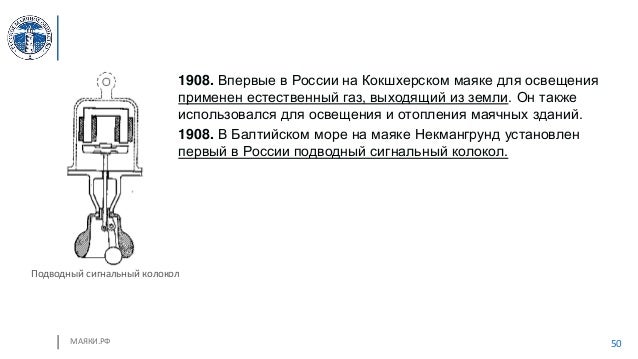
- 50. MAYAKI.RF 50 1908. For the first time in Russia, natural gas coming out of the ground was used for lighting at the Kokshkher lighthouse. It was also used for lighting and heating lighthouse buildings. 1908. The first underwater signal bell in Russia was installed in the Baltic Sea at the Nekmangrund lighthouse. Underwater signal bell
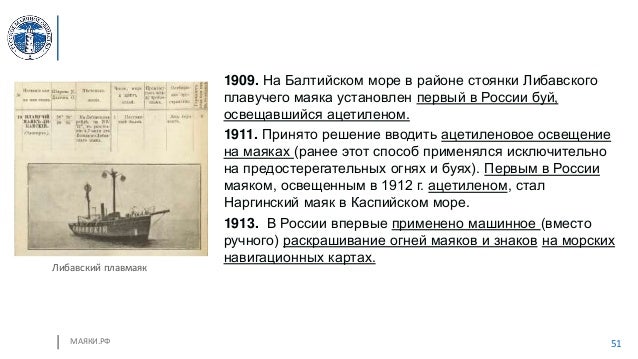
- 51. LIGHTHOUSES.RF 51 1909. In the Baltic Sea, in the area of the Libavsky floating lighthouse, the first lighted buoy in Russia was installed acetylene. 1911. A decision was made to introduce acetylene lighting in lighthouses (previously this method was used exclusively on warning lights and buoys). The first lighthouse in Russia illuminated with acetylene in 1912 was the Narginsky lighthouse in the Caspian Sea. 1913. In Russia, machine (instead of manual) coloring of lighthouse lights and signs on sea navigation charts was used for the first time. Libavsky lighthouse
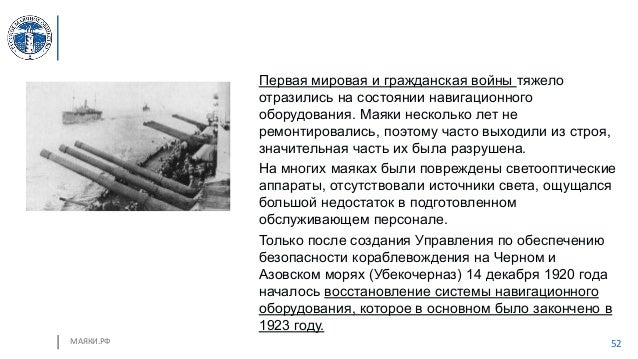
- 52. MAYAKI.RF 52 The First World War and the Civil War had a serious impact on the state of navigation equipment. The lighthouses were not repaired for several years, so they often failed, and a significant part of them were destroyed. At many lighthouses, light-optical devices were damaged, there were no light sources, and there was a great shortage of trained maintenance personnel. Only after the creation of the Office for Ensuring the Safety of Navigation in the Black and Azov Seas (Ubekochernaz) on December 14, 1920, the restoration of the navigation equipment system began, which was basically completed in 1923.
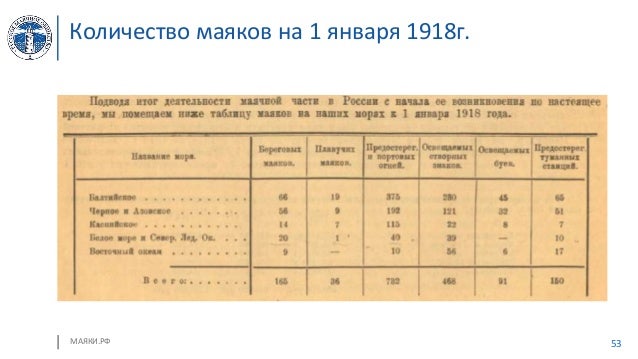
- 53. MAYAKI.RF 53 Number of lighthouses as of January 1, 1918.
- 54. MAYAKI.RF 54 1918. At the Petrograd Polytechnic Institute under the guidance of Professor Valerian Ivanovich Bazhenov (1889 – 1938) the first domestic directional radio beacon was created. 1924. The import of acetylene lighthouse equipment from abroad was resumed. 1930-1932. The conversion of class beacons from kerosene-wick to kerosene-heat lighting has been completed. 1932. The Hydrographic Administration began the planned development of sea navigation equipment. Before 1941, the following were built: 30 light beacons, 45 radio beacons, 30 sirens, 31 nautophones, 845 luminous signs. 1932-1934. The first domestic standard RMS circular radio beacons were created in the workshops of the Hydrographic Directorate.
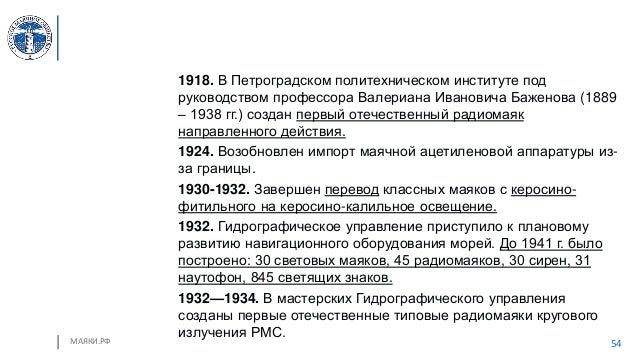
- 55. MAYAKI.RF 55 Radio beacons
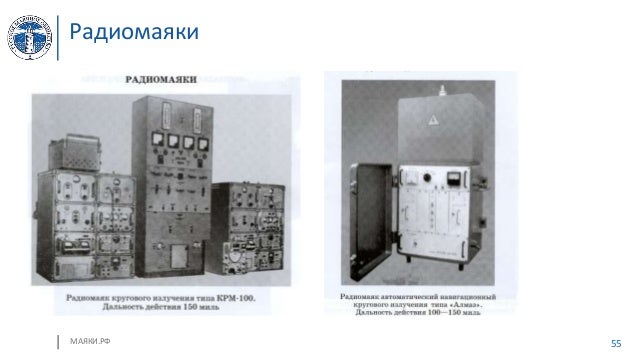
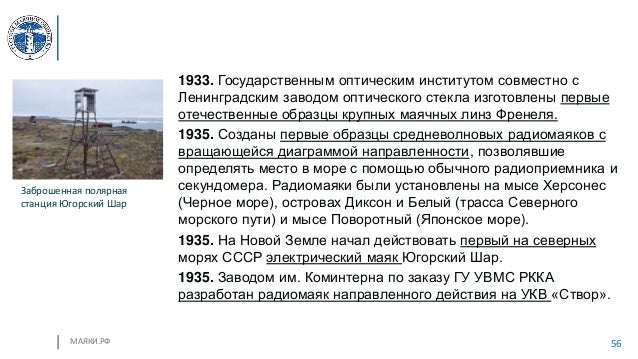
- 56. MAYAKI.RF 56 1933. The State Optical Institute together with the Leningrad Optical Glass Plant produced the first domestic samples of large lighthouse lenses Fresnel. 1935. The first samples of medium-wave radio beacons with a rotating radiation pattern were created, which made it possible to determine a place at sea using a conventional radio receiver and a stopwatch. Radio beacons were installed on Cape Khersones (Black Sea), Dikson and Bely Islands (Northern Sea Route) and Cape Povorotny (Sea of Japan). 1935. On Novaya Zemlya, the first electric lighthouse in the northern seas of the USSR, Yugorsky Shar, began operating. 1935. Plant named after. By order of the Comintern, a directional radio beacon for the VHF “Stor” was developed by order of the Main Directorate of the Military Military Migration Service of the Red Army. Abandoned polar station Yugorsky Shar
- 57. MAYAKI.RF 57
- 58. MAYAKI.RF 58 1938. In the Hydrographic Department, under the leadership of A.F. Smirnovsky, a stationary directional radio beacon “Safar” was created. 1940. The Triton-P radio beacon with an underwater acoustic emitter was put into service. 1941. A radio beacon with airborne and underwater acoustic emitters was put into service.

- 59. MAYAKI.RF

- 60. MAYAKI.RF 60 Lighthouse development was interrupted by the beginning of the Second World War. The personnel of the Hydrographic Service took an active part in navigation and hydrographic support. In particular, the Hydrographic Service of the Baltic Fleet ensured the operation of ice roads connecting Kronstadt with Bolshaya and Malaya Izhora, Lisiy Nos, Gorskaya; the ice road from the Shepelevsky lighthouse to the islands of Seskar and Lavensaari, as well as the Ladoga ice road between the villages of Lavrovo - Kokorevo.
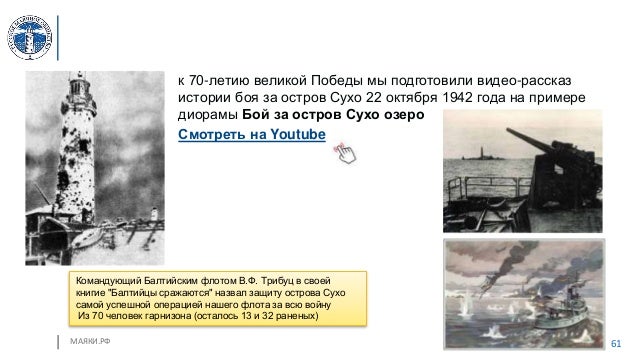
- 61. MAYAKI.RF 61 for the 70th anniversary of the Great Victory, we prepared a video story of the history of the battle for Suho Island on October 22, 1942 on example of a diorama Battle for the island of Dry Lake Watch on Youtube Commander of the Baltic Fleet V.F. Tributs in his book “The Baltic People Are Fighting” called the defense of Suho Island the most successful operation of our fleet during the entire war. Of the 70 garrison men (13 and 32 wounded remained)
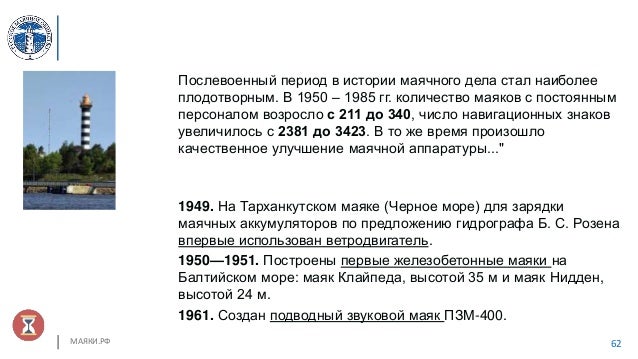
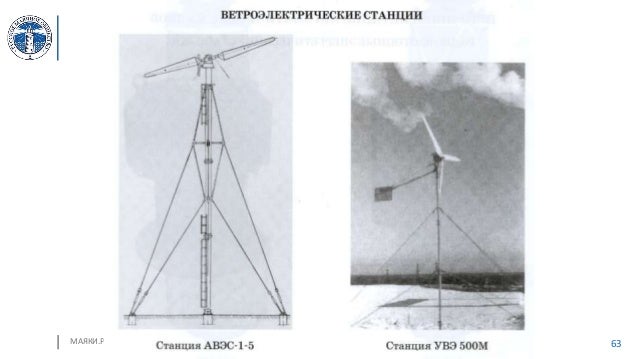
- 62. MAYAKI.RF 62 The post-war period in the history of lighthouse business became the most fruitful. In 1950 – 1985 the number of lighthouses with permanent staff increased from 211 to 340, the number of navigational signs increased from 2381 to 3423. At the same time, there was a qualitative improvement in lighthouse equipment..." 1949. At the Tarkhankut lighthouse (Black Sea), a wind engine was first used to charge lighthouse batteries at the suggestion of hydrographer B. S. Rosen. 1950-1951. The first ones were built reinforced concrete lighthouses on the Baltic Sea: Klaipeda lighthouse, 35 m high and Nidden lighthouse, 24 m high. 1961. The PZM-400 underwater sound beacon was created.
- 63. MAYAKI.RF 63
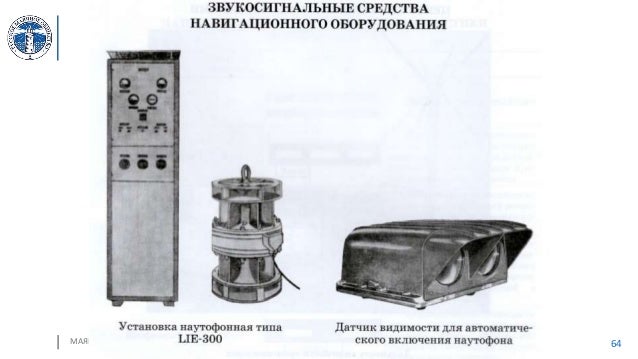
- 64. MAYAKI.RF 64
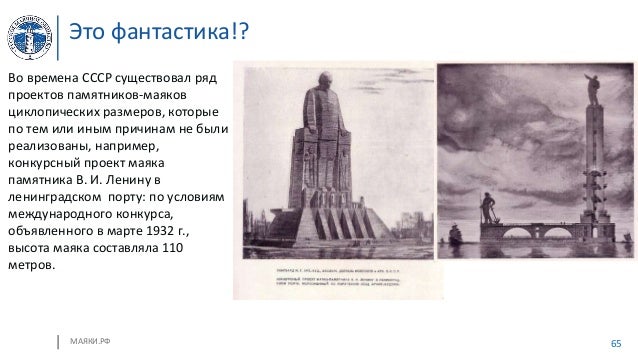
- 65. MAYAKI.RF 65 Is this fantastic!? During the Soviet era, there were a number of projects for lighthouse monuments of cyclopean proportions, which for one reason or another were not implemented, for example, a competition project for a lighthouse monument to V.I. Lenin in the Leningrad port: according to the terms of the international competition announced in March 1932, the height of the lighthouse was 110 meters.
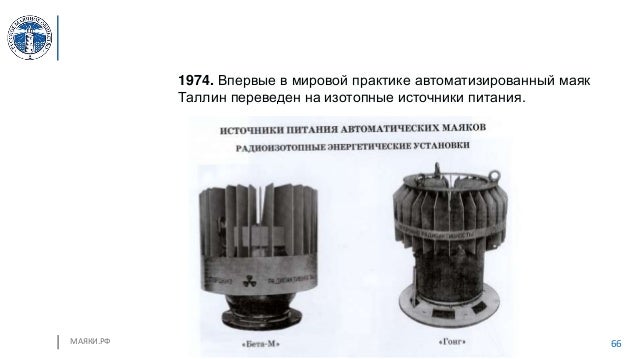
- 66. MAYAKI.RF 66 1974. For the first time in world practice, the automated Tallinn lighthouse was switched to isotope power sources.
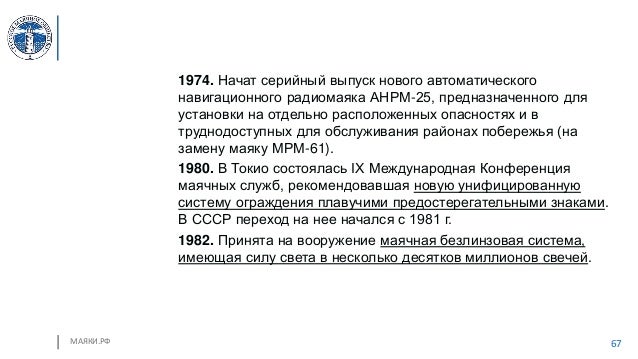
- 67. MAYAKI.RF 67 1974. The serial production of the new automatic navigation radio beacon ANRM-25, designed for installation on separately located dangers and in coastal areas difficult to access (to replace the MRM-61 lighthouse). 1980. The IX International Conference of Lighthouse Authorities was held in Tokyo, recommending a new unified system of fencing with floating warning signs. In the USSR, the transition to it began in 1981. 1982. A lensless lighthouse system with a luminous intensity of several tens of millions of candles was adopted.
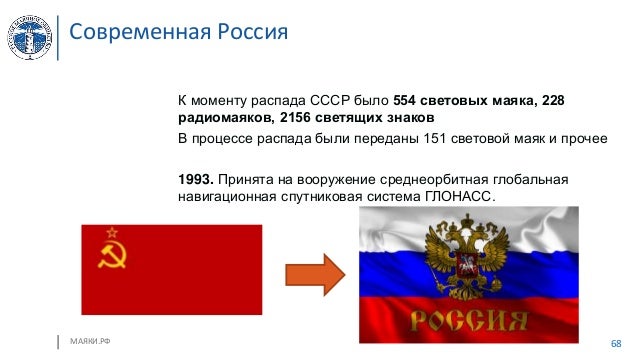
- 68. MAYAKI.RF 68 By the time of the collapse of the USSR there were 554 light beacons, 228 radio beacons, 2156 luminous signs In the process of collapse 151 light beacons were transferred, etc. 1993. The medium-orbit global navigation satellite system GLONASS was adopted. Modern Russia
- 69. MAYAKI.RF 69 In order to ensure the safety of navigation in Russian waters, a reliable system of navigation equipment was created. More than 4 thousand objects were deployed on the country’s coast, including 399 illuminated beacons, 2,538 illuminated and non-illuminated navigation signs, 148 radio beacons and radar transponders, 45 radio navigation system stations. More than 150 hydrographic and pilot vessels and specially built boats are used annually to maintain navigational facilities and monitor their operation. Hydrographic service of the Navy today
- 70. MAYAKI.RF 70 IN THE XXI century. The lighthouse service has introduced new technologies that increase the safety of navigation: • a network of control and correction stations of global navigation satellite systems “GLONASS/NAVSTAR” based on marine radio beacons is actively developing. The creation of such a network on the approaches to the main ports of Russia will significantly increase the accuracy of determining the location of ships (up to 5 meters) within a radius of 250 km from the station installation site; • low-power light-optical devices have been developed that significantly increase the reliability and range of luminous navigation signs and beacons; • the creation of a control system for navigational equipment based on the use of geoinformation technologies and modern means of communication is being completed. Hydrographic service of the Navy today
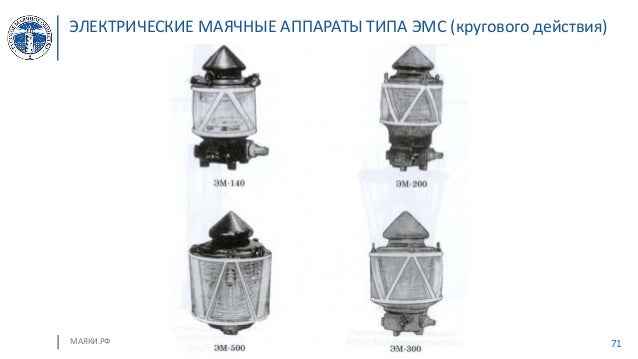
- 71. MAYAKI.RF 71 ELECTRIC BEACON DEVICES OF EMC TYPE (circular action)
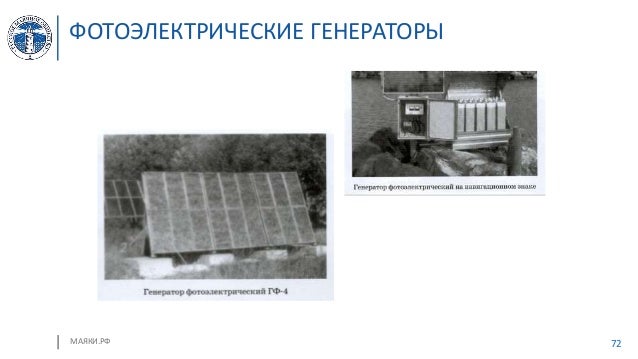
- 72. MAYAKI.RF 72 PHOTOVOLTAIC GENERATORS
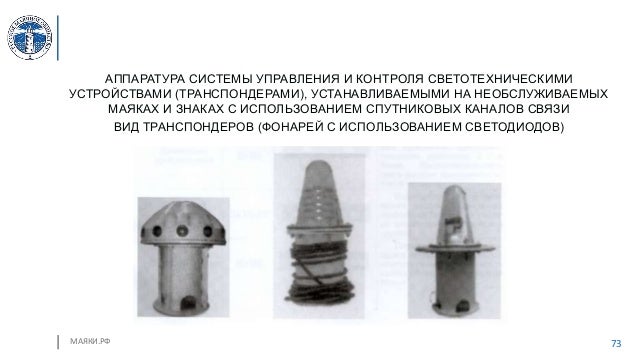
- 73. MAYAKI.RF 73 EQUIPMENT FOR CONTROL AND CONTROL SYSTEMS OF LIGHTING DEVICES (TRANSPONDERS) INSTALLED ON UNMAINTAINED BEACONS AND SIGNS USING SATELLITE COMMUNICATION CHANNELS TYPE OF TRANSPONDERS (LIGHTS USING LEDS)
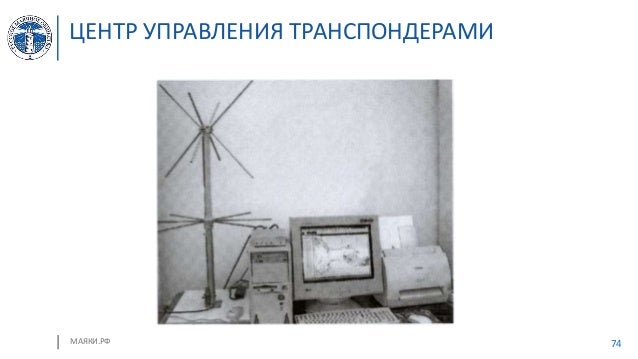
- 74. MAYAKI.RF 74 TRANSPONDER CONTROL CENTER
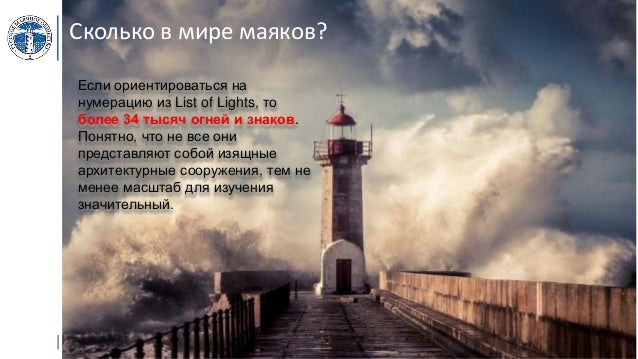
- 75. LIGHTHOUSES.RF 75 How many lighthouses are there in the world? If you go by the numbering from the List of Lights, then there are more than 34 thousand lights and signs. It is clear that not all of them are elegant architectural structures, however, the scale for study is significant.
- 76. MAYAKI.RF 76 In order to ensure the safety of navigation in Russian waters, a reliable system of navigation equipment was created. More than 4 thousand objects were deployed on the country’s coast, including 399 illuminated beacons, 2,538 illuminated and non-illuminated navigation signs, 148 radio beacons and radar transponders, 45 radio navigation system stations. More than 150 hydrographic and pilot vessels and specially built boats are used annually to maintain navigational facilities and monitor their operation. Hydrographic service of the Navy today
- 77. MAYAKI.RF 77 What is the role of lighthouses now? 1- Navigation Despite the rapid development and improvement of electronic and satellite navigation systems (GPS, GLONASS, etc.), which makes it possible to accurately determine location and other navigation parameters regardless of the weather, beacons continue to be an important means of fencing navigational hazards and determining location. There are several reasons: • Determining the location using beacons gives the navigator greater psychological confidence when observing the approach to the shore. • In remote, hard-to-reach regions not equipped with radio navigation aids, beacons are indispensable for fencing off dangers, because allow you to directly “see” the navigation situation, which gives additional confidence to mariners. • Not all ships and vessels are equipped with expensive radio navigation and satellite equipment. A huge number of small vessels use compasses and logs, the use of which requires periodic clarification of coordinates using visual observation.
- 78. MAYAKI.RF 78 What is the role of lighthouses now? 1- Navigation The lighthouses themselves are also being improved. More and more beacons operate in fully automatic modes and are complex complexes of light-optical, electronic, sound-signaling equipment and power supply systems. The light-optical system automatically turns on at dusk and turns off at dawn. Also, light sources that are out and under construction are automatically switched to backup ones. Automated monitoring and control systems allow you to remotely control the characteristics of automatic beacon lights from the dispatch console. Increasingly, halogen, laser and LED lamps are used as light sources.
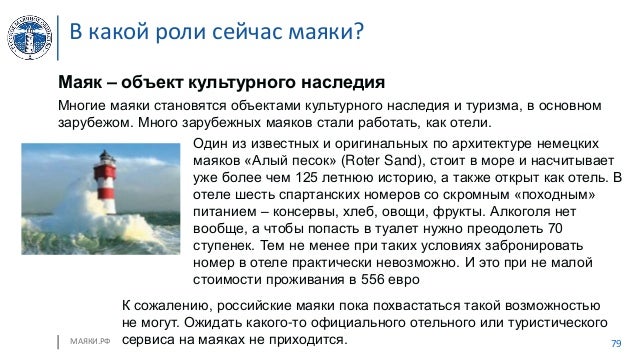
- 79. MAYAKI.RF 79 What is the role of lighthouses now? Lighthouse - an object of cultural heritage Many lighthouses become objects of cultural heritage and tourism, mainly abroad. Many foreign lighthouses began to operate as hotels. Unfortunately, Russian lighthouses cannot yet boast of such an opportunity. You shouldn’t expect any official hotel or tourist services at lighthouses. One of the famous and architecturally original German lighthouses, “Scarlet Sand” (Roter Sand), stands in the sea and has a history of more than 125 years, and is also open as a hotel. The hotel has six spartan rooms with modest “camping” food - canned food, bread, vegetables, fruits. There is no alcohol at all, and to get to the toilet you need to climb 70 steps. However, under such conditions it is almost impossible to book a hotel room. And this is at a rather low cost of living of 556 euros
- 80. MAYAKI.RF 80 What is the role of lighthouses now? The changes that have occurred in Russia over the past decades have also affected the lighthouse service. It is very painful to see how many lighthouses have become dilapidated and destroyed, and it cannot be said that the main reason was the development of progress associated with the advent of modern satellite navigation equipment. Mainly lack of funding or its misuse. I would like to hope that unused lighthouses, like shrines of the seas, will finally be recognized as objects of cultural heritage and transferred to the management of responsible organizations and people interested in their preservation. IPs that have become targets, but are administered by the state, should be properly financed, including through tourism.
- 81. MAYAKI.RF Unusual lighthouses

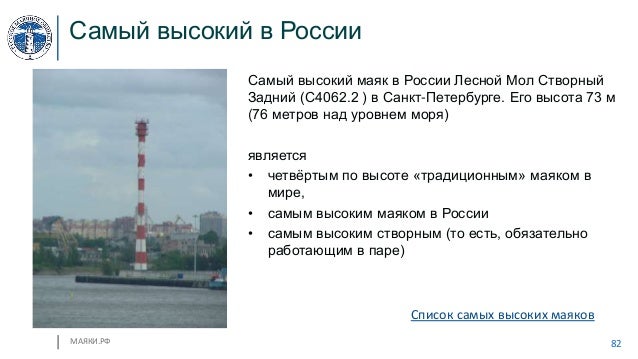
- 82. MAYAKI.RF 82 The tallest lighthouse in Russia The tallest lighthouse in Russia Lesnoy Mol Svorny Rear (C4062.2) in St. Petersburg. Its height of 73 m (76 meters above sea level) is • the fourth highest “traditional” lighthouse in the world, • the tallest lighthouse in Russia • the highest folding (that is, necessarily working in pairs) List of the tallest lighthouses
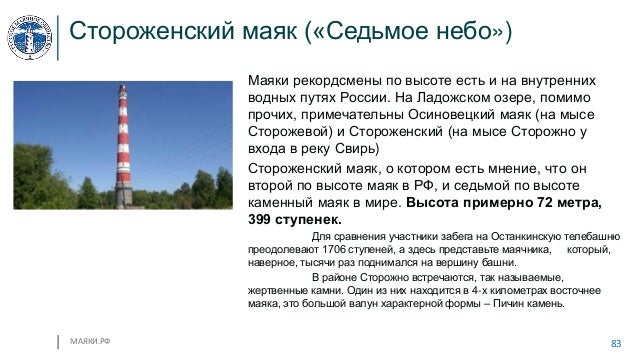
- 83. MAYAKI.RF 83 Storozhensky Lighthouse (“Seventh Heaven”) There are record-breaking lighthouses on the inland waterways of Russia. On Lake Ladoga, among others, notable are the Osinovetsky lighthouse (on Cape Storozhevoy) and the Storozhensky lighthouse (on Cape Storozheno at the entrance to the Svir River) Storozhensky lighthouse, which is believed to be the second tallest lighthouse in the Russian Federation, and the seventh tallest stone lighthouse in the world. Height is approximately 72 meters, 399 steps. For comparison, participants in the race to the Ostankino TV tower overcome 1,706 steps, but here imagine a lighthouse keeper who has probably climbed to the top of the tower thousands of times. In the Storozhno area there are so-called sacrificial stones. One of them is located 4 kilometers east of the lighthouse; it is a large boulder of a characteristic shape - the Pichin stone.
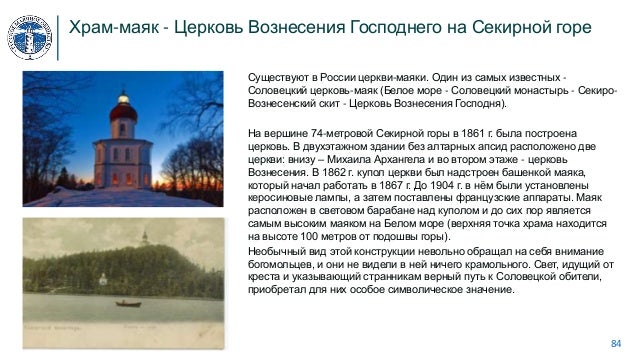
- 84. MAYAKI.RF 84 Lighthouse Temple - Church of the Ascension on Sekirnaya Mountain There are lighthouse churches in Russia. One of the most famous is the Solovetsky Church-Lighthouse (White Sea - Solovetsky Monastery - Sekiro-Voznesensky Skete - Church of the Ascension of the Lord). A church was built on the top of the 74-meter Sekirnaya Mountain in 1861. In a two-story building without altar apses, there are two churches: below - St. Michael the Archangel and on the second floor - the Church of the Ascension. In 1862, the dome of the church was built over the turret of a lighthouse, which began operating in 1867. Until 1904, kerosene lamps were installed in it, and then French apparatus were installed. The lighthouse is located in a light drum above the dome and is still the highest lighthouse on the White Sea (the highest point of the temple is 100 meters above the base of the mountain). The unusual appearance of this structure involuntarily attracted the attention of pilgrims, and they did not see anything seditious in it. The light coming from the cross and showing wanderers the right path to the Solovetsky monastery acquired a special symbolic meaning for them.
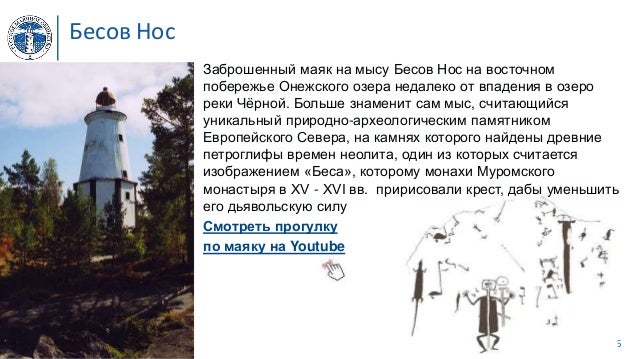
- 85. LIGHTHOUSES.RF 85 Besov Nos An abandoned lighthouse on Cape Besov Nos on the eastern coast of Lake Onega near the confluence of the Chernaya River into the lake. More famous is the cape itself, which is considered a unique natural and archaeological monument of the European North, on the stones of which ancient petroglyphs from the Neolithic times were found, one of which is considered to be an image of the “Demon”, to whom the monks of the Murom Monastery in the 15th - 16th centuries. they painted a cross in order to reduce its devilish power. Watch a walk through the lighthouse on Youtube
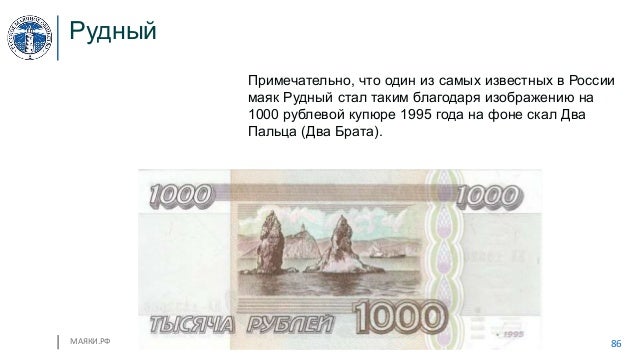
- 86. MAYAKI.RF 86 Rudny It is noteworthy that one of the most famous lighthouses in Russia, Rudny, became so thanks to its image on the 1000 ruble bill 1995 against the backdrop of the Two Fingers (Two Brothers) rocks.
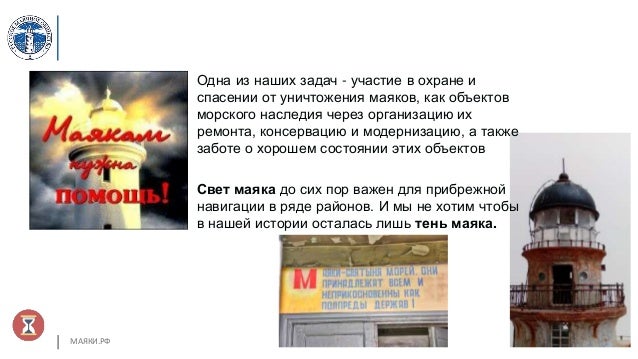
- 87. MAYAKI.RF 87 One of our tasks is to participate in the protection and rescue from destruction of lighthouses as objects of maritime heritage through organizing their repair, conservation and modernization, as well as caring for good condition of these objects The light of the lighthouse is still important for coastal navigation in a number of areas. And we don’t want only the shadow of a lighthouse to remain in our history.
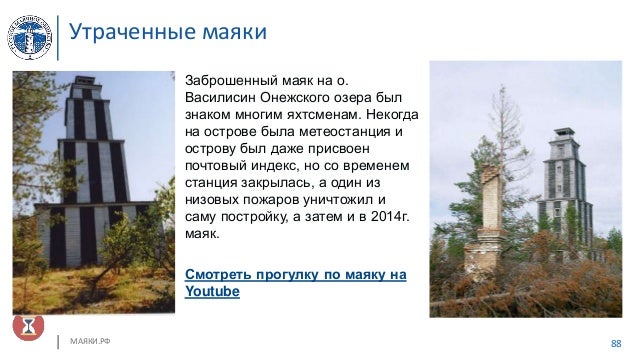
- 88. LIGHTHOUSES.RF 88 Abandoned lighthouse on the island. Vasilisin of Lake Onega was familiar to many yachtsmen. There was once a weather station on the island and the island was even assigned a postal code, but over time the station closed, and one of the ground fires destroyed the building itself, and then in 2014. lighthouse. Watch a lighthouse walk on Youtube Lost Lighthouses
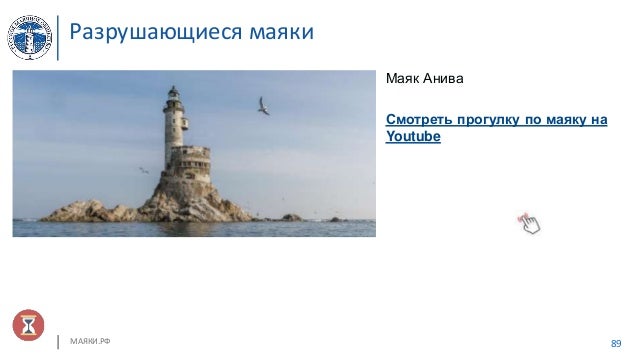
- 89. MAYAKI.RF 89 Aniva Lighthouse Watch a walk through the lighthouse on Youtube Collapsed lighthouses
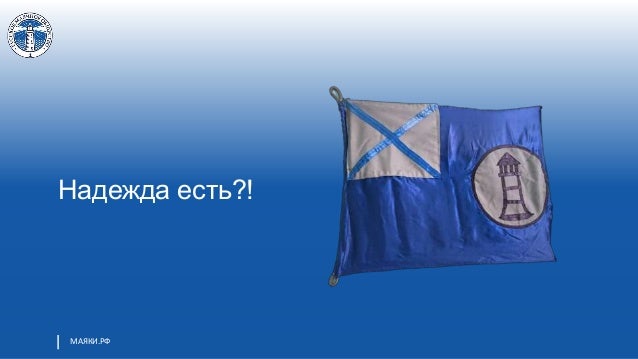
- 90. MAYAKI.RF Is there hope?!
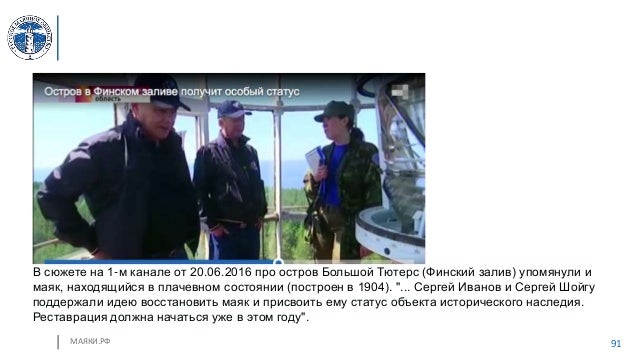
- 91. MAYAKI.RF 91 In the story on Channel 1 dated 06.20.2016 about the island of Bolshoi Tyuters (Gulf of Finland) they also mentioned lighthouse in poor condition (built in 1904). "...Sergei Ivanov and Sergei Shoigu supported the idea of restoring the lighthouse and assigning it the status of an object of historical heritage. Restoration should begin this year."
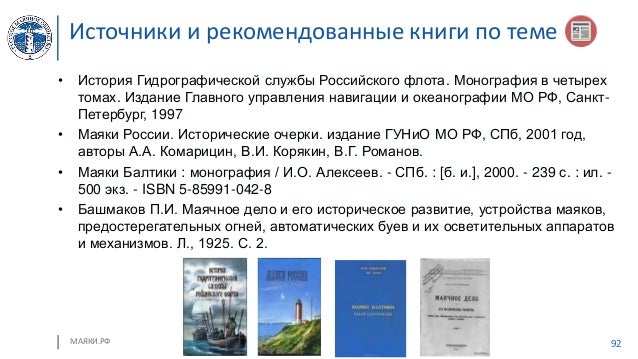
- 92. MAYAKI.RF 92 Sources and recommended books on the topic • History of the Hydrographic Service of the Russian Fleet. Monograph in four volumes. Publication of the Main Directorate of Navigation and Oceanography of the Ministry of Defense of the Russian Federation, St. Petersburg, 1997 • Lighthouses of Russia. Historical essays. publication of GUNIO MO RF, St. Petersburg, 2001, authors A.A. Komaritsin, V.I. Koryakin, V.G. Romanov. • Lighthouses of the Baltic: monograph / I.O. Alekseev. - St. Petersburg. : [b. i.], 2000. - 239 p. : ill. - 500 copies. - ISBN 5-85991-042-8 • Bashmakov P.I. Lighthouse business and its historical development, construction of beacons, warning lights, automatic buoys and their lighting apparatus and mechanisms. L., 1925. S. 2.
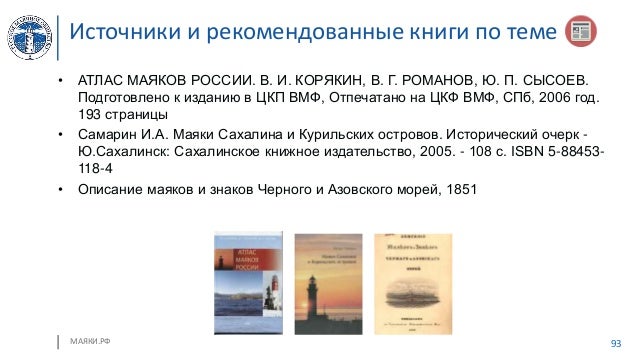
- 93. MAYAKI.RF 93 Sources and recommended books on the topic • ATLAS OF LIGHTHOUSES OF RUSSIA. V. I. KORYAKIN, V. G. ROMANOV, Y. P. SYSOEV. Prepared for publication at the Navy Central Commission for Use, Printed at the Navy Central Commission for Use, St. Petersburg, 2006. 193 pages • Samarin I.A. Lighthouses of Sakhalin and the Kuril Islands. Historical essay - Yu. Sakhalinsk: Sakhalin Book Publishing House, 2005. - 108 p. ISBN 5-88453- 118-4 • Description of lighthouses and signs of the Black and Azov Seas, 1851
- Thank you for your attention! e-mail: [email protected] MAYAKI.RF | mayachnik.ru Vasily Korablev President of the Foundation for Support of Lighthouses and Lighthouses "Russian Lighthouse Society" Head of the project "Lighthouse. Lighthouses of Russia and the World"
On the history and development of lighthouse business in Russia. Foundation "Russian Lighthouse Society" from Vasily Korablev
This description is machine-translated and has not yet been reviewed.
About the history and development of the lighthouse...
More presentations from Mayachnik
Script
- 1. LIGHTHOUSES.RF Foundation "Russian Lighthouse Society" On the history and development of lighthouse business in Russia Speaker: Vasily Korablev President of the Foundation for Support of Lighthouses and Lighthousemen "Russian Lighthouse Society" Head of the project "Lighthouse. Lighthouses of Russia and the world" "Lighthouse. Lighthouses of Russia and the world"
- 2. MAYAKI.RF The main focus of our projects is aimed at popularizing and preserving Russian lighthouses, because this interesting topic with a rich history is practically inaccessible to the general public in Russia, and even more so to lighthouse lovers from abroad who are interested in Russian lighthouses “Lighthouses are the shrines of the seas. They belong to everyone and are inviolable, like the plenipotentiaries of the powers" Konstantin Paustovsky
- 3. MAYAKI.RF Foundation for the support of lighthouses and lighthouses "Russian Lighthouse Society" Project "Lighthouse. Lighthouses of Russia and the world." • Encyclopedia of lighthouses in Russia, the world, lighthouse makers • Models of lighthouses • Forum about lighthouses and lighthouse makers http://mayaki.ru/ • Communities on social networks “Lighthouse Lovers Club” Our projects Founded: July 1, 2016 Founded: 2008 mayachnik.ru MAYAKI.RF
- 4. LIGHTHOUSES.RF 4 World history of lighthouses There is an opinion that the first lighthouses appeared along with the birth of navigation more than six thousand years ago: noticeable places in the area, buildings, floating lighthouses, bonfires, “cow beacons” (wandering beacons), lamps, lanterns, trumpets, gongs, tom-toms, bells, sirens, cannons, natural sound beacons Cow lighthouse Fire beacon We can find in Homer that in ancient times sailors, sailing at night, used the lights of ordinary bonfires. In the tenth song of the Odyssey, he talks about how the inhabitants of Ithaca lit fires so that Odysseus could find his native harbor
- 5. MAYAKI.RF 5 Natural sound beacons In the La Perouse Strait in the Far East there is a rocky island called Stone of Danger. Before installing an automatic beacon on it, the location of a dangerous island was determined by the cry of sea lions. Having stuck to all the rocks, they raise such a roar that it can be heard for many miles in any weather. Such a natural sound beacon as roaring caves is also known. In some coastal cliffs there are caves that, in stormy weather, are filled with water for a short time with huge waves breaking into them. In this case, the air from the caves is forced into a small hole located at the back and facing the ground. The sound that arises in this case can hardly be tolerated by the person nearby. Until now, despite the high level of modern equipment on ships, natural sound beacons continue to be used as an additional means of orientation.
- 6. LIGHTHOUSES.RF 6 The Alexandria Lighthouse is the oldest. The first information about lighthouse towers is reported by the Roman historian Pliny the Elder in his “Natural History”. In his time, there were lighthouses in Alexandria, Ostia, Ravenna and other ports of the Mediterranean Sea. Many beacons have left their light in history. One of the most famous Alexandria (Pharos) lighthouse is one of the Seven Wonders of the World, with a height of 120-180 meters according to various sources, which stood for about 1600 years (built in the 3rd century (283) BC on the island of Pharos. In the 14th century (1317) the lighthouse was completely destroyed by an earthquake). Currently, only the base of the lighthouse has been preserved, completely built into a medieval fortress in Egypt. By the beginning of our era, there were 27 lighthouses in the world. They illuminated the shores of the Dardanelles, Bosphorus, English Channel, Apennine Peninsula, Southern France, and Spain.
- 7. LIGHTHOUSES.RF 7 In the Middle Ages, with the flourishing of the commercial activities of the Hanseatic League, lighthouse towers appeared in the North Sea. The first of them was built by merchants of the free city of Hamburg in 1286 on the island of Neuwerk at the approach to the mouth of the Elbe.
- 8. MAYAKI.RF 8 Evolution of lighthouse lighting devices 16901560
- 9. MAYAKI.RF 9 Evolution of lighthouse lighting devices 1791 (1765)1759
- 10. MAYAKI.RF 10 Lighthouse lighting devices. Argand lamps In 1783, the French engineer Theler improved the equipment for catoptric lighting, giving the reflectors a parabolic shape and placing a lamp invented by his compatriot Argand at the focus of each reflector. Its peculiarity was that the oil reservoir was located on the side and slightly above the burner, due to which the pressure of the oil flowing to the wick was constant and the combustion of the fire was uniform. Somewhat later, the same engineer Teler invented a system of revolving lighthouses, which was soon adopted by all maritime powers. In Russia, these innovations were introduced only in the 19th century. Lighthouse lamps of the catoptric (reflective) system: a) cranked lamp b) Argand lamp
- 11. MAYAKI.RF 11 Lantern with a Fresnel lens stationary rotating In 1819, the French physicist A. Fresnel invented a refractive a lighting apparatus with a lamp in the middle, called dioptric; it made it possible to obtain a flashing light of any characteristic. The first Fresnel apparatus was installed in 1822 at the Corduan lighthouse (France).
- 12. MAYAKI.RF 12 How did it all begin in our open spaces? Archaeological data undoubtedly indicate that navigation on the rivers, lakes and seas of our country began in the Stone Age. 9-4 thousand BC The oldest stage of discovery, study and development of the shores of seas, lakes and rivers. The emergence of the first stops of sea fishermen and hunters in the Black, Caspian, Baltic, Chukchi and Bering seas. VI century AD The first mentions by Byzantine historians of the seafaring art of the Eastern Slavs. Underwater archaeologist Dmitry Pospelov found the remains of an ancient lighthouse of the 4th century BC in Crimea at Cape Tarkhankut. Rock paintings of animals and hunting sea animals on the shores of the White Sea. From the book by V. I. Ravdonikas “Rock Carvings of the White Sea”
- 13. MAYAKI.RF 13 The emergence of lighthouses in Russia dates back to the birth of the regular domestic fleet. With the access of the Russian state to the seas, Peter I had to take care of ensuring the safety of navigation. How did it all begin in our open spaces?
- 14. MAYAKI.RF 14 How did it all begin in our open spaces? According to hydrographer P.I. Bashmakov, who studied the history of lighthouses, until the end of the 18th century. On the Black and Azov Seas, only temporary lighthouses operated, which were small artificial elevations made of stones, on which fires were burned for the time of ships arriving from the sea. On the coast of the White Sea and the seas of the Arctic Ocean, there were also no permanent lighthouses in pre-Petrine times. In these areas, industrialists and fishermen have since ancient times used natural signs and artificial landmarks - houris and large wooden crosses installed on elevated places and at the entrance to bays and straits. Gurias were piles of cone-shaped stones, and crosses were made from local driftwood and served, as a rule, as gravestones. The plane of the crosses was located mostly in the direction of the plane of the magnetic meridian, which made it possible for navigators to roughly navigate not only by the location of the crosses, but also by their orientation. Bashmakov Pavel Ivanovich
- 15. MAYAKI.RF 15 How did it all begin in our open spaces? “...It should be noted that the word “lighthouse” in documents of that time is not always used in its modern meaning, and refers equally to a fire laid simply on the ground, or on a specially constructed “pillar” (tower), and to any sign built on the shore or on the water to indicate the fairway. Therefore, in contrast to modern identification signs, which were then called “daylight beacons,” bonfires, as well as all kinds of lights in general for giving a signal, were called “fire beacons.” “Beacons” were also called temporary guard posts, which by fire or some other means were supposed to “repair a signal” about the approach of the enemy, etc.; therefore, there were “lighthouses” on the dry route. So, for example, in 1723, to prevent Tatar raids on our southern outskirts, “fire beacons” were set up in Ukraine, Kazan, Voronezh and Astrakhan provinces...” Pavel Ivanovich Bashmakov
- 16. MAYAKI.RF 16 How did it all begin in our open spaces? XVIII century, beginning. On the island of Mudyug in the White Sea, the first lighthouse structure in the northern seas was built - a wooden tower. Source: http://kamelopardalis.livejournal.com/14014.html Modern lighthouse "White Tower" One of the oldest lighthouses in Russia can be considered Mudyugsky (White Sea) built in 1705
- 17. MAYAKI.RF 17 How did it all begin in our open spaces? 1700. On the Russian seas, specially made poles and “pilot barrels” began to be installed for the first time to fencing fairways. The original type of poles were poles with flags, then flags were replaced by wickerwork made of twigs.
- 18. MAYAKI.RF 18 How did it all begin in our open spaces? Simultaneously with the river navigation equipment, the construction of navigation signs began on the shores of the Azov Sea. In 1702, the first two lighthouses were built at the mouth of the Don River “to signal the passage of ships,” illuminated by firewood. Their structure was apparently very primitive, since already in 1704 they collapsed “from spring water.” The restoration of these lighthouses began in the same year, but no information about their further fate has been preserved.
- 19. MAYAKI.RF 19 How did it all begin in our open spaces? 1704, April 4. A fire was lit at the Peter and Paul Fortress, which became the first Russian lighthouse on the Baltic Sea. With the development of St. Petersburg, it was abolished as unnecessary.
- 20. MAYAKI.RF 20 How did it all begin in our open spaces? 1710, August 30. Russia signed the first international agreement on lighthouse dues with England, which prescribed “for the convenience of maritime merchants...sea, buoy, lighthouse and other money in all Russian sea piers to be taken from British ships according to the same calculation as they are collected in Great Britain.”
- 21. MAYAKI.RF 21 The oldest lighthouse organizations In 2014, Trinity House (full name Corporation of Trinity House of Deptford Strond) celebrated its 500th anniversary. Trinity House has operated on a charitable basis since it was established by Henry VIII's royal charter on 20 May 1514. Around £4 million a year is donated to charity across its charities, which include training, the welfare of retired seafarers and the teaching of educational programs that develop maritime safety skills. The corporation's mission is to provide navigational aids for the safe passage of a huge variety of vessels through some of the world's busiest shipping lanes. To accomplish this task, an impressive array of over 600 navigation aids will be deployed, ranging from lighthouses to satellite navigation services. Organization website: http://www.trinityhouse.co.uk/
- 22. MAYAKI.RF 22 Hydrographic Service of Russia The official date of creation of the lighthouse service of Russia is considered to be June 8 (May 27), 1807, when the Emperor Alexander I approved the “Regulations on the maintenance of lighthouses and the staff of the lighthouse team.” The Regulations provided for the introduction of oil lighting and uniform staffing at all lighthouses (one keeper and five to eight maritime department servants at each lighthouse), and the position of director of the Baltic lighthouses was introduced. All issues of lighthouse construction in Russia, and then in the USSR, were dealt with by the Hydrographic Service of the Navy, formed in 1827. In 2017 it will be 190 years old.
- 23. LIGHTHOUSES.RF 23 Tolbukhin (Kotlinsky) Schematic drawing of the Kotlin lighthouse, made by Peter I. 1719. One of the oldest lighthouses Baltic Sea. Kotlinsky was the first lighthouse in Russia in which the fire was lit more or less constantly and at a certain time. The wooden lighthouse was rebuilt many times and burned down in 1744. Watch on Youtube under the drawing, the king wrote: “The rest is left to the will of the architect.”
- 24. LIGHTHOUSES.RF 24 By the end of the reign of Peter I, several lighthouses - stone and wooden - were already operating on the Baltic Sea. Most of them were lit with wood, some with coal. Firewood was usually collected by peasants from nearby villages for 30 kopecks. per fathom, and a lot of them were required. For example, at the Dagerort lighthouse about 900 fathoms of wood were burned annually, and at the Gotland lighthouse - 250 fathoms of firewood and up to 1,500 pounds of “overseas” (Dutch) coal. After the death of Peter the Great on January 28 (February 8), 1725, much less attention was paid to maritime activities and, accordingly, to the lighthouse business.
- 25. LIGHTHOUSES.RF 25 Around 1730. Beginning of systematic work on the navigation fencing of the Baltic Sea, including maintenance of coastal lighthouses. For this purpose, two or three galliot pilots were appointed annually for the navigation period. 1737. From this year, navigators began to be appointed to the positions of lighthouse keepers, who were obliged to keep special logs, noting in them passing ships, weather and other information related to navigation safety. 1738. The first mention of a lighthouse on the Kamchatka Peninsula (a wooden frame with a flagpole on the roof). Each time when leaving for the lighthouse, those observing the lighting were given instructions, which always invariably ended with the instruction “to have diligent supervision, with great caution, so that [the lighthouses] are always maintained properly” and “the fire is burning great and high.”
- 26. LIGHTHOUSES.RF 26 1769. The first permanent lighthouse (wooden) on the White Sea, Zhizhgin, was built. Around 1770. The first capital lighthouse on the Caspian Sea, Chetyrehbugorny, began to operate. Modern Zhizhginsky lighthouse
- 27. LIGHTHOUSES.RF 27 1803. At the Kokshkher (Keri) lighthouse of the Baltic Sea In 1803, for the first time in Russia on The catoptric, or reflective, method of lighting was used in the Kokshkher lighthouse. – A lighthouse was built on a stone conical foundation made of wood, and an eight-sided lantern with oil lamps and copper reflectors, made in Russia based on the model of a reflector purchased in England, was placed on it.
- 28. MAYAKI.RF 28 1807. All lighthouses of the Baltic Sea, with the exception of two Domesnes, were transferred from private management to the subordination of the maritime department. The right to build and maintain lighthouses at that time belonged not only to the government, but also to private individuals, so owners of coastal estates often built lighthouses for their needs and operated them partly on their own, partly by renting them out. Lighthouse fires, no different from the fires lit by the local population, often led to shipwrecks. However, the greatest inconvenience was associated with the fact that private owners were allowed to maintain lighthouse lights at their own expense. These owners, taking advantage of the ancient ruling of Coastal Law, which allowed them to take part of the value of a broken ship and its cargo, often deliberately extinguished the lighthouse fire or lit it in another place, contributing to shipwrecks. 1807, May 27. A new Regulation on lighthouses was approved, providing, in particular, for the introduction of oil lighting instead of coal and wood lighting and new states. The same provision established the position of director of Balt
Iysky lighthouses. The first director was captain 2nd rank L.V. Spafariev. L. V. Spafarev
- 29. MAYAKI.RF 29 Many people know the Rostral columns on the Spit of Vasilyevsky Island in St. Petersburg. They were built according to the design of J. F. Thomas de Thomon simultaneously with the building of the Exchange in 1805-1810. At the tops of the columns there are metal tripods with bowls: in the 19th century. oil was poured into them, which was lit at dusk. One of the columns was a lighthouse for ships on the Malaya Neva, the other pointed the way to the Bolshaya Neva. The lighthouses served until 1885. Nowadays, fires are also lit on the rostral columns, but this only happens during special celebrations. Today, instead of oil, gas is used, which is supplied to metal tripods through a special pipe. Rostral column at the finish line of the Volvo Ocean Race 2008-2009
- 30. MAYAKI.RF 30 How did it all begin in our open spaces? 1809. The exemplary Kokshkhery lighthouse was built at the Aleksandrovsky cast iron plant. By 1820, all the lighthouses of the Gulf of Finland and Riga were reconstructed according to its model. 1810. The conversion of lighthouse lighting from wood and coal to oil, purchased in England, was completed. At the same time, a lamp, invented in 1800 by the Frenchman Carcel, was increasingly used as a light source.
- 31. LIGHTHOUSES.RF 31 Belosaraysky Lighthouse 1811. The first capital Belosaraysky lighthouse on the Sea of Azov was built and put into operation.
- 32. MAYAKI.RF 32 Lighthouses Tarkhankutsky and Chersonesos 1816. The first illuminated stone lighthouses were built on the Black Sea Tarkhankutsky and Chersonesos. 2016 marks 200 years
- 33. LIGHTHOUSES.RF 33 In 1817, the Directorate of lighthouses and sailing directions, similar to the Baltic one, was created in the Black Sea Fleet. Lieutenant-Commander M.B. Berkh, later a full admiral, was appointed its first director.
- 34. LIGHTHOUSES.RF 34 1820. The first description of lighthouses and signs of the Gulf of Finland and Riga, compiled by L.V. Spafariev, was published. L. V. Spafarev
- 35. MAYAKI.RF 35 Inkerman folding lighthouses 1821. To ensure a safe entrance to Sevastopol Bay, Inkerman folding lighthouses were built with visibility range: front - 20 miles, rear - 28 miles.
- 36. LIGHTHOUSES.RF 36 1838. The first permanent stone lighthouse in the northern seas of Russia began operating on Mudyug Island. Source: http://kamelopardalis.livejournal.com/14014.html Modern lighthouse "White Tower"
- 37. MAYAKI.RF 37 1840—1850. The first special hydrographic vessels on the Black Sea were built in Nikolaev, which were called pilot vessels, pilot boats, or simply pilot vessels. They were mainly used for servicing lighthouses, installing floating fencing, but sometimes also for taking soundings. If in the Baltic Sea there were no special problems with lighthouse construction - the difficulties were the same as in any European state, then in the seas of the North and Far East Russian hydrographers had to solve the most difficult problems.
- 38. MAYAKI.RF 38 1849, July 1. The first cool lighthouse on the Kamchatka coast, Dalny, began operating. It was officially established in 1850. Dalniy Lighthouse in our time
- 39. MAYAKI.RF 39 1851. A description of the lighthouses of the Black and Azov Seas in the Black Sea Hydrographic Depot was published. The heights of lighthouses from the sea surface were determined by Second Lieutenant Fedorov in 1850.
- 40. MAYAKI.RF 40 1855, July 9. A new Regulation on lighthouses and sailing directions of the Baltic Sea has been approved. It noted that the Baltic lighthouses “... mean all the lighthouses located along the southern coast of the Gulf of Finland and Riga and on the islands belonging to them from Kronstadt to the borders with Prussia...”. A total of 25 lighthouses are listed. 1858. At the Kokshkher (Keri) lighthouse in the Baltic Sea, the first Fresnel lighting apparatus in Russia, purchased in France, was installed. Since that time, the Fresnel lighting system has been introduced at all lighthouses in Russia.
- 41. MAYAKI.RF 41 1858. For the first time in Russia, a dynamo for electric lighting was installed at the Odessa lighthouse.
- 42. MAYAKI.RF 42 1860. Beginning of publication of Pilot’s Notes, which contained information about new lighthouses, towers, etc. 1860. Replacement of government servants at lighthouses with civilian personnel. The number of civilian servants ranged from three to eight people. An officer (career or retired) was appointed as the head of the lighthouse.
- 43. MAYAKI.RF 43 1863. The first rescue stations were established at four lighthouses of the Baltic Sea. 1864. The first lightship on the Baltic Sea, Revelstein, was installed in the area of Revel (Tallinn). 1864. Lieutenant A.F. Ulsky, while inventorying the Caspian Sea, took several photostereoscopic photographs of coastal views obtained from a moving ship. He also photographed the operating lighthouses of the Caspian Sea. 1867. The first electric lighthouse in Russia, Odessa, began operating. Revelstein lighthouse
- 44. MAYAKI.RF 44 1872. The first steam siren in Russian lighthouses was installed on the southern tip of Gogland Island. 1873. The Directorate of Lighthouses of the Black and Azov Seas equipped a traveling lighthouse workshop on the steamship “Ingul”, which until 1889 carried out the necessary repairs of lighthouse equipment during navigation. In 1885, the second camp lighthouse workshop was formed on the steamship “Prut”. 1874. The first steam siren (Holmes steam whistle) in the northern seas of Russia was installed at the Svyatonossky lighthouse. 1875. A plan for lighthouse construction on the Russian seas was drawn up for 16 years (until 1891).
- 45. MAYAKI.RF 45 1875. The first stationary Kolka lighthouse in Russia was built, built in the open sea on a hydraulic foundation. Lighthouse Domesngs (1895)
- 46. MAYAKI.RF 46 1875. The first experiments in the use of petroleum (oil) in lighthouse lamps for lighting. 1882. In the Gulf of Finland, for the first time in Russia, lighthouse apparatuses of the Swedish engineer Lindbergh were used, in which gas emitted by gasoline burned; could burn without refueling for 10-15 days. Trotter-Lindberg Lamp
- 47. MAYAKI.RF 47 1882. Mechanical fog alarms were installed for the first time on the Black Sea: “Canadian whistle” - on the Sandy floating lighthouse and siren - at the Tarkhankut lighthouse. 1885. The Depot of Nautical Instruments and the Lighthouse Unit were established in the Main Hydrographic Directorate. floating lighthouse
- 48. MAYAKI.RF 48 1888. The transition to kerosene lighting for lighthouses began on the Black Sea. 1895-1900. Equipping coastal lighthouses with telephones for communication with postal and telegraph stations. 1896, January 12. A temporary staff has been approved for manning lightships with a civilian crew. 1896. The GGU commission, chaired by Rear Admiral N.A. Ivashintsov, developed measures to extinguish beacons and buoys when the enemy approaches and in the event of war. 1899, June 30. The first lighthouse on Lake Baikal-Goloustensky began to operate. Wagner lamp
- 49. MAYAKI.RF 49 1903. The introduction of kerosene-heated lighting began at large lighthouses in Russia. 1905. The world's first reinforced concrete lighthouse was built on the Black Sea - Ozharsky, 36.7 m high from the base. Ozharsky Lighthouse
- 50. MAYAKI.RF 50 1908. For the first time in Russia, natural gas coming out of the ground was used for lighting at the Kokshkher lighthouse. It was also used for lighting and heating lighthouse buildings. 1908. The first underwater signal bell in Russia was installed in the Baltic Sea at the Nekmangrund lighthouse. Underwater signal bell
- 51. LIGHTHOUSES.RF 51 1909. In the Baltic Sea, in the area of the Libavsky floating lighthouse, the first lighted buoy in Russia was installed acetylene. 1911. A decision was made to introduce acetylene lighting in lighthouses (previously this method was used exclusively on warning lights and buoys). The first lighthouse in Russia illuminated with acetylene in 1912 was the Narginsky lighthouse in the Caspian Sea. 1913. In Russia, machine (instead of manual) coloring of lighthouse lights and signs on sea navigation charts was used for the first time. Libavsky lighthouse
- 52. MAYAKI.RF 52 The First World War and the Civil War had a serious impact on the state of navigation equipment. The lighthouses were not repaired for several years, so they often failed, and a significant part of them were destroyed. At many lighthouses, light-optical devices were damaged, there were no light sources, and there was a great shortage of trained maintenance personnel. Only after the creation of the Office for Ensuring the Safety of Navigation in the Black and Azov Seas (Ubekochernaz) on December 14, 1920, the restoration of the navigation equipment system began, which was basically completed in 1923.
- 53. MAYAKI.RF 53 Number of lighthouses as of January 1, 1918.
- 54. MAYAKI.RF 54 1918. At the Petrograd Polytechnic Institute under the guidance of Professor Valerian Ivanovich Bazhenov (1889 – 1938) the first domestic directional radio beacon was created. 1924. The import of acetylene lighthouse equipment from abroad was resumed. 1930-1932. The conversion of class beacons from kerosene-wick to kerosene-heat lighting has been completed. 1932. The Hydrographic Administration began the planned development of sea navigation equipment. Before 1941, the following were built: 30 light beacons, 45 radio beacons, 30 sirens, 31 nautophones, 845 luminous signs. 1932-1934. The first domestic standard RMS circular radio beacons were created in the workshops of the Hydrographic Directorate.
- 55. MAYAKI.RF 55 Radio beacons
- 56. MAYAKI.RF 56 1933. The State Optical Institute together with the Leningrad Optical Glass Plant produced the first domestic samples of large lighthouse lenses Fresnel. 1935. The first samples of medium-wave radio beacons with a rotating radiation pattern were created, which made it possible to determine a place at sea using a conventional radio receiver and a stopwatch. Radio beacons were installed on Cape Khersones (Black Sea), Dikson and Bely Islands (Northern Sea Route) and Cape Povorotny (Sea of Japan). 1935. On Novaya Zemlya, the first electric lighthouse in the northern seas of the USSR, Yugorsky Shar, began operating. 1935. Plant named after. By order of the Comintern, a directional radio beacon for the VHF “Stor” was developed by order of the Main Directorate of the Military Military Migration Service of the Red Army. Abandoned polar station Yugorsky Shar
- 57. MAYAKI.RF 57
- 58. MAYAKI.RF 58 1938. In the Hydrographic Department, under the leadership of A.F. Smirnovsky, a stationary directional radio beacon “Safar” was created. 1940. The Triton-P radio beacon with an underwater acoustic emitter was put into service. 1941. A radio beacon with airborne and underwater acoustic emitters was put into service.
- 59. MAYAKI.RF
- 60. MAYAKI.RF 60 Lighthouse development was interrupted by the beginning of the Second World War. The personnel of the Hydrographic Service took an active part in navigation and hydrographic support. In particular, the Hydrographic Service of the Baltic Fleet ensured the operation of ice roads connecting Kronstadt with Bolshaya and Malaya Izhora, Lisiy Nos, Gorskaya; the ice road from the Shepelevsky lighthouse to the islands of Seskar and Lavensaari, as well as the Ladoga ice road between the villages of Lavrovo - Kokorevo.
- 61. MAYAKI.RF 61 for the 70th anniversary of the Great Victory, we prepared a video story of the history of the battle for Suho Island on October 22, 1942 on example of a diorama Battle for the island of Dry Lake Watch on Youtube Commander of the Baltic Fleet V.F. Tributs in his book “The Baltic People Are Fighting” called the defense of Suho Island the most successful operation of our fleet during the entire war. Of the 70 garrison men (13 and 32 wounded remained)
- 62. MAYAKI.RF 62 The post-war period in the history of lighthouse business became the most fruitful. In 1950 – 1985 the number of lighthouses with permanent staff increased from 211 to 340, the number of navigational signs increased from 2381 to 3423. At the same time, there was a qualitative improvement in lighthouse equipment..." 1949. At the Tarkhankut lighthouse (Black Sea), a wind engine was first used to charge lighthouse batteries at the suggestion of hydrographer B. S. Rosen. 1950-1951. The first ones were built reinforced concrete lighthouses on the Baltic Sea: Klaipeda lighthouse, 35 m high and Nidden lighthouse, 24 m high. 1961. The PZM-400 underwater sound beacon was created.
- 63. MAYAKI.RF 63
- 64. MAYAKI.RF 64
- 65. MAYAKI.RF 65 Is this fantastic!? During the Soviet era, there were a number of projects for lighthouse monuments of cyclopean proportions, which for one reason or another were not implemented, for example, a competition project for a lighthouse monument to V.I. Lenin in the Leningrad port: according to the terms of the international competition announced in March 1932, the height of the lighthouse was 110 meters.
- 66. MAYAKI.RF 66 1974. For the first time in world practice, the automated Tallinn lighthouse was switched to isotope power sources.
- 67. MAYAKI.RF 67 1974. The serial production of the new automatic navigation radio beacon ANRM-25, designed for installation on separately located dangers and in coastal areas difficult to access (to replace the MRM-61 lighthouse). 1980. The IX International Conference of Lighthouse Authorities was held in Tokyo, recommending a new unified system of fencing with floating warning signs. In the USSR, the transition to it began in 1981. 1982. A lensless lighthouse system with a luminous intensity of several tens of millions of candles was adopted.
- 68. MAYAKI.RF 68 By the time of the collapse of the USSR there were 554 light beacons, 228 radio beacons, 2156 luminous signs In the process of collapse 151 light beacons were transferred, etc. 1993. The medium-orbit global navigation satellite system GLONASS was adopted. Modern Russia
- 69. MAYAKI.RF 69 In order to ensure the safety of navigation in Russian waters, a reliable system of navigation equipment was created. More than 4 thousand objects were deployed on the country’s coast, including 399 illuminated beacons, 2,538 illuminated and non-illuminated navigation signs, 148 radio beacons and radar transponders, 45 radio navigation system stations. More than 150 hydrographic and pilot vessels and specially built boats are used annually to maintain navigational facilities and monitor their operation. Hydrographic service of the Navy today
- 70. MAYAKI.RF 70 IN THE XXI century. The lighthouse service has introduced new technologies that increase the safety of navigation: • a network of control and correction stations of global navigation satellite systems “GLONASS/NAVSTAR” based on marine radio beacons is actively developing. The creation of such a network on the approaches to the main ports of Russia will significantly increase the accuracy of determining the location of ships (up to 5 meters) within a radius of 250 km from the station installation site; • low-power light-optical devices have been developed that significantly increase the reliability and range of luminous navigation signs and beacons; • the creation of a control system for navigational equipment based on the use of geoinformation technologies and modern means of communication is being completed. Hydrographic service of the Navy today
- 71. MAYAKI.RF 71 ELECTRIC BEACON DEVICES OF EMC TYPE (circular action)
- 72. MAYAKI.RF 72 PHOTOVOLTAIC GENERATORS
- 73. MAYAKI.RF 73 EQUIPMENT FOR CONTROL AND CONTROL SYSTEMS OF LIGHTING DEVICES (TRANSPONDERS) INSTALLED ON UNMAINTAINED BEACONS AND SIGNS USING SATELLITE COMMUNICATION CHANNELS TYPE OF TRANSPONDERS (LIGHTS USING LEDS)
- 74. MAYAKI.RF 74 TRANSPONDER CONTROL CENTER
- 75. LIGHTHOUSES.RF 75 How many lighthouses are there in the world? If you go by the numbering from the List of Lights, then there are more than 34 thousand lights and signs. It is clear that not all of them are elegant architectural structures, however, the scale for study is significant.
- 76. MAYAKI.RF 76 In order to ensure the safety of navigation in Russian waters, a reliable system of navigation equipment was created. More than 4 thousand objects were deployed on the country’s coast, including 399 illuminated beacons, 2,538 illuminated and non-illuminated navigation signs, 148 radio beacons and radar transponders, 45 radio navigation system stations. More than 150 hydrographic and pilot vessels and specially built boats are used annually to maintain navigational facilities and monitor their operation. Hydrographic service of the Navy today
- 77. MAYAKI.RF 77 What is the role of lighthouses now? 1- Navigation Despite the rapid development and improvement of electronic and satellite navigation systems (GPS, GLONASS, etc.), which makes it possible to accurately determine location and other navigation parameters regardless of the weather, beacons continue to be an important means of fencing navigational hazards and determining location. There are several reasons: • Determining the location using beacons gives the navigator greater psychological confidence when observing the approach to the shore. • In remote, hard-to-reach regions not equipped with radio navigation aids, beacons are indispensable for fencing off dangers, because allow you to directly “see” the navigation situation, which gives additional confidence to mariners. • Not all ships and vessels are equipped with expensive radio navigation and satellite equipment. A huge number of small vessels use compasses and logs, the use of which requires periodic clarification of coordinates using visual observation.
- 78. MAYAKI.RF 78 What is the role of lighthouses now? 1- Navigation The lighthouses themselves are also being improved. More and more beacons operate in fully automatic modes and are complex complexes of light-optical, electronic, sound-signaling equipment and power supply systems. The light-optical system automatically turns on at dusk and turns off at dawn. Also, light sources that are out and under construction are automatically switched to backup ones. Automated monitoring and control systems allow you to remotely control the characteristics of automatic beacon lights from the dispatch console. Increasingly, halogen, laser and LED lamps are used as light sources.
- 79. MAYAKI.RF 79 What is the role of lighthouses now? Lighthouse - an object of cultural heritage Many lighthouses become objects of cultural heritage and tourism, mainly abroad. Many foreign lighthouses began to operate as hotels. Unfortunately, Russian lighthouses cannot yet boast of such an opportunity. You shouldn’t expect any official hotel or tourist services at lighthouses. One of the famous and architecturally original German lighthouses, “Scarlet Sand” (Roter Sand), stands in the sea and has a history of more than 125 years, and is also open as a hotel. The hotel has six spartan rooms with modest “camping” food - canned food, bread, vegetables, fruits. There is no alcohol at all, and to get to the toilet you need to climb 70 steps. However, under such conditions it is almost impossible to book a hotel room. And this is at a rather low cost of living of 556 euros
- 80. MAYAKI.RF 80 What is the role of lighthouses now? The changes that have occurred in Russia over the past decades have also affected the lighthouse service. It is very painful to see how many lighthouses have become dilapidated and destroyed, and it cannot be said that the main reason was the development of progress associated with the advent of modern satellite navigation equipment. Mainly lack of funding or its misuse. I would like to hope that unused lighthouses, like shrines of the seas, will finally be recognized as objects of cultural heritage and transferred to the management of responsible organizations and people interested in their preservation. IPs that have become targets, but are administered by the state, should be properly financed, including through tourism.
- 81. MAYAKI.RF Unusual lighthouses
- 82. MAYAKI.RF 82 The tallest lighthouse in Russia The tallest lighthouse in Russia Lesnoy Mol Svorny Rear (C4062.2) in St. Petersburg. Its height of 73 m (76 meters above sea level) is • the fourth highest “traditional” lighthouse in the world, • the tallest lighthouse in Russia • the highest folding (that is, necessarily working in pairs) List of the tallest lighthouses
- 83. MAYAKI.RF 83 Storozhensky Lighthouse (“Seventh Heaven”) There are record-breaking lighthouses on the inland waterways of Russia. On Lake Ladoga, among others, notable are the Osinovetsky lighthouse (on Cape Storozhevoy) and the Storozhensky lighthouse (on Cape Storozheno at the entrance to the Svir River) Storozhensky lighthouse, which is believed to be the second tallest lighthouse in the Russian Federation, and the seventh tallest stone lighthouse in the world. Height is approximately 72 meters, 399 steps. For comparison, participants in the race to the Ostankino TV tower overcome 1,706 steps, but here imagine a lighthouse keeper who has probably climbed to the top of the tower thousands of times. In the Storozhno area there are so-called sacrificial stones. One of them is located 4 kilometers east of the lighthouse; it is a large boulder of a characteristic shape - the Pichin stone.
- 84. MAYAKI.RF 84 Lighthouse Temple - Church of the Ascension on Sekirnaya Mountain There are lighthouse churches in Russia. One of the most famous is the Solovetsky Church-Lighthouse (White Sea - Solovetsky Monastery - Sekiro-Voznesensky Skete - Church of the Ascension of the Lord). A church was built on the top of the 74-meter Sekirnaya Mountain in 1861. In a two-story building without altar apses, there are two churches: below - St. Michael the Archangel and on the second floor - the Church of the Ascension. In 1862, the dome of the church was built over the turret of a lighthouse, which began operating in 1867. Until 1904, kerosene lamps were installed in it, and then French apparatus were installed. The lighthouse is located in a light drum above the dome and is still the highest lighthouse on the White Sea (the highest point of the temple is 100 meters above the base of the mountain). The unusual appearance of this structure involuntarily attracted the attention of pilgrims, and they did not see anything seditious in it. The light coming from the cross and showing wanderers the right path to the Solovetsky monastery acquired a special symbolic meaning for them.
- 85. LIGHTHOUSES.RF 85 Besov Nos An abandoned lighthouse on Cape Besov Nos on the eastern coast of Lake Onega near the confluence of the Chernaya River into the lake. More famous is the cape itself, which is considered a unique natural and archaeological monument of the European North, on the stones of which ancient petroglyphs from the Neolithic times were found, one of which is considered to be an image of the “Demon”, to whom the monks of the Murom Monastery in the 15th - 16th centuries. they painted a cross in order to reduce its devilish power. Watch a walk through the lighthouse on Youtube
- 86. MAYAKI.RF 86 Rudny It is noteworthy that one of the most famous lighthouses in Russia, Rudny, became so thanks to its image on the 1000 ruble bill 1995 against the backdrop of the Two Fingers (Two Brothers) rocks.
- 87. MAYAKI.RF 87 One of our tasks is to participate in the protection and rescue from destruction of lighthouses as objects of maritime heritage through organizing their repair, conservation and modernization, as well as caring for good condition of these objects The light of the lighthouse is still important for coastal navigation in a number of areas. And we don’t want only the shadow of a lighthouse to remain in our history.
- 88. LIGHTHOUSES.RF 88 Abandoned lighthouse on the island. Vasilisin of Lake Onega was familiar to many yachtsmen. There was once a weather station on the island and the island was even assigned a postal code, but over time the station closed, and one of the ground fires destroyed the building itself, and then in 2014. lighthouse. Watch a lighthouse walk on Youtube Lost Lighthouses
- 89. MAYAKI.RF 89 Aniva Lighthouse Watch a walk through the lighthouse on Youtube Collapsed lighthouses
- 90. MAYAKI.RF Is there hope?!
- 91. MAYAKI.RF 91 In the story on Channel 1 dated 06.20.2016 about the island of Bolshoi Tyuters (Gulf of Finland) they also mentioned lighthouse in poor condition (built in 1904). "...Sergei Ivanov and Sergei Shoigu supported the idea of restoring the lighthouse and assigning it the status of an object of historical heritage. Restoration should begin this year."
- 92. MAYAKI.RF 92 Sources and recommended books on the topic • History of the Hydrographic Service of the Russian Fleet. Monograph in four volumes. Publication of the Main Directorate of Navigation and Oceanography of the Ministry of Defense of the Russian Federation, St. Petersburg, 1997 • Lighthouses of Russia. Historical essays. publication of GUNIO MO RF, St. Petersburg, 2001, authors A.A. Komaritsin, V.I. Koryakin, V.G. Romanov. • Lighthouses of the Baltic: monograph / I.O. Alekseev. - St. Petersburg. : [b. i.], 2000. - 239 p. : ill. - 500 copies. - ISBN 5-85991-042-8 • Bashmakov P.I. Lighthouse business and its historical development, construction of beacons, warning lights, automatic buoys and their lighting apparatus and mechanisms. L., 1925. S. 2.
- 93. MAYAKI.RF 93 Sources and recommended books on the topic • ATLAS OF LIGHTHOUSES OF RUSSIA. V. I. KORYAKIN, V. G. ROMANOV, Y. P. SYSOEV. Prepared for publication at the Navy Central Commission for Use, Printed at the Navy Central Commission for Use, St. Petersburg, 2006. 193 pages • Samarin I.A. Lighthouses of Sakhalin and the Kuril Islands. Historical essay - Yu. Sakhalinsk: Sakhalin Book Publishing House, 2005. - 108 p. ISBN 5-88453- 118-4 • Description of lighthouses and signs of the Black and Azov Seas, 1851
- Thank you for your attention! e-mail: [email protected] MAYAKI.RF | mayachnik.ru Vasily Korablev President of the Foundation for Support of Lighthouses and Lighthouses "Russian Lighthouse Society" Head of the project "Lighthouse. Lighthouses of Russia and the World"
On the history and development of lighthouse business in Russia. Foundation "Russian Lighthouse Society" from Vasily Korablev
This description is machine-translated and has not yet been reviewed.
About the history and development of the lighthouse...
More presentations from Mayachnik
Script
- 1. LIGHTHOUSES.RF Foundation "Russian Lighthouse Society" On the history and development of lighthouse business in Russia Speaker: Vasily Korablev President of the Foundation for Support of Lighthouses and Lighthousemen "Russian Lighthouse Society" Head of the project "Lighthouse. Lighthouses of Russia and the world" "Lighthouse. Lighthouses of Russia and the world"
- 2. MAYAKI.RF The main focus of our projects is aimed at popularizing and preserving Russian lighthouses, because this interesting topic with a rich history is practically inaccessible to the general public in Russia, and even more so to lighthouse lovers from abroad who are interested in Russian lighthouses “Lighthouses are the shrines of the seas. They belong to everyone and are inviolable, like the plenipotentiaries of the powers" Konstantin Paustovsky
- 3. MAYAKI.RF Foundation for the support of lighthouses and lighthouses "Russian Lighthouse Society" Project "Lighthouse. Lighthouses of Russia and the world." • Encyclopedia of lighthouses in Russia, the world, lighthouse makers • Models of lighthouses • Forum about lighthouses and lighthouse makers http://mayaki.ru/ • Communities on social networks “Lighthouse Lovers Club” Our projects Founded: July 1, 2016 Founded: 2008 mayachnik.ru MAYAKI.RF
- 4. LIGHTHOUSES.RF 4 World history of lighthouses There is an opinion that the first lighthouses appeared along with the birth of navigation more than six thousand years ago: noticeable places in the area, buildings, floating lighthouses, bonfires, “cow beacons” (wandering beacons), lamps, lanterns, trumpets, gongs, tom-toms, bells, sirens, cannons, natural sound beacons Cow lighthouse Fire beacon We can find in Homer that in ancient times sailors, sailing at night, used the lights of ordinary bonfires. In the tenth song of the Odyssey, he talks about how the inhabitants of Ithaca lit fires so that Odysseus could find his native harbor
- 5. MAYAKI.RF 5 Natural sound beacons In the La Perouse Strait in the Far East there is a rocky island called Stone of Danger. Before installing an automatic beacon on it, the location of a dangerous island was determined by the cry of sea lions. Having stuck to all the rocks, they raise such a roar that it can be heard for many miles in any weather. Such a natural sound beacon as roaring caves is also known. In some coastal cliffs there are caves that, in stormy weather, are filled with water for a short time with huge waves breaking into them. In this case, the air from the caves is forced into a small hole located at the back and facing the ground. The sound that arises in this case can hardly be tolerated by the person nearby. Until now, despite the high level of modern equipment on ships, natural sound beacons continue to be used as an additional means of orientation.
- 6. LIGHTHOUSES.RF 6 The Alexandria Lighthouse is the oldest. The first information about lighthouse towers is reported by the Roman historian Pliny the Elder in his “Natural History”. In his time, there were lighthouses in Alexandria, Ostia, Ravenna and other ports of the Mediterranean Sea. Many beacons have left their light in history. One of the most famous Alexandria (Pharos) lighthouse is one of the Seven Wonders of the World, with a height of 120-180 meters according to various sources, which stood for about 1600 years (built in the 3rd century (283) BC on the island of Pharos. In the 14th century (1317) the lighthouse was completely destroyed by an earthquake). Currently, only the base of the lighthouse has been preserved, completely built into a medieval fortress in Egypt. By the beginning of our era, there were 27 lighthouses in the world. They illuminated the shores of the Dardanelles, Bosphorus, English Channel, Apennine Peninsula, Southern France, and Spain.
- 7. LIGHTHOUSES.RF 7 In the Middle Ages, with the flourishing of the commercial activities of the Hanseatic League, lighthouse towers appeared in the North Sea. The first of them was built by merchants of the free city of Hamburg in 1286 on the island of Neuwerk at the approach to the mouth of the Elbe.
- 8. MAYAKI.RF 8 Evolution of lighthouse lighting devices 16901560
- 9. MAYAKI.RF 9 Evolution of lighthouse lighting devices 1791 (1765)1759
- 10. MAYAKI.RF 10 Lighthouse lighting devices. Argand lamps In 1783, the French engineer Theler improved the equipment for catoptric lighting, giving the reflectors a parabolic shape and placing a lamp invented by his compatriot Argand at the focus of each reflector. Its peculiarity was that the oil reservoir was located on the side and slightly above the burner, due to which the pressure of the oil flowing to the wick was constant and the combustion of the fire was uniform. Somewhat later, the same engineer Teler invented a system of revolving lighthouses, which was soon adopted by all maritime powers. In Russia, these innovations were introduced only in the 19th century. Lighthouse lamps of the catoptric (reflective) system: a) cranked lamp b) Argand lamp
- 11. MAYAKI.RF 11 Lantern with a Fresnel lens stationary rotating In 1819, the French physicist A. Fresnel invented a refractive a lighting apparatus with a lamp in the middle, called dioptric; it made it possible to obtain a flashing light of any characteristic. The first Fresnel apparatus was installed in 1822 at the Corduan lighthouse (France).
- 12. MAYAKI.RF 12 How did it all begin in our open spaces? Archaeological data undoubtedly indicate that navigation on the rivers, lakes and seas of our country began in the Stone Age. 9-4 thousand BC The oldest stage of discovery, study and development of the shores of seas, lakes and rivers. The emergence of the first stops of sea fishermen and hunters in the Black, Caspian, Baltic, Chukchi and Bering seas. VI century AD The first mentions by Byzantine historians of the seafaring art of the Eastern Slavs. Underwater archaeologist Dmitry Pospelov found the remains of an ancient lighthouse of the 4th century BC in Crimea at Cape Tarkhankut. Rock paintings of animals and hunting sea animals on the shores of the White Sea. From the book by V. I. Ravdonikas “Rock Carvings of the White Sea”
- 13. MAYAKI.RF 13 The emergence of lighthouses in Russia dates back to the birth of the regular domestic fleet. With the access of the Russian state to the seas, Peter I had to take care of ensuring the safety of navigation. How did it all begin in our open spaces?
- 14. MAYAKI.RF 14 How did it all begin in our open spaces? According to hydrographer P.I. Bashmakov, who studied the history of lighthouses, until the end of the 18th century. On the Black and Azov Seas, only temporary lighthouses operated, which were small artificial elevations made of stones, on which fires were burned for the time of ships arriving from the sea. On the coast of the White Sea and the seas of the Arctic Ocean, there were also no permanent lighthouses in pre-Petrine times. In these areas, industrialists and fishermen have since ancient times used natural signs and artificial landmarks - houris and large wooden crosses installed on elevated places and at the entrance to bays and straits. Gurias were piles of cone-shaped stones, and crosses were made from local driftwood and served, as a rule, as gravestones. The plane of the crosses was located mostly in the direction of the plane of the magnetic meridian, which made it possible for navigators to roughly navigate not only by the location of the crosses, but also by their orientation. Bashmakov Pavel Ivanovich
- 15. MAYAKI.RF 15 How did it all begin in our open spaces? “...It should be noted that the word “lighthouse” in documents of that time is not always used in its modern meaning, and refers equally to a fire laid simply on the ground, or on a specially constructed “pillar” (tower), and to any sign built on the shore or on the water to indicate the fairway. Therefore, in contrast to modern identification signs, which were then called “daylight beacons,” bonfires, as well as all kinds of lights in general for giving a signal, were called “fire beacons.” “Beacons” were also called temporary guard posts, which by fire or some other means were supposed to “repair a signal” about the approach of the enemy, etc.; therefore, there were “lighthouses” on the dry route. So, for example, in 1723, to prevent Tatar raids on our southern outskirts, “fire beacons” were set up in Ukraine, Kazan, Voronezh and Astrakhan provinces...” Pavel Ivanovich Bashmakov
- 16. MAYAKI.RF 16 How did it all begin in our open spaces? XVIII century, beginning. On the island of Mudyug in the White Sea, the first lighthouse structure in the northern seas was built - a wooden tower. Source: http://kamelopardalis.livejournal.com/14014.html Modern lighthouse "White Tower" One of the oldest lighthouses in Russia can be considered Mudyugsky (White Sea) built in 1705
- 17. MAYAKI.RF 17 How did it all begin in our open spaces? 1700. On the Russian seas, specially made poles and “pilot barrels” began to be installed for the first time to fencing fairways. The original type of poles were poles with flags, then flags were replaced by wickerwork made of twigs.
- 18. MAYAKI.RF 18 How did it all begin in our open spaces? Simultaneously with the river navigation equipment, the construction of navigation signs began on the shores of the Azov Sea. In 1702, the first two lighthouses were built at the mouth of the Don River “to signal the passage of ships,” illuminated by firewood. Their structure was apparently very primitive, since already in 1704 they collapsed “from spring water.” The restoration of these lighthouses began in the same year, but no information about their further fate has been preserved.
- 19. MAYAKI.RF 19 How did it all begin in our open spaces? 1704, April 4. A fire was lit at the Peter and Paul Fortress, which became the first Russian lighthouse on the Baltic Sea. With the development of St. Petersburg, it was abolished as unnecessary.
- 20. MAYAKI.RF 20 How did it all begin in our open spaces? 1710, August 30. Russia signed the first international agreement on lighthouse dues with England, which prescribed “for the convenience of maritime merchants...sea, buoy, lighthouse and other money in all Russian sea piers to be taken from British ships according to the same calculation as they are collected in Great Britain.”
- 21. MAYAKI.RF 21 The oldest lighthouse organizations In 2014, Trinity House (full name Corporation of Trinity House of Deptford Strond) celebrated its 500th anniversary. Trinity House has operated on a charitable basis since it was established by Henry VIII's royal charter on 20 May 1514. Around £4 million a year is donated to charity across its charities, which include training, the welfare of retired seafarers and the teaching of educational programs that develop maritime safety skills. The corporation's mission is to provide navigational aids for the safe passage of a huge variety of vessels through some of the world's busiest shipping lanes. To accomplish this task, an impressive array of over 600 navigation aids will be deployed, ranging from lighthouses to satellite navigation services. Organization website: http://www.trinityhouse.co.uk/
- 22. MAYAKI.RF 22 Hydrographic Service of Russia The official date of creation of the lighthouse service of Russia is considered to be June 8 (May 27), 1807, when the Emperor Alexander I approved the “Regulations on the maintenance of lighthouses and the staff of the lighthouse team.” The Regulations provided for the introduction of oil lighting and uniform staffing at all lighthouses (one keeper and five to eight maritime department servants at each lighthouse), and the position of director of the Baltic lighthouses was introduced. All issues of lighthouse construction in Russia, and then in the USSR, were dealt with by the Hydrographic Service of the Navy, formed in 1827. In 2017 it will be 190 years old.
- 23. LIGHTHOUSES.RF 23 Tolbukhin (Kotlinsky) Schematic drawing of the Kotlin lighthouse, made by Peter I. 1719. One of the oldest lighthouses Baltic Sea. Kotlinsky was the first lighthouse in Russia in which the fire was lit more or less constantly and at a certain time. The wooden lighthouse was rebuilt many times and burned down in 1744. Watch on Youtube under the drawing, the king wrote: “The rest is left to the will of the architect.”
- 24. LIGHTHOUSES.RF 24 By the end of the reign of Peter I, several lighthouses - stone and wooden - were already operating on the Baltic Sea. Most of them were lit with wood, some with coal. Firewood was usually collected by peasants from nearby villages for 30 kopecks. per fathom, and a lot of them were required. For example, at the Dagerort lighthouse about 900 fathoms of wood were burned annually, and at the Gotland lighthouse - 250 fathoms of firewood and up to 1,500 pounds of “overseas” (Dutch) coal. After the death of Peter the Great on January 28 (February 8), 1725, much less attention was paid to maritime activities and, accordingly, to the lighthouse business.
- 25. LIGHTHOUSES.RF 25 Around 1730. Beginning of systematic work on the navigation fencing of the Baltic Sea, including maintenance of coastal lighthouses. For this purpose, two or three galliot pilots were appointed annually for the navigation period. 1737. From this year, navigators began to be appointed to the positions of lighthouse keepers, who were obliged to keep special logs, noting in them passing ships, weather and other information related to navigation safety. 1738. The first mention of a lighthouse on the Kamchatka Peninsula (a wooden frame with a flagpole on the roof). Each time when leaving for the lighthouse, those observing the lighting were given instructions, which always invariably ended with the instruction “to have diligent supervision, with great caution, so that [the lighthouses] are always maintained properly” and “the fire is burning great and high.”
- 26. LIGHTHOUSES.RF 26 1769. The first permanent lighthouse (wooden) on the White Sea, Zhizhgin, was built. Around 1770. The first capital lighthouse on the Caspian Sea, Chetyrehbugorny, began to operate. Modern Zhizhginsky lighthouse
- 27. LIGHTHOUSES.RF 27 1803. At the Kokshkher (Keri) lighthouse of the Baltic Sea In 1803, for the first time in Russia on The catoptric, or reflective, method of lighting was used in the Kokshkher lighthouse. – A lighthouse was built on a stone conical foundation made of wood, and an eight-sided lantern with oil lamps and copper reflectors, made in Russia based on the model of a reflector purchased in England, was placed on it.
- 28. MAYAKI.RF 28 1807. All lighthouses of the Baltic Sea, with the exception of two Domesnes, were transferred from private management to the subordination of the maritime department. The right to build and maintain lighthouses at that time belonged not only to the government, but also to private individuals, so owners of coastal estates often built lighthouses for their needs and operated them partly on their own, partly by renting them out. Lighthouse fires, no different from the fires lit by the local population, often led to shipwrecks. However, the greatest inconvenience was associated with the fact that private owners were allowed to maintain lighthouse lights at their own expense. These owners, taking advantage of the ancient ruling of Coastal Law, which allowed them to take part of the value of a broken ship and its cargo, often deliberately extinguished the lighthouse fire or lit it in another place, contributing to shipwrecks. 1807, May 27. A new Regulation on lighthouses was approved, providing, in particular, for the introduction of oil lighting instead of coal and wood lighting and new states. The same provision established the position of director of Balt
Iysky lighthouses. The first director was captain 2nd rank L.V. Spafariev. L. V. Spafarev
- 29. MAYAKI.RF 29 Many people know the Rostral columns on the Spit of Vasilyevsky Island in St. Petersburg. They were built according to the design of J. F. Thomas de Thomon simultaneously with the building of the Exchange in 1805-1810. At the tops of the columns there are metal tripods with bowls: in the 19th century. oil was poured into them, which was lit at dusk. One of the columns was a lighthouse for ships on the Malaya Neva, the other pointed the way to the Bolshaya Neva. The lighthouses served until 1885. Nowadays, fires are also lit on the rostral columns, but this only happens during special celebrations. Today, instead of oil, gas is used, which is supplied to metal tripods through a special pipe. Rostral column at the finish line of the Volvo Ocean Race 2008-2009
- 30. MAYAKI.RF 30 How did it all begin in our open spaces? 1809. The exemplary Kokshkhery lighthouse was built at the Aleksandrovsky cast iron plant. By 1820, all the lighthouses of the Gulf of Finland and Riga were reconstructed according to its model. 1810. The conversion of lighthouse lighting from wood and coal to oil, purchased in England, was completed. At the same time, a lamp, invented in 1800 by the Frenchman Carcel, was increasingly used as a light source.
- 31. LIGHTHOUSES.RF 31 Belosaraysky Lighthouse 1811. The first capital Belosaraysky lighthouse on the Sea of Azov was built and put into operation.
- 32. MAYAKI.RF 32 Lighthouses Tarkhankutsky and Chersonesos 1816. The first illuminated stone lighthouses were built on the Black Sea Tarkhankutsky and Chersonesos. 2016 marks 200 years
- 33. LIGHTHOUSES.RF 33 In 1817, the Directorate of lighthouses and sailing directions, similar to the Baltic one, was created in the Black Sea Fleet. Lieutenant-Commander M.B. Berkh, later a full admiral, was appointed its first director.
- 34. LIGHTHOUSES.RF 34 1820. The first description of lighthouses and signs of the Gulf of Finland and Riga, compiled by L.V. Spafariev, was published. L. V. Spafarev
- 35. MAYAKI.RF 35 Inkerman folding lighthouses 1821. To ensure a safe entrance to Sevastopol Bay, Inkerman folding lighthouses were built with visibility range: front - 20 miles, rear - 28 miles.
- 36. LIGHTHOUSES.RF 36 1838. The first permanent stone lighthouse in the northern seas of Russia began operating on Mudyug Island. Source: http://kamelopardalis.livejournal.com/14014.html Modern lighthouse "White Tower"
- 37. MAYAKI.RF 37 1840—1850. The first special hydrographic vessels on the Black Sea were built in Nikolaev, which were called pilot vessels, pilot boats, or simply pilot vessels. They were mainly used for servicing lighthouses, installing floating fencing, but sometimes also for taking soundings. If in the Baltic Sea there were no special problems with lighthouse construction - the difficulties were the same as in any European state, then in the seas of the North and Far East Russian hydrographers had to solve the most difficult problems.
- 38. MAYAKI.RF 38 1849, July 1. The first cool lighthouse on the Kamchatka coast, Dalny, began operating. It was officially established in 1850. Dalniy Lighthouse in our time
- 39. MAYAKI.RF 39 1851. A description of the lighthouses of the Black and Azov Seas in the Black Sea Hydrographic Depot was published. The heights of lighthouses from the sea surface were determined by Second Lieutenant Fedorov in 1850.
- 40. MAYAKI.RF 40 1855, July 9. A new Regulation on lighthouses and sailing directions of the Baltic Sea has been approved. It noted that the Baltic lighthouses “... mean all the lighthouses located along the southern coast of the Gulf of Finland and Riga and on the islands belonging to them from Kronstadt to the borders with Prussia...”. A total of 25 lighthouses are listed. 1858. At the Kokshkher (Keri) lighthouse in the Baltic Sea, the first Fresnel lighting apparatus in Russia, purchased in France, was installed. Since that time, the Fresnel lighting system has been introduced at all lighthouses in Russia.
- 41. MAYAKI.RF 41 1858. For the first time in Russia, a dynamo for electric lighting was installed at the Odessa lighthouse.
- 42. MAYAKI.RF 42 1860. Beginning of publication of Pilot’s Notes, which contained information about new lighthouses, towers, etc. 1860. Replacement of government servants at lighthouses with civilian personnel. The number of civilian servants ranged from three to eight people. An officer (career or retired) was appointed as the head of the lighthouse.
- 43. MAYAKI.RF 43 1863. The first rescue stations were established at four lighthouses of the Baltic Sea. 1864. The first lightship on the Baltic Sea, Revelstein, was installed in the area of Revel (Tallinn). 1864. Lieutenant A.F. Ulsky, while inventorying the Caspian Sea, took several photostereoscopic photographs of coastal views obtained from a moving ship. He also photographed the operating lighthouses of the Caspian Sea. 1867. The first electric lighthouse in Russia, Odessa, began operating. Revelstein lighthouse
- 44. MAYAKI.RF 44 1872. The first steam siren in Russian lighthouses was installed on the southern tip of Gogland Island. 1873. The Directorate of Lighthouses of the Black and Azov Seas equipped a traveling lighthouse workshop on the steamship “Ingul”, which until 1889 carried out the necessary repairs of lighthouse equipment during navigation. In 1885, the second camp lighthouse workshop was formed on the steamship “Prut”. 1874. The first steam siren (Holmes steam whistle) in the northern seas of Russia was installed at the Svyatonossky lighthouse. 1875. A plan for lighthouse construction on the Russian seas was drawn up for 16 years (until 1891).
- 45. MAYAKI.RF 45 1875. The first stationary Kolka lighthouse in Russia was built, built in the open sea on a hydraulic foundation. Lighthouse Domesngs (1895)
- 46. MAYAKI.RF 46 1875. The first experiments in the use of petroleum (oil) in lighthouse lamps for lighting. 1882. In the Gulf of Finland, for the first time in Russia, lighthouse apparatuses of the Swedish engineer Lindbergh were used, in which gas emitted by gasoline burned; could burn without refueling for 10-15 days. Trotter-Lindberg Lamp
- 47. MAYAKI.RF 47 1882. Mechanical fog alarms were installed for the first time on the Black Sea: “Canadian whistle” - on the Sandy floating lighthouse and siren - at the Tarkhankut lighthouse. 1885. The Depot of Nautical Instruments and the Lighthouse Unit were established in the Main Hydrographic Directorate. floating lighthouse
- 48. MAYAKI.RF 48 1888. The transition to kerosene lighting for lighthouses began on the Black Sea. 1895-1900. Equipping coastal lighthouses with telephones for communication with postal and telegraph stations. 1896, January 12. A temporary staff has been approved for manning lightships with a civilian crew. 1896. The GGU commission, chaired by Rear Admiral N.A. Ivashintsov, developed measures to extinguish beacons and buoys when the enemy approaches and in the event of war. 1899, June 30. The first lighthouse on Lake Baikal-Goloustensky began to operate. Wagner lamp
- 49. MAYAKI.RF 49 1903. The introduction of kerosene-heated lighting began at large lighthouses in Russia. 1905. The world's first reinforced concrete lighthouse was built on the Black Sea - Ozharsky, 36.7 m high from the base. Ozharsky Lighthouse
- 50. MAYAKI.RF 50 1908. For the first time in Russia, natural gas coming out of the ground was used for lighting at the Kokshkher lighthouse. It was also used for lighting and heating lighthouse buildings. 1908. The first underwater signal bell in Russia was installed in the Baltic Sea at the Nekmangrund lighthouse. Underwater signal bell
- 51. LIGHTHOUSES.RF 51 1909. In the Baltic Sea, in the area of the Libavsky floating lighthouse, the first lighted buoy in Russia was installed acetylene. 1911. A decision was made to introduce acetylene lighting in lighthouses (previously this method was used exclusively on warning lights and buoys). The first lighthouse in Russia illuminated with acetylene in 1912 was the Narginsky lighthouse in the Caspian Sea. 1913. In Russia, machine (instead of manual) coloring of lighthouse lights and signs on sea navigation charts was used for the first time. Libavsky lighthouse
- 52. MAYAKI.RF 52 The First World War and the Civil War had a serious impact on the state of navigation equipment. The lighthouses were not repaired for several years, so they often failed, and a significant part of them were destroyed. At many lighthouses, light-optical devices were damaged, there were no light sources, and there was a great shortage of trained maintenance personnel. Only after the creation of the Office for Ensuring the Safety of Navigation in the Black and Azov Seas (Ubekochernaz) on December 14, 1920, the restoration of the navigation equipment system began, which was basically completed in 1923.
- 53. MAYAKI.RF 53 Number of lighthouses as of January 1, 1918.
- 54. MAYAKI.RF 54 1918. At the Petrograd Polytechnic Institute under the guidance of Professor Valerian Ivanovich Bazhenov (1889 – 1938) the first domestic directional radio beacon was created. 1924. The import of acetylene lighthouse equipment from abroad was resumed. 1930-1932. The conversion of class beacons from kerosene-wick to kerosene-heat lighting has been completed. 1932. The Hydrographic Administration began the planned development of sea navigation equipment. Before 1941, the following were built: 30 light beacons, 45 radio beacons, 30 sirens, 31 nautophones, 845 luminous signs. 1932-1934. The first domestic standard RMS circular radio beacons were created in the workshops of the Hydrographic Directorate.
- 55. MAYAKI.RF 55 Radio beacons
- 56. MAYAKI.RF 56 1933. The State Optical Institute together with the Leningrad Optical Glass Plant produced the first domestic samples of large lighthouse lenses Fresnel. 1935. The first samples of medium-wave radio beacons with a rotating radiation pattern were created, which made it possible to determine a place at sea using a conventional radio receiver and a stopwatch. Radio beacons were installed on Cape Khersones (Black Sea), Dikson and Bely Islands (Northern Sea Route) and Cape Povorotny (Sea of Japan). 1935. On Novaya Zemlya, the first electric lighthouse in the northern seas of the USSR, Yugorsky Shar, began operating. 1935. Plant named after. By order of the Comintern, a directional radio beacon for the VHF “Stor” was developed by order of the Main Directorate of the Military Military Migration Service of the Red Army. Abandoned polar station Yugorsky Shar
- 57. MAYAKI.RF 57
- 58. MAYAKI.RF 58 1938. In the Hydrographic Department, under the leadership of A.F. Smirnovsky, a stationary directional radio beacon “Safar” was created. 1940. The Triton-P radio beacon with an underwater acoustic emitter was put into service. 1941. A radio beacon with airborne and underwater acoustic emitters was put into service.
- 59. MAYAKI.RF
- 60. MAYAKI.RF 60 Lighthouse development was interrupted by the beginning of the Second World War. The personnel of the Hydrographic Service took an active part in navigation and hydrographic support. In particular, the Hydrographic Service of the Baltic Fleet ensured the operation of ice roads connecting Kronstadt with Bolshaya and Malaya Izhora, Lisiy Nos, Gorskaya; the ice road from the Shepelevsky lighthouse to the islands of Seskar and Lavensaari, as well as the Ladoga ice road between the villages of Lavrovo - Kokorevo.
- 61. MAYAKI.RF 61 for the 70th anniversary of the Great Victory, we prepared a video story of the history of the battle for Suho Island on October 22, 1942 on example of a diorama Battle for the island of Dry Lake Watch on Youtube Commander of the Baltic Fleet V.F. Tributs in his book “The Baltic People Are Fighting” called the defense of Suho Island the most successful operation of our fleet during the entire war. Of the 70 garrison men (13 and 32 wounded remained)
- 62. MAYAKI.RF 62 The post-war period in the history of lighthouse business became the most fruitful. In 1950 – 1985 the number of lighthouses with permanent staff increased from 211 to 340, the number of navigational signs increased from 2381 to 3423. At the same time, there was a qualitative improvement in lighthouse equipment..." 1949. At the Tarkhankut lighthouse (Black Sea), a wind engine was first used to charge lighthouse batteries at the suggestion of hydrographer B. S. Rosen. 1950-1951. The first ones were built reinforced concrete lighthouses on the Baltic Sea: Klaipeda lighthouse, 35 m high and Nidden lighthouse, 24 m high. 1961. The PZM-400 underwater sound beacon was created.
- 63. MAYAKI.RF 63
- 64. MAYAKI.RF 64
- 65. MAYAKI.RF 65 Is this fantastic!? During the Soviet era, there were a number of projects for lighthouse monuments of cyclopean proportions, which for one reason or another were not implemented, for example, a competition project for a lighthouse monument to V.I. Lenin in the Leningrad port: according to the terms of the international competition announced in March 1932, the height of the lighthouse was 110 meters.
- 66. MAYAKI.RF 66 1974. For the first time in world practice, the automated Tallinn lighthouse was switched to isotope power sources.
- 67. MAYAKI.RF 67 1974. The serial production of the new automatic navigation radio beacon ANRM-25, designed for installation on separately located dangers and in coastal areas difficult to access (to replace the MRM-61 lighthouse). 1980. The IX International Conference of Lighthouse Authorities was held in Tokyo, recommending a new unified system of fencing with floating warning signs. In the USSR, the transition to it began in 1981. 1982. A lensless lighthouse system with a luminous intensity of several tens of millions of candles was adopted.
- 68. MAYAKI.RF 68 By the time of the collapse of the USSR there were 554 light beacons, 228 radio beacons, 2156 luminous signs In the process of collapse 151 light beacons were transferred, etc. 1993. The medium-orbit global navigation satellite system GLONASS was adopted. Modern Russia
- 69. MAYAKI.RF 69 In order to ensure the safety of navigation in Russian waters, a reliable system of navigation equipment was created. More than 4 thousand objects were deployed on the country’s coast, including 399 illuminated beacons, 2,538 illuminated and non-illuminated navigation signs, 148 radio beacons and radar transponders, 45 radio navigation system stations. More than 150 hydrographic and pilot vessels and specially built boats are used annually to maintain navigational facilities and monitor their operation. Hydrographic service of the Navy today
- 70. MAYAKI.RF 70 IN THE XXI century. The lighthouse service has introduced new technologies that increase the safety of navigation: • a network of control and correction stations of global navigation satellite systems “GLONASS/NAVSTAR” based on marine radio beacons is actively developing. The creation of such a network on the approaches to the main ports of Russia will significantly increase the accuracy of determining the location of ships (up to 5 meters) within a radius of 250 km from the station installation site; • low-power light-optical devices have been developed that significantly increase the reliability and range of luminous navigation signs and beacons; • the creation of a control system for navigational equipment based on the use of geoinformation technologies and modern means of communication is being completed. Hydrographic service of the Navy today
- 71. MAYAKI.RF 71 ELECTRIC BEACON DEVICES OF EMC TYPE (circular action)
- 72. MAYAKI.RF 72 PHOTOVOLTAIC GENERATORS
- 73. MAYAKI.RF 73 EQUIPMENT FOR CONTROL AND CONTROL SYSTEMS OF LIGHTING DEVICES (TRANSPONDERS) INSTALLED ON UNMAINTAINED BEACONS AND SIGNS USING SATELLITE COMMUNICATION CHANNELS TYPE OF TRANSPONDERS (LIGHTS USING LEDS)
- 74. MAYAKI.RF 74 TRANSPONDER CONTROL CENTER
- 75. LIGHTHOUSES.RF 75 How many lighthouses are there in the world? If you go by the numbering from the List of Lights, then there are more than 34 thousand lights and signs. It is clear that not all of them are elegant architectural structures, however, the scale for study is significant.
- 76. MAYAKI.RF 76 In order to ensure the safety of navigation in Russian waters, a reliable system of navigation equipment was created. More than 4 thousand objects were deployed on the country’s coast, including 399 illuminated beacons, 2,538 illuminated and non-illuminated navigation signs, 148 radio beacons and radar transponders, 45 radio navigation system stations. More than 150 hydrographic and pilot vessels and specially built boats are used annually to maintain navigational facilities and monitor their operation. Hydrographic service of the Navy today
- 77. MAYAKI.RF 77 What is the role of lighthouses now? 1- Navigation Despite the rapid development and improvement of electronic and satellite navigation systems (GPS, GLONASS, etc.), which makes it possible to accurately determine location and other navigation parameters regardless of the weather, beacons continue to be an important means of fencing navigational hazards and determining location. There are several reasons: • Determining the location using beacons gives the navigator greater psychological confidence when observing the approach to the shore. • In remote, hard-to-reach regions not equipped with radio navigation aids, beacons are indispensable for fencing off dangers, because allow you to directly “see” the navigation situation, which gives additional confidence to mariners. • Not all ships and vessels are equipped with expensive radio navigation and satellite equipment. A huge number of small vessels use compasses and logs, the use of which requires periodic clarification of coordinates using visual observation.
- 78. MAYAKI.RF 78 What is the role of lighthouses now? 1- Navigation The lighthouses themselves are also being improved. More and more beacons operate in fully automatic modes and are complex complexes of light-optical, electronic, sound-signaling equipment and power supply systems. The light-optical system automatically turns on at dusk and turns off at dawn. Also, light sources that are out and under construction are automatically switched to backup ones. Automated monitoring and control systems allow you to remotely control the characteristics of automatic beacon lights from the dispatch console. Increasingly, halogen, laser and LED lamps are used as light sources.
- 79. MAYAKI.RF 79 What is the role of lighthouses now? Lighthouse - an object of cultural heritage Many lighthouses become objects of cultural heritage and tourism, mainly abroad. Many foreign lighthouses began to operate as hotels. Unfortunately, Russian lighthouses cannot yet boast of such an opportunity. You shouldn’t expect any official hotel or tourist services at lighthouses. One of the famous and architecturally original German lighthouses, “Scarlet Sand” (Roter Sand), stands in the sea and has a history of more than 125 years, and is also open as a hotel. The hotel has six spartan rooms with modest “camping” food - canned food, bread, vegetables, fruits. There is no alcohol at all, and to get to the toilet you need to climb 70 steps. However, under such conditions it is almost impossible to book a hotel room. And this is at a rather low cost of living of 556 euros
- 80. MAYAKI.RF 80 What is the role of lighthouses now? The changes that have occurred in Russia over the past decades have also affected the lighthouse service. It is very painful to see how many lighthouses have become dilapidated and destroyed, and it cannot be said that the main reason was the development of progress associated with the advent of modern satellite navigation equipment. Mainly lack of funding or its misuse. I would like to hope that unused lighthouses, like shrines of the seas, will finally be recognized as objects of cultural heritage and transferred to the management of responsible organizations and people interested in their preservation. IPs that have become targets, but are administered by the state, should be properly financed, including through tourism.
- 81. MAYAKI.RF Unusual lighthouses
- 82. MAYAKI.RF 82 The tallest lighthouse in Russia The tallest lighthouse in Russia Lesnoy Mol Svorny Rear (C4062.2) in St. Petersburg. Its height of 73 m (76 meters above sea level) is • the fourth highest “traditional” lighthouse in the world, • the tallest lighthouse in Russia • the highest folding (that is, necessarily working in pairs) List of the tallest lighthouses
- 83. MAYAKI.RF 83 Storozhensky Lighthouse (“Seventh Heaven”) There are record-breaking lighthouses on the inland waterways of Russia. On Lake Ladoga, among others, notable are the Osinovetsky lighthouse (on Cape Storozhevoy) and the Storozhensky lighthouse (on Cape Storozheno at the entrance to the Svir River) Storozhensky lighthouse, which is believed to be the second tallest lighthouse in the Russian Federation, and the seventh tallest stone lighthouse in the world. Height is approximately 72 meters, 399 steps. For comparison, participants in the race to the Ostankino TV tower overcome 1,706 steps, but here imagine a lighthouse keeper who has probably climbed to the top of the tower thousands of times. In the Storozhno area there are so-called sacrificial stones. One of them is located 4 kilometers east of the lighthouse; it is a large boulder of a characteristic shape - the Pichin stone.
- 84. MAYAKI.RF 84 Lighthouse Temple - Church of the Ascension on Sekirnaya Mountain There are lighthouse churches in Russia. One of the most famous is the Solovetsky Church-Lighthouse (White Sea - Solovetsky Monastery - Sekiro-Voznesensky Skete - Church of the Ascension of the Lord). A church was built on the top of the 74-meter Sekirnaya Mountain in 1861. In a two-story building without altar apses, there are two churches: below - St. Michael the Archangel and on the second floor - the Church of the Ascension. In 1862, the dome of the church was built over the turret of a lighthouse, which began operating in 1867. Until 1904, kerosene lamps were installed in it, and then French apparatus were installed. The lighthouse is located in a light drum above the dome and is still the highest lighthouse on the White Sea (the highest point of the temple is 100 meters above the base of the mountain). The unusual appearance of this structure involuntarily attracted the attention of pilgrims, and they did not see anything seditious in it. The light coming from the cross and showing wanderers the right path to the Solovetsky monastery acquired a special symbolic meaning for them.
- 85. LIGHTHOUSES.RF 85 Besov Nos An abandoned lighthouse on Cape Besov Nos on the eastern coast of Lake Onega near the confluence of the Chernaya River into the lake. More famous is the cape itself, which is considered a unique natural and archaeological monument of the European North, on the stones of which ancient petroglyphs from the Neolithic times were found, one of which is considered to be an image of the “Demon”, to whom the monks of the Murom Monastery in the 15th - 16th centuries. they painted a cross in order to reduce its devilish power. Watch a walk through the lighthouse on Youtube
- 86. MAYAKI.RF 86 Rudny It is noteworthy that one of the most famous lighthouses in Russia, Rudny, became so thanks to its image on the 1000 ruble bill 1995 against the backdrop of the Two Fingers (Two Brothers) rocks.
- 87. MAYAKI.RF 87 One of our tasks is to participate in the protection and rescue from destruction of lighthouses as objects of maritime heritage through organizing their repair, conservation and modernization, as well as caring for good condition of these objects The light of the lighthouse is still important for coastal navigation in a number of areas. And we don’t want only the shadow of a lighthouse to remain in our history.
- 88. LIGHTHOUSES.RF 88 Abandoned lighthouse on the island. Vasilisin of Lake Onega was familiar to many yachtsmen. There was once a weather station on the island and the island was even assigned a postal code, but over time the station closed, and one of the ground fires destroyed the building itself, and then in 2014. lighthouse. Watch a lighthouse walk on Youtube Lost Lighthouses
- 89. MAYAKI.RF 89 Aniva Lighthouse Watch a walk through the lighthouse on Youtube Collapsed lighthouses
- 90. MAYAKI.RF Is there hope?!
- 91. MAYAKI.RF 91 In the story on Channel 1 dated 06.20.2016 about the island of Bolshoi Tyuters (Gulf of Finland) they also mentioned lighthouse in poor condition (built in 1904). "...Sergei Ivanov and Sergei Shoigu supported the idea of restoring the lighthouse and assigning it the status of an object of historical heritage. Restoration should begin this year."
- 92. MAYAKI.RF 92 Sources and recommended books on the topic • History of the Hydrographic Service of the Russian Fleet. Monograph in four volumes. Publication of the Main Directorate of Navigation and Oceanography of the Ministry of Defense of the Russian Federation, St. Petersburg, 1997 • Lighthouses of Russia. Historical essays. publication of GUNIO MO RF, St. Petersburg, 2001, authors A.A. Komaritsin, V.I. Koryakin, V.G. Romanov. • Lighthouses of the Baltic: monograph / I.O. Alekseev. - St. Petersburg. : [b. i.], 2000. - 239 p. : ill. - 500 copies. - ISBN 5-85991-042-8 • Bashmakov P.I. Lighthouse business and its historical development, construction of beacons, warning lights, automatic buoys and their lighting apparatus and mechanisms. L., 1925. S. 2.
- 93. MAYAKI.RF 93 Sources and recommended books on the topic • ATLAS OF LIGHTHOUSES OF RUSSIA. V. I. KORYAKIN, V. G. ROMANOV, Y. P. SYSOEV. Prepared for publication at the Navy Central Commission for Use, Printed at the Navy Central Commission for Use, St. Petersburg, 2006. 193 pages • Samarin I.A. Lighthouses of Sakhalin and the Kuril Islands. Historical essay - Yu. Sakhalinsk: Sakhalin Book Publishing House, 2005. - 108 p. ISBN 5-88453- 118-4 • Description of lighthouses and signs of the Black and Azov Seas, 1851
- Thank you for your attention! e-mail: [email protected] MAYAKI.RF | mayachnik.ru Vasily Korablev President of the Foundation for Support of Lighthouses and Lighthouses "Russian Lighthouse Society" Head of the project "Lighthouse. Lighthouses of Russia and the World"
On the history and development of lighthouse business in Russia. Foundation "Russian Lighthouse Society" from Vasily Korablev
Об истории и развитии маячног...
Скрипт
- 1. МАЯКИ.РФ Фонд «Русское маячное общество» Об истории и развитии маячного дела в России Докладчик: Василий Кораблев Президент Фонда поддержки маяков и маячников «Русское маячное общество» Руководитель проекта "Маячник. Маяки России и мира" "Маячник. Маяки России и мира"
- 2. МАЯКИ.РФ Основной фокус наших проектов направлен на популяризацию и сохранение маяков России, т.к. эта интереснейшая тема с богатой историей, практически недоступна широкой публике в России, и еще больше любителям маяков из-за рубежа, интересующимся российскими маяками «Маяки – святыни морей. Они принадлежат всем и неприкосновенны, как полпреды держав» Константин Паустовский
- 3. МАЯКИ.РФ Фонд поддержки маяков и маячников "Русское маячное общество" Проект "Маячник. Маяки России и мира". • Энциклопедия маяков России, мира, маячников • Модели маяков • Форум о маяках и маячниках http://mayaki.ru/ • Сообщества в социальных сетях "Клуб любителей маяков" Наши проекты Основан: 1 июля 2016г. Основан: 2008г. mayachnik.ru МАЯКИ.РФ
- 4. МАЯКИ.РФ 4 Мировая история маяков Есть мнение, что первые маяки появились вместе с зарождением мореплавания более шести тысяч лет назад: приметные места на местности, строения, плавучие маяки, костры, «коровьи маяки» (блуждающие маяки), лампы, фонари, трубы, гонги, тамтамы, колокола, сирены, пушки, природные звуковые маяки Коровий маяк Огневой маяк О том, что в древности моряки, плавая в ночное время, пользовались огнями обыкновенных костров, мы можем найти у Гомера. В десятой песне "Одиссеи" он рассказывает о том, что жители Итаки зажигали огни для того, чтобы Одиссей смог найти родную гавань
- 5. МАЯКИ.РФ 5 Природные звуковые маяки В проливе Лаперуза на Дальнем Востоке есть скалистый островок Камень Опасности. До установки на нем автоматического маяка место опасного островка определяли по крику сивучей. Облепив все скалы, они поднимают такой рев, что он слышен в любую погоду за много миль. Известен и такой природный звуковой маяк, как ревущие пещеры. В некоторых прибрежных скалах есть пещеры, которые в бурную погоду огромными волнами, врывающимися в них, ненадолго наполняются водой. При этом воздух из пещер вытесняется в небольшое отверстие, находящееся сзади и обращенное к земле. Звук, возникающий при этом, с трудом выдерживает человек, находящийся рядом. До сих пор, несмотря на высокий уровень современного оборудования судов, природные звуковые маяки продолжают использоваться как дополнительное средство ориентирования.
- 6. МАЯКИ.РФ 6 Александрийский маяк – самый древний Первые сведения о маяках-башнях сообщает римский историк Плиний Старший в своей "Естественной истории". В его время маяки были в Александрии, Остии, Равенне и других портах Средиземного моря. В истории оставили свой свет много маяков. Один из самых известных Александрийский (Фаросский) маяк - одно из Семи чудес света, высотой по разным источникам от 120-180 метров, простоявший около 1600 лет (построен в III веке (283) до н. э. на острове Фарос. В XIV веке (1317) маяк был полностью уничтожен землетрясением). В настоящее время сохранился только цоколь маяка, целиком встроенный в средневековую крепость в Египте. К началу нашей эры в мире существовало 27 маяков. Они освещали берега проливов Дарданеллы, Босфор, Ла-Манш, Апеннинского полуострова, Южной Франции, Испании.
- 7. МАЯКИ.РФ 7 В средние века с расцветом коммерческой деятельности Ганзейского союза маяки-башни появились и в Северном море. Первый из них был сооружен купцами вольного города Гамбург в 1286 г. на острове Нейверк при подходе к устью Эльбы.
- 8. МАЯКИ.РФ 8 Эволюция маячных осветительных аппаратов 16901560
- 9. МАЯКИ.РФ 9 Эволюция маячных осветительных аппаратов 1791 (1765)1759
- 10. МАЯКИ.РФ 10 Маячные осветительные аппараты. Аргандовские лампы В 1783 г. французский инженер Телер усовершенствовал аппаратуру катоптрического освещения, придав рефлекторам параболическую форму и поместив в фокусе каждого рефлектора лампу, изобретенную его соотечественником Аргандом. Ее особенность состояла в том, что резервуар с маслом размещался сбоку и несколько выше горелки, благодаря чему напор масла, поступавшего к фитилю, был постоянным, а горение огня равномерным. Несколько позже тот же инженер Телер изобрел систему вертящихся маяков, которая вскоре была принята всеми морскими державами. В России эти новшества были введены лишь в XIX в. Маячные лампы катоптрической (отражательной) системы: а) лампа коленчатая б)лампа Арганда
- 11. МАЯКИ.РФ 11 Фонарь с линзой Френеля неподвижный вращающийся В 1819 г. французский физик А. Френель изобрел преломляющий осветительный аппарат с лампой посередине, названный диоптрическим; он позволял получать проблесковый огонь любой характеристики. Первый френелевский аппарат был установлен в 1822 г. на маяке Кордуанский (Франция).
- 12. МАЯКИ.РФ 12 С чего всё начиналось на наших просторах? Археологические данные, бесспорно, свидетельствуют о том, что плавания на реках, озерах и морях нашей страны начались еще в каменном веке. 9—4 тыс. до н.э. Древнейший этап открытия, изучения и освоения берегов морей, озер и рек. Возникновение первых стоянок морских рыболовов и охотников на Черном, Каспийском, Балтийском, Чукотском и Беринговом морях. VI в. н.э. Первые упоминания византийскими историками о мореходном искусстве восточных славян. Подводный археолог Дмитрий Поспелов нашел останки античного маяка IV века до нашей эры в Крыму на мысе Тарханкут. Наскальные изображения животных и охоты на морского зверя на берегу Белого моря. Из книги В. И. Равдоникаса «Наскальные изображения Белого моря»
- 13. МАЯКИ.РФ 13 Возникновение маяков в России относится ко времени зарождения регулярного отечественного флота. С выходом русского государства к морям Петру I приходилось проявлять заботу об обеспечении безопасности мореплавания. С чего всё начиналось на наших просторах?
- 14. МАЯКИ.РФ 14 С чего всё начиналось на наших просторах? По мнению гидрографа П. И. Башмакова, занимавшегося историей маячного дела, до конца XVIII в. на Черном и Азовском морях действовали лишь временные маяки, представлявшие собой небольшие искусственные возвышения из камней, на которых жгли костры на время прихода с моря судов На побережье Белого моря и морей Северного Ледовитого океана никаких постоянных маяков в допетровские времена также не было. В этих районах промышленники и рыболовы издревле пользовались естественными приметами и искусственными ориентирами — гуриями и большими деревянными крестами, устанавливаемыми на возвышенных местах и у входа в бухты и проливы. Гурии представляли собой груды камней конусообразной формы, а кресты изготавливались из местного плавника и служили, как правило, надгробными памятниками. Плоскость крестов располагали большей частью в направлении плоскости магнитного меридиана, что давало возможность мореплавателям приблизительно ориентироваться не только по месту расположения крестов, но и по их ориентированию. Башмаков Павел Иванович
- 15. МАЯКИ.РФ 15 С чего всё начиналось на наших просторах? «…Необходимо заметить, что слово «маяк» в документах того времени, не всегда употребляется в современной значении, и одинаково относится как к костру, разложенному просто на земле, или на особенно устроенном «столбу» (башне), так и ко всякому знаку, построенному на берегу или на воде для указания фарватера. Поэтому, в отличие от современных опознательных знаков, называвшихся тогда «дневными маяками»—костры, а также и вообще всякие огни для подачи сигнала назывались «огневыми маяками». «Маяками» назывались также и временные сторожевые посты, которые огнем или какими другими способами должны были «чинить сигнал» о приближении неприятеля и т. и.; следовательно «маяки» были и на сухом пути. Так, например, в 1723 году для предупреждения набегов татар на наши южные окраины были устроены «огневые маяки» на Украйне, Казанской, Воронежской и Астраханской губерниях…» Башмаков Павел Иванович
- 16. МАЯКИ.РФ 16 С чего всё начиналось на наших просторах? XVIII в., начало. На острове Мудьюг в Белом море построено первое на северных морях маячное сооружение — деревянная башня. *Источник: http://kamelopardalis.livejournal.com/14014.html Современный маяк "Белая башня” * Одним из старейших маяков в России можно считать Мудьюгский (Белое море) 1705 года
- 17. МАЯКИ.РФ 17 С чего всё начиналось на наших просторах? 1700. На морях России для ограждения фарватеров начали впервые устанавливаться специально изготовленные вехи и «лоц-бочки». Первоначальным типом вех были шесты с флагами, затем флаги заменили плетением из прутьев.
- 18. МАЯКИ.РФ 18 С чего всё начиналось на наших просторах? Одновременно с навигационным оборудованием рек началось строительство навигационных знаков на берегах Азовского моря. В 1702 г. в устье реки Дон были построены два первых маяка «для знака корабельного ходу», освещавшиеся дровами. Устройство их было, по-видимому, весьма примитивным, поскольку уже в 1704 г. они разрушились «от вешней воды». Восстановление этих маяков началось в том же году, однако каких-либо сведений об их дальнейшей судьбе не сохранилось.
- 19. МАЯКИ.РФ 19 С чего всё начиналось на наших просторах? 1704, 4 апреля. На Петропавловской крепости зажжен огонь, который стал первым русским маяком на Балтийском море. С развитием Санкт-Петербурга он за ненадобностью был упразднен.
- 20. МАЯКИ.РФ 20 С чего всё начиналось на наших просторах? 1710, 30 августа. С Англией подписано первое международное соглашение России о маячных сборах, которым предписывалось «ко удобствию морского купечества...морские, буевые, маячные и прочие деньги во всех Российских морских пристанях брать с британских кораблей по тому же расчету, как оные взимаются в Великобритании».
- 21. МАЯКИ.РФ 21 Старейшие маячные организации В 2014 году Trinity House (полное название Corporation of Trinity House of Deptford Strond) отметила свое 500 летие. Trinity House работает на благотворительной основе с тех пор, как была учреждена королевской хартией Генриха VIII от 20 мая 1514 года. В год на благотворительность жертвуется около 4 млн. фунтов, чтобы его благотворительных объектов, которые включают подготовку кадров, обеспечение благосостояния пенсионеров моряков и преподавание образовательных программ, вырабатывающих навыки безопасности на море. Задача корпорации состоит в обеспечении навигационных средств для безопасного прохода огромного разнообразия судов через некоторые из самых оживленных морских путей в мире. Для выполнения этой задачи развернут впечатляющий набор из свыше 600 навигационных средств, начиная от маяков до сервисов спутниковой навигации. Сайт организации: http://www.trinityhouse.co.uk/
- 22. МАЯКИ.РФ 22 Гидрографическая служба России Официальной датой создания маячной службы России считается 8 июня (27 мая) 1807 г., когда император Александр I утвердил «Положение о содержании маяков и штате маячной команды». В Положении предусматривалось введение на всех маяках масляного освещения и единых штатов (один смотритель и пять – восемь служителей морского ведомства на каждом маяке), вводилась должность директора балтийских маяков. Всеми вопросами маячного строительства в России, а затем в СССР, занималась Гидрографическая служба ВМФ, образованная в 1827 г. в 2017 году ей исполнится 190 лет
- 23. МАЯКИ.РФ 23 Толбухин (Котлинский) Схематический чертеж Котлинского маяка, сделанный Петром I. 1719. Один из старейших маяков Балтийского моря. Котлинский был первым в России маяком, на котором огонь зажигался более или менее постоянно и в определенное время. Деревянный маяк много раз перестраивался и сгорел в 1744. Смотреть на Youtube под чертежом царь приписал: "Протчее дается на волю архитекту".
- 24. МАЯКИ.РФ 24 К концу царствования Петра I на Балтийском море уже действовали несколько маяков - каменных и деревянных. Большинство из них освещались дровами, некоторые - углем. Дрова обыкновенно заготавливались крестьянами близлежащих селений по 30 коп. за сажень, и требовалось их немало. К примеру, на Дагерортском маяке ежегодно сжигалось около 900 сажень дров, а на Готландском - 250 сажень дров и до 1500 пудов "заморского" (голландского) угля. После смерти Петра Великого, последовавшей 28 января (8 февраля) 1725 года, морской деятельности и, соответственно, маячному делу стало уделяться значительно меньше внимания.
- 25. МАЯКИ.РФ 25 Около 1730. Начало систематических работ по навигационному ограждению Балтийского моря, включая обслуживание береговых маяков. Для этой цели ежегодно на период навигации назначались два-три лоц-галиота. 1737. С этого года на должности смотрителей маяков стали назначать штурманов, которые обязывались вести специальные журналы, отмечая в них проходящие суда, погоду и другие сведения, имеющие отношение к безопасности плавания. 1738. Первое упоминание о маячном сооружении на полуострове Камчатка (деревянный сруб с флагштоком на крыше). Каждый раз при отправлении на маяк наблюдающим за освещением давались инструкции, которые всегда неизменно заканчивались указанием "иметь прилежное смотрение, в крепкой осторожности, дабы [маяки] содержаны были всегда исправно" и "огонь великой и высокой горел".
- 26. МАЯКИ.РФ 26 1769. Построен первый на Белом море капитальный маяк (деревянный) Жижгин. Около 1770. Начал действовать первый на Каспийском море капитальный маяк Четырехбугорный. Современный Жижгинский маяк
- 27. МАЯКИ.РФ 27 1803. На маяке Кокшхер (Кери) Балтийского моря В 1803 г. впервые в России на Кокшхерском маяке был применен катоптрический, или отражательный, способ освещения. – На каменном коническом фундаменте был надстроен из дерева маяк, и на нем поставлен восьмисторонний фонарь с масляными лампами и медными рефлекторами, изготовленными в России по образцу рефлектора, закупленного в Англии.
- 28. МАЯКИ.РФ 28 1807. Все маяки Балтийского моря, за исключением двух Домеснесских, переведены из частного заведования в подчинение морского ведомства. Право на сооружение и содержание маяков в то время принадлежало не только правительству, но и частным лицам, поэтому владельцы прибрежных имений нередко строили для своих нужд маяки и эксплуатировали их частично собственными силами, частично сдачей в аренду. Маячные огни, ничем не отличавшиеся от огней, разводимых местным населением, часто приводили к кораблекрушениям. Однако наибольшие неудобства были связаны с тем, что частным владельцам разрешалось содержать маячные огни за свой счет. Эти владельцы, пользуясь древним постановлением Берегового права, которое дозволяло брать часть ценности разбитого судна и его груза, нередко специально гасили маячный огонь или зажигали его на другом месте, способствуя кораблекрушениям. 1807, 27 мая. Утверждено новое Положение о маяках, предусматривающее, в частности, введение масляного освещения вместо угольного и дровяного и новых штатов. Этим же положением учреждена должность директора Балтийских маяков. Первым директором стал капитан 2 ранга Л. В. Спафарьев. Л. В. Спафарьев
- 29. МАЯКИ.РФ 29 Многим известны Ростральные колонны на Стрелке Васильевского острова в Санкт-Петербурге. Построены они по проекту Ж. Ф. Тома-де-Томона одновременно со зданием Биржи в 1805-1810 гг. На вершинах колонн установлены металлические треножники с чашами: в XIX в. в них заливалось масло, которое зажигалось с наступлением сумерек. Одна из колонн была маяком для судов на малой Неве, другая - указывала путь в Большую Неву. Маяки служили до 1885 г. В наши дни на ростральных колоннах тоже зажигается огонь, но это случается во время особых празднеств. Сегодня вместо масла используется газ, который подается к металлическим треножникам по специальной трубе. Ростральная колонна на финише Volvo Ocean Race 2008-2009
- 30. МАЯКИ.РФ 30 С чего всё начиналось на наших просторах? 1809. На Александровском чугунном заводе построен образцовый Кокшхерский маяк. По его образцу к 1820 г. были реконструированы все маяки Финского и Рижского заливов. 1810. Завершен перевод освещения маяков с дровяного и угольного на масляное, закупленного в Англии. При этом в качестве источника света все чаще применяли лампу, изобретенную в 1800 г. французом Карселем.
- 31. МАЯКИ.РФ 31 Маяк Белосарайский 1811. Построен и введен в действие первый на Азовском море капитальный маяк Белосарайский.
- 32. МАЯКИ.РФ 32 Маяки Тарханкутский и Херсонесский 1816. На Черном море построены первые световые каменные маяки Тарханкутский и Херсонесский. В 2016 году исполняется 200 лет
- 33. МАЯКИ.РФ 33 В 1817 г. на Черноморском флоте была создана Дирекция маяков и лоций по типу Балтийской. Первым ее директором был назначен капитан- лейтенант М. Б. Берх, впоследствии полный адмирал.
- 34. МАЯКИ.РФ 34 1820. Издано первое описание маяков и знаков Финского и Рижского заливов, составленное Л. В. Спафарьевым. Л. В. Спафарьев
- 35. МАЯКИ.РФ 35 Инкерманские створные 1821. Для обеспечения безопасного входа в Севастопольскую бухту построены Инкерманские створные маяки с дальностью видимости: переднего — 20 миль, заднего — 28 миль.
- 36. МАЯКИ.РФ 36 1838. Начал действовать первый на северных морях России капитальный каменный маяк на острове Мудьюг. *Источник: http://kamelopardalis.livejournal.com/14014.html Современный маяк "Белая башня” *
- 37. МАЯКИ.РФ 37 1840—1850. В Николаеве построены первые на Черном море специальные гидрографические суда, которые назывались лоцмейстерскими судами, лоцшхунами или просто лоциями. В основном использовались для обслуживания маяков, установки плавучего ограждения, но иногда и для выполнения промера. Если на Балтийском море особых проблем с маячным строительством не было – трудности были такими же, как и у любого европейского государства, то на морях Севера и Дальнего востока российским гидрографам пришлось решать сложнейшие задачи.
- 38. МАЯКИ.РФ 38 1849, 1 июля. Начал действовать первый на побережье Камчатки классный маяк Дальний. Официально он учрежден в 1850 г. Маяк Дальний наше время
- 39. МАЯКИ.РФ 39 1851. Издано описание маяков Черного и Азовского морей в Черноморском гидрографическом депо. Высоты маяков от поверхности моря были определены подпоручиком Федоровым в 1850 г.
- 40. МАЯКИ.РФ 40 1855, 9 июля. Утверждено новое Положение о маяках и лоции Балтийского моря. В нем было отмечено, что под Балтийскими маяками «... разумеются все маяки, расположенные по южному берегу Финского и Рижского заливов и на островах к ним принадлежащих от Кронштадта до границ с Пруссией ...». Всего перечислено 25 маяков. 1858. На маяке Кокшхер (Кери) в Балтийском море установлен первый в России аппарат освещения Френеля, купленный во Франции. С этого времени френелевская система освещения была введена на всех маяках России.
- 41. МАЯКИ.РФ 41 1858. На Одесском маяке впервые в России была установлена динамо-машина для электрического освещения.
- 42. МАЯКИ.РФ 42 1860. Начало издания Лоцманских заметок, в которых помещались данные о новых маяках, башнях и т. п. 1860. Замена казенной прислуги на маяках вольнонаемным составом. Число вольнонаемных служителей было от трех до восьми человек. Начальником маяка назначался офицер (кадровый или в отставке).
- 43. МАЯКИ.РФ 43 1863. На четырех маяках Балтийского моря учреждены первые спасательные станции. 1864. В районе Ревеля (Таллина) установлен первый на Балтийском море плавучий маяк Ревельстейн. 1864. Лейтенант А. Ф. Ульский при описи Каспийского моря сделал несколько фотостереоскопических снимков видов берегов, полученных с движущегося судна. Им же были сфотографированы действующие маяки Каспийского моря. 1867. Начал действовать первый в России электрический маяк — Одесский. маяк Ревельстейн
- 44. МАЯКИ.РФ 44 1872. На южной оконечности острова Гогланд установлена первая на маяках России паровая сирена. 1873. Дирекцией маяков Черного и Азовского морей на пароходе «Ин- гул» оборудована походная маячная мастерская, которая до 1889 г. в навигации производила необходимый ремонт маячной аппаратуры. В 1885 г. была образована вторая походная маячная мастерская на пароходе «Прут». 1874. На Святоносском маяке установлена первая на северных морях России паровая сирена (паровой свисток Гольмса). 1875. Составлен план маячного строительства на морях России на 16 лет (по 1891 г.).
- 45. МАЯКИ.РФ 45 1875. Построен первый в России стационарный маяк Колка, сооруженный в открытом море на гидротехническом основании. Маяк Домеснгс (1895 год)
- 46. МАЯКИ.РФ 46 1875. На маяках Балтийского моря проведены первые опыты применения петролеума (нефти) в маячных лампах для освещения. 1882. В Финском заливе впервые в России применены маячные аппараты шведского инженера Линдберга, в которых горел газ, выделяемый бензином; могли гореть без заправки 10—15 дней. Trotter-Lindberg Lamp
- 47. МАЯКИ.РФ 47 1882. На Черном море впервые установлены механические средства туманной сигнализации: «канадский свисток» — на Песчаном плавучем маяке и сирена — на Тарханкутском маяке. 1885. В Главном гидрографическом управлении образованы Депо мореходных инструментов и Маячная часть. Плавучий маяк
- 48. МАЯКИ.РФ 48 1888. На Черном море начался переход на керосиновое освещение маяков. 1895-1900. Оборудование береговых маяков телефонами для связи с почтово-телеграфными станциями. 1896, 12 января. Утвержден временный штат для комплектования плавучих маяков вольнонаемной командой. 1896. Комиссия ГГУ под председательством контр-адмирала Н. А. Ивашинцова разработала мероприятия по тушению маяков, бакенов при приближении неприятеля и в случае войны. 1899, 30 июня. Начал действовать первый маяк на озере Байкал—Голоустенский. Лампа системы Вагнера
- 49. МАЯКИ.РФ 49 1903. На больших маяках России началось внедрение керосинокалильного освещения. 1905. На Черном море сооружен первый в мире железобетонный маяк — Ожарский, высотой от основания 36,7 м. Маяк Ожарский
- 50. МАЯКИ.РФ 50 1908. Впервые в России на Кокшхерском маяке для освещения применен естественный газ, выходящий из земли. Он также использовался для освещения и отопления маячных зданий. 1908. В Балтийском море на маяке Некмангрунд установлен первый в России подводный сигнальный колокол. Подводный сигнальный колокол
- 51. МАЯКИ.РФ 51 1909. На Балтийском море в районе стоянки Либавского плавучего маяка установлен первый в России буй, освещавшийся ацетиленом. 1911. Принято решение вводить ацетиленовое освещение на маяках (ранее этот способ применялся исключительно на предостерегательных огнях и буях). Первым в России маяком, освещенным в 1912 г. ацетиленом, стал Наргинский маяк в Каспийском море. 1913. В России впервые применено машинное (вместо ручного) раскрашивание огней маяков и знаков на морских навигационных картах. Либавский плавмаяк
- 52. МАЯКИ.РФ 52 Первая мировая и гражданская войны тяжело отразились на состоянии навигационного оборудования. Маяки несколько лет не ремонтировались, поэтому часто выходили из строя, значительная часть их была разрушена. На многих маяках были повреждены светооптические аппараты, отсутствовали источники света, ощущался большой недостаток в подготовленном обслуживающем персонале. Только после создания Управления по обеспечению безопасности кораблевождения на Черном и Азовском морях (Убекочерназ) 14 декабря 1920 года началось восстановление системы навигационного оборудования, которое в основном было закончено в 1923 году.
- 53. МАЯКИ.РФ 53 Количество маяков на 1 января 1918г.
- 54. МАЯКИ.РФ 54 1918. В Петроградском политехническом институте под руководством профессора Валериана Ивановича Баженова (1889 – 1938 гг.) создан первый отечественный радиомаяк направленного действия. 1924. Возобновлен импорт маячной ацетиленовой аппаратуры из- за границы. 1930-1932. Завершен перевод классных маяков с керосино- фитильного на керосино-калильное освещение. 1932. Гидрографическое управление приступило к плановому развитию навигационного оборудования морей. До 1941 г. было построено: 30 световых маяков, 45 радиомаяков, 30 сирен, 31 наутофон, 845 светящих знаков. 1932—1934. В мастерских Гидрографического управления созданы первые отечественные типовые радиомаяки кругового излучения РМС.
- 55. МАЯКИ.РФ 55 Радиомаяки
- 56. МАЯКИ.РФ 56 1933. Государственным оптическим институтом совместно с Ленинградским заводом оптического стекла изготовлены первые отечественные образцы крупных маячных линз Френеля. 1935. Созданы первые образцы средневолновых радиомаяков с вращающейся диаграммой направленности, позволявшие определять место в море с помощью обычного радиоприемника и секундомера. Радиомаяки были установлены на мысе Херсонес (Черное море), островах Диксон и Белый (трасса Северного морского пути) и мысе Поворотный (Японское море). 1935. На Новой Земле начал действовать первый на северных морях СССР электрический маяк Югорский Шар. 1935. Заводом им. Коминтерна по заказу ГУ УВМС РККА разработан радиомаяк направленного действия на УКВ «Створ». Заброшенная полярная станция Югорский Шар
- 57. МАЯКИ.РФ 57
- 58. МАЯКИ.РФ 58 1938. В Гидрографическом управлении под руководством А. Ф. Смирновского создан стационарный створный радиомаяк «Сафар». 1940. Принят на вооружение радиомаяк с подводным акустическим излучателем «Тритон-П». 1941. Принят на вооружение радиомаяк с воздушным и подводным акустическими излучателями.
- 59. МАЯКИ.РФ
- 60. МАЯКИ.РФ 60 Маячное развитие прервало начало ВОВ. Личный состав Гидрографической службы принимал активное участие в навигационно-гидрографическом обеспечении. В частности Гидрографическая служба Балтийского флота обеспечивала деятельность ледовых дорог, соединявших Кронштадт с Большой и Малой Ижорой, Лисьим Носом, Горской; ледовой дороги от Шепелевского маяка к островам Сескар и Лавенсаари, а также Ладожской ледовой дороги между селениями Лаврово — Кокорево.
- 61. МАЯКИ.РФ 61 к 70-летию великой Победы мы подготовили видео-рассказ истории боя за остров Сухо 22 октября 1942 года на примере диорамы Бой за остров Сухо озеро Смотреть на Youtube Командующий Балтийским флотом В.Ф. Трибуц в своей книгие "Балтийцы сражаются" назвал защиту острова Сухо самой успешной операцией нашего флота за всю войну Из 70 человек гарнизона (осталось 13 и 32 раненых)
- 62. МАЯКИ.РФ 62 Послевоенный период в истории маячного дела стал наиболее плодотворным. В 1950 – 1985 гг. количество маяков с постоянным персоналом возросло с 211 до 340, число навигационных знаков увеличилось с 2381 до 3423. В то же время произошло качественное улучшение маячной аппаратуры..." 1949. На Тарханкутском маяке (Черное море) для зарядки маячных аккумуляторов по предложению гидрографа Б. С. Розена впервые использован ветродвигатель. 1950—1951. Построены первые железобетонные маяки на Балтийском море: маяк Клайпеда, высотой 35 м и маяк Нидден, высотой 24 м. 1961. Создан подводный звуковой маяк ПЗМ-400.
- 63. МАЯКИ.РФ 63
- 64. МАЯКИ.РФ 64
- 65. МАЯКИ.РФ 65 Это фантастика!? Во времена СССР существовал ряд проектов памятников-маяков циклопических размеров, которые по тем или иным причинам не были реализованы, например, конкурсный проект маяка памятника В. И. Ленину в ленинградском порту: по условиям международного конкурса, объявленного в марте 1932 г., высота маяка составляла 110 метров.
- 66. МАЯКИ.РФ 66 1974. Впервые в мировой практике автоматизированный маяк Таллин переведен на изотопные источники питания.
- 67. МАЯКИ.РФ 67 1974. Начат серийный выпуск нового автоматического навигационного радиомаяка АНРМ-25, предназначенного для установки на отдельно расположенных опасностях и в труднодоступных для обслуживания районах побережья (на замену маяку МРМ-61). 1980. В Токио состоялась IX Международная Конференция маячных служб, рекомендовавшая новую унифицированную систему ограждения плавучими предостерегательными знаками. В СССР переход на нее начался с 1981 г. 1982. Принята на вооружение маячная безлинзовая система, имеющая силу света в несколько десятков миллионов свечей.
- 68. МАЯКИ.РФ 68 К моменту распада СССР было 554 световых маяка, 228 радиомаяков, 2156 светящих знаков В процессе распада были переданы 151 световой маяк и прочее 1993. Принята на вооружение среднеорбитная глобальная навигационная спутниковая система ГЛОНАСС. Современная Россия
- 69. МАЯКИ.РФ 69 В целях обеспечения безопасности мореплавания в водах России была создана надежная система навигационного оборудования. На побережье страны было развернуто более 4 тыс. объектов, в том числе 399 светящих маяков, 2538 светящих и несветящих навигационных знаков, 148 радиомаяков и радиолокационных маяков-ответчиков, 45 станций радионавигационных систем. Для обслуживания средств навигационного ограждения и контроля за их работой ежегодно используется более 150 гидрографических и лоцмейстерских судов и катеров специальной постройки. Гидрографическая служба ВМФ сегодня
- 70. МАЯКИ.РФ 70 В ХХI в. маячная служба вошла с новыми технологиями, повышающими безопасность мореплавания: • активно развивается сеть контрольно-корректирующих станций глобальных навигационных спутниковых систем «ГЛОНАСС/НАВСТАР» на базе морских радиомаяков. Создание такой сети на подходах к основным портам России существенно повысит точность определения местоположения судов (до 5 метров) в радиусе 250 км от места установки станции; • разработаны светооптические аппараты малой энергоемкости, значительно повышающие надежность и дальность действия светящих навигационных знаков и маяков; • завершается создание системы контроля за средствами навигационного оборудования, основанной на использовании геоинформационных технологий и современных средств связи. Гидрографическая служба ВМФ сегодня
- 71. МАЯКИ.РФ 71 ЭЛЕКТРИЧЕСКИЕ МАЯЧНЫЕ АППАРАТЫ ТИПА ЭМС (кругового действия)
- 72. МАЯКИ.РФ 72 ФОТОЭЛЕКТРИЧЕСКИЕ ГЕНЕРАТОРЫ
- 73. МАЯКИ.РФ 73 АППАРАТУРА СИСТЕМЫ УПРАВЛЕНИЯ И КОНТРОЛЯ СВЕТОТЕХНИЧЕСКИМИ УСТРОЙСТВАМИ (ТРАНСПОНДЕРАМИ), УСТАНАВЛИВАЕМЫМИ НА НЕОБСЛУЖИВАЕМЫХ МАЯКАХ И ЗНАКАХ С ИСПОЛЬЗОВАНИЕМ СПУТНИКОВЫХ КАНАЛОВ СВЯЗИ ВИД ТРАНСПОНДЕРОВ (ФОНАРЕЙ С ИСПОЛЬЗОВАНИЕМ СВЕТОДИОДОВ)
- 74. МАЯКИ.РФ 74 ЦЕНТР УПРАВЛЕНИЯ ТРАНСПОНДЕРАМИ
- 75. МАЯКИ.РФ 75 Сколько в мире маяков? Если ориентироваться на нумерацию из List of Lights, то более 34 тысяч огней и знаков. Понятно, что не все они представляют собой изящные архитектурные сооружения, тем не менее масштаб для изучения значительный.
- 76. МАЯКИ.РФ 76 В целях обеспечения безопасности мореплавания в водах России была создана надежная система навигационного оборудования. На побережье страны было развернуто более 4 тыс. объектов, в том числе 399 светящих маяков, 2538 светящих и несветящих навигационных знаков, 148 радиомаяков и радиолокационных маяков-ответчиков, 45 станций радионавигационных систем. Для обслуживания средств навигационного ограждения и контроля за их работой ежегодно используется более 150 гидрографических и лоцмейстерских судов и катеров специальной постройки. Гидрографическая служба ВМФ сегодня
- 77. МАЯКИ.РФ 77 В какой роли сейчас маяки? 1- Навигация Не смотря на бурное развитие и совершенствование систем радиоэлектронной и спутниковой навигации (GPS, ГЛОНАСС и т.д.), позволяющая независимо от погоды точно определять местоположение и другие навигационные параметры, маяки продолжают быть важным средством ограждения навигационных опасностей и определения местоположения. Причин несколько: • Определение места по маякам дает штурману большую психологическую уверенность при обсервации на подходе к берегу. • В удаленных труднодоступных регионах, не оборудованных радионавигационными средствами, маяки незаменимы для ограждения опасностей, т.к. позволяют непосредственно «видеть» навигационную обстановку, что дает дополнительную уверенность мореплавателям. • Далеко не все корабли и суда оборудованы дорогостоящей радионавигационной и спутниковой аппаратурой. Огромное количество маломерных судов используют компасы и лаги, при использовании которых необходимо периодическое уточнение координат с помощью визуального наблюдения.
- 78. МАЯКИ.РФ 78 В какой роли сейчас маяки? 1- Навигация Совершенствуются и сами маяки. Все больше маяков работают в полностью автоматических режимах и представляют из себя сложные комплексы светооптического, электронного, звукосигнального оборудования и систем электропитания. Светооптическая система автоматически включается с наступлением сумерек и выключается с рассветом. Также автоматически переключаются вышедшие и строя источники света на резервные. Автоматизированные системы контроля и управления позволяют удаленно с диспетчерского пульта управлять характеристиками огней автоматических маяков. Все чаще в качестве источников света используют галогенные, лазерные и светодиодные светильники.
- 79. МАЯКИ.РФ 79 В какой роли сейчас маяки? Маяк – объект культурного наследия Многие маяки становятся объектами культурного наследия и туризма, в основном зарубежом. Много зарубежных маяков стали работать, как отели. К сожалению, российские маяки пока похвастаться такой возможностью не могут. Ожидать какого-то официального отельного или туристического сервиса на маяках не приходится. Один из известных и оригинальных по архитектуре немецких маяков «Алый песок» (Roter Sand), стоит в море и насчитывает уже более чем 125 летнюю историю, а также открыт как отель. В отеле шесть спартанских номеров со скромным «походным» питанием – консервы, хлеб, овощи, фрукты. Алкоголя нет вообще, а чтобы попасть в туалет нужно преодолеть 70 ступенек. Тем не менее при таких условиях забронировать номер в отеле практически невозможно. И это при не малой стоимости проживания в 556 евро
- 80. МАЯКИ.РФ 80 В какой роли сейчас маяки? Перемены, произошедшие в России за последние десятилетия, коснулись и маячной службы. Очень больно видеть, как немало маяков обветшало и разрушилось, причем нельзя сказать, что основной причиной стало развитие прогресса, связанное с появлением современных средств спутниковой навигации. В основном отсутствие финансирования или его нецелевое использование. Хочется надеяться, что неиспользуемые маяки, как святыни морей будут наконец признаваться объектами культурного наследия и передаваться в управление ответственным организациям и людям, заинтересованным в их сохранении. Ставшие объектами КН, но находящиеся в ведении государства, надлежавшим образом финансироваться, в том числе за счет туризма.
- 81. МАЯКИ.РФ Необычные маяки
- 82. МАЯКИ.РФ 82 Самый высокий в России Самый высокий маяк в России Лесной Мол Створный Задний (C4062.2 ) в Санкт-Петербурге. Его высота 73 м (76 метров над уровнем моря) является • четвёртым по высоте «традиционным» маяком в мире, • самым высоким маяком в России • самым высоким створным (то есть, обязательно работающим в паре) Список самых высоких маяков
- 83. МАЯКИ.РФ 83 Стороженский маяк («Седьмое небо») Маяки рекордсмены по высоте есть и на внутренних водных путях России. На Ладожском озере, помимо прочих, примечательны Осиновецкий маяк (на мысе Сторожевой) и Стороженский (на мысе Сторожно у входа в реку Свирь) Стороженский маяк, о котором есть мнение, что он второй по высоте маяк в РФ, и седьмой по высоте каменный маяк в мире. Высота примерно 72 метра, 399 ступенек. Для сравнения участники забега на Останкинскую телебашню преодолевают 1706 ступеней, а здесь представьте маячника, который, наверное, тысячи раз поднимался на вершину башни. В районе Сторожно встречаются, так называемые, жертвенные камни. Один из них находится в 4-х километрах восточнее маяка, это большой валун характерной формы – Пичин камень.
- 84. МАЯКИ.РФ 84 Храм-маяк - Церковь Вознесения Господнего на Секирной горе Существуют в России церкви-маяки. Один из самых известных - Соловецкий церковь-маяк (Белое море - Соловецкий монастырь - Секиро- Вознесенский скит - Церковь Вознесения Господня). На вершине 74-метровой Секирной горы в 1861 г. была построена церковь. В двухэтажном здании без алтарных апсид расположено две церкви: внизу – Михаила Архангела и во втором этаже - церковь Вознесения. В 1862 г. купол церкви был надстроен башенкой маяка, который начал работать в 1867 г. До 1904 г. в нём были установлены керосиновые лампы, а затем поставлены французские аппараты. Маяк расположен в световом барабане над куполом и до сих пор является самым высоким маяком на Белом море (верхняя точка храма находится на высоте 100 метров от подошвы горы). Необычный вид этой конструкции невольно обращал на себя внимание богомольцев, и они не видели в ней ничего крамольного. Свет, идущий от креста и указывающий странникам верный путь к Соловецкой обители, приобретал для них особое символическое значение.
- 85. МАЯКИ.РФ 85 Бесов Нос Заброшенный маяк на мысу Бесов Нос на восточном побережье Онежского озера недалеко от впадения в озеро реки Чёрной. Больше знаменит сам мыс, считающийся уникальный природно-археологическим памятником Европейского Севера, на камнях которого найдены древние петроглифы времен неолита, один из которых считается изображением «Беса», которому монахи Муромского монастыря в XV - XVI вв. пририсовали крест, дабы уменьшить его дьявольскую силу Смотреть прогулку по маяку на Youtube
- 86. МАЯКИ.РФ 86 Рудный Примечательно, что один из самых известных в России маяк Рудный стал таким благодаря изображению на 1000 рублевой купюре 1995 года на фоне скал Два Пальца (Два Брата).
- 87. МАЯКИ.РФ 87 Одна из наших задач - участие в охране и спасении от уничтожения маяков, как объектов морского наследия через организацию их ремонта, консервацию и модернизацию, а также заботе о хорошем состоянии этих объектов Свет маяка до сих пор важен для прибрежной навигации в ряде районов. И мы не хотим чтобы в нашей истории осталась лишь тень маяка.
- 88. МАЯКИ.РФ 88 Заброшенный маяк на о. Василисин Онежского озера был знаком многим яхтсменам. Некогда на острове была метеостанция и острову был даже присвоен почтовый индекс, но со временем станция закрылась, а один из низовых пожаров уничтожил и саму постройку, а затем и в 2014г. маяк. Смотреть прогулку по маяку на Youtube Утраченные маяки
- 89. МАЯКИ.РФ 89 Маяк Анива Смотреть прогулку по маяку на Youtube Разрушающиеся маяки
- 90. МАЯКИ.РФ Надежда есть?!
- 91. МАЯКИ.РФ 91 В сюжете на 1-м канале от 20.06.2016 про остров Большой Тютерс (Финский залив) упомянули и маяк, находящийся в плачевном состоянии (построен в 1904). "... Сергей Иванов и Сергей Шойгу поддержали идею восстановить маяк и присвоить ему статус объекта исторического наследия. Реставрация должна начаться уже в этом году".
- 92. МАЯКИ.РФ 92 Источники и рекомендованные книги по теме • История Гидрографической службы Российского флота. Монография в четырех томах. Издание Главного управления навигации и океанографии МО РФ, Санкт- Петербург, 1997 • Маяки России. Исторические очерки. издание ГУНиО МО РФ, СПб, 2001 год, авторы А.А. Комарицин, В.И. Корякин, В.Г. Романов. • Маяки Балтики : монография / И.О. Алексеев. - СПб. : [б. и.], 2000. - 239 с. : ил. - 500 экз. - ISBN 5-85991-042-8 • Башмаков П.И. Маячное дело и его историческое развитие, устройства маяков, предостерегательных огней, автоматических буев и их осветительных аппаратов и механизмов. Л., 1925. С. 2.
- 93. МАЯКИ.РФ 93 Источники и рекомендованные книги по теме • АТЛАС МАЯКОВ РОССИИ. В. И. КОРЯКИН, В. Г. РОМАНОВ, Ю. П. СЫСОЕВ. Подготовлено к изданию в ЦКП ВМФ, Отпечатано на ЦКФ ВМФ, СПб, 2006 год. 193 страницы • Самарин И.А. Маяки Сахалина и Курильских островов. Исторический очерк - Ю.Сахалинск: Сахалинское книжное издательство, 2005. - 108 с. ISBN 5-88453- 118-4 • Описание маяков и знаков Черного и Азовского морей, 1851
- Спасибо за внимание! e-mail: [email protected] МАЯКИ.РФ | mayachnik.ru Василий Кораблев Президент Фонда поддержки маяков и маячников «Русское маячное общество» Руководитель проекта "Маячник. Маяки России и мира"
This description is machine-translated and has not yet been reviewed.
About the history and development of the lighthouse...
More presentations from Mayachnik
Script
- 1. LIGHTHOUSES.RF Foundation "Russian Lighthouse Society" On the history and development of lighthouse business in Russia Speaker: Vasily Korablev President of the Foundation for Support of Lighthouses and Lighthousemen "Russian Lighthouse Society" Head of the project "Lighthouse. Lighthouses of Russia and the world" "Lighthouse. Lighthouses of Russia and the world"
- 2. MAYAKI.RF The main focus of our projects is aimed at popularizing and preserving Russian lighthouses, because this interesting topic with a rich history is practically inaccessible to the general public in Russia, and even more so to lighthouse lovers from abroad who are interested in Russian lighthouses “Lighthouses are the shrines of the seas. They belong to everyone and are inviolable, like the plenipotentiaries of the powers" Konstantin Paustovsky
- 3. MAYAKI.RF Foundation for the support of lighthouses and lighthouses "Russian Lighthouse Society" Project "Lighthouse. Lighthouses of Russia and the world." • Encyclopedia of lighthouses in Russia, the world, lighthouse makers • Models of lighthouses • Forum about lighthouses and lighthouse makers http://mayaki.ru/ • Communities on social networks “Lighthouse Lovers Club” Our projects Founded: July 1, 2016 Founded: 2008 mayachnik.ru MAYAKI.RF
- 4. LIGHTHOUSES.RF 4 World history of lighthouses There is an opinion that the first lighthouses appeared along with the birth of navigation more than six thousand years ago: noticeable places in the area, buildings, floating lighthouses, bonfires, “cow beacons” (wandering beacons), lamps, lanterns, trumpets, gongs, tom-toms, bells, sirens, cannons, natural sound beacons Cow lighthouse Fire beacon We can find in Homer that in ancient times sailors, sailing at night, used the lights of ordinary bonfires. In the tenth song of the Odyssey, he talks about how the inhabitants of Ithaca lit fires so that Odysseus could find his native harbor
- 5. MAYAKI.RF 5 Natural sound beacons In the La Perouse Strait in the Far East there is a rocky island called Stone of Danger. Before installing an automatic beacon on it, the location of a dangerous island was determined by the cry of sea lions. Having stuck to all the rocks, they raise such a roar that it can be heard for many miles in any weather. Such a natural sound beacon as roaring caves is also known. In some coastal cliffs there are caves that, in stormy weather, are filled with water for a short time with huge waves breaking into them. In this case, the air from the caves is forced into a small hole located at the back and facing the ground. The sound that arises in this case can hardly be tolerated by the person nearby. Until now, despite the high level of modern equipment on ships, natural sound beacons continue to be used as an additional means of orientation.
- 6. LIGHTHOUSES.RF 6 The Alexandria Lighthouse is the oldest. The first information about lighthouse towers is reported by the Roman historian Pliny the Elder in his “Natural History”. In his time, there were lighthouses in Alexandria, Ostia, Ravenna and other ports of the Mediterranean Sea. Many beacons have left their light in history. One of the most famous Alexandria (Pharos) lighthouse is one of the Seven Wonders of the World, with a height of 120-180 meters according to various sources, which stood for about 1600 years (built in the 3rd century (283) BC on the island of Pharos. In the 14th century (1317) the lighthouse was completely destroyed by an earthquake). Currently, only the base of the lighthouse has been preserved, completely built into a medieval fortress in Egypt. By the beginning of our era, there were 27 lighthouses in the world. They illuminated the shores of the Dardanelles, Bosphorus, English Channel, Apennine Peninsula, Southern France, and Spain.
- 7. LIGHTHOUSES.RF 7 In the Middle Ages, with the flourishing of the commercial activities of the Hanseatic League, lighthouse towers appeared in the North Sea. The first of them was built by merchants of the free city of Hamburg in 1286 on the island of Neuwerk at the approach to the mouth of the Elbe.
- 8. MAYAKI.RF 8 Evolution of lighthouse lighting devices 16901560
- 9. MAYAKI.RF 9 Evolution of lighthouse lighting devices 1791 (1765)1759
- 10. MAYAKI.RF 10 Lighthouse lighting devices. Argand lamps In 1783, the French engineer Theler improved the equipment for catoptric lighting, giving the reflectors a parabolic shape and placing a lamp invented by his compatriot Argand at the focus of each reflector. Its peculiarity was that the oil reservoir was located on the side and slightly above the burner, due to which the pressure of the oil flowing to the wick was constant and the combustion of the fire was uniform. Somewhat later, the same engineer Teler invented a system of revolving lighthouses, which was soon adopted by all maritime powers. In Russia, these innovations were introduced only in the 19th century. Lighthouse lamps of the catoptric (reflective) system: a) cranked lamp b) Argand lamp
- 11. MAYAKI.RF 11 Lantern with a Fresnel lens stationary rotating In 1819, the French physicist A. Fresnel invented a refractive a lighting apparatus with a lamp in the middle, called dioptric; it made it possible to obtain a flashing light of any characteristic. The first Fresnel apparatus was installed in 1822 at the Corduan lighthouse (France).
- 12. MAYAKI.RF 12 How did it all begin in our open spaces? Archaeological data undoubtedly indicate that navigation on the rivers, lakes and seas of our country began in the Stone Age. 9-4 thousand BC The oldest stage of discovery, study and development of the shores of seas, lakes and rivers. The emergence of the first stops of sea fishermen and hunters in the Black, Caspian, Baltic, Chukchi and Bering seas. VI century AD The first mentions by Byzantine historians of the seafaring art of the Eastern Slavs. Underwater archaeologist Dmitry Pospelov found the remains of an ancient lighthouse of the 4th century BC in Crimea at Cape Tarkhankut. Rock paintings of animals and hunting sea animals on the shores of the White Sea. From the book by V. I. Ravdonikas “Rock Carvings of the White Sea”
- 13. MAYAKI.RF 13 The emergence of lighthouses in Russia dates back to the birth of the regular domestic fleet. With the access of the Russian state to the seas, Peter I had to take care of ensuring the safety of navigation. How did it all begin in our open spaces?
- 14. MAYAKI.RF 14 How did it all begin in our open spaces? According to hydrographer P.I. Bashmakov, who studied the history of lighthouses, until the end of the 18th century. On the Black and Azov Seas, only temporary lighthouses operated, which were small artificial elevations made of stones, on which fires were burned for the time of ships arriving from the sea. On the coast of the White Sea and the seas of the Arctic Ocean, there were also no permanent lighthouses in pre-Petrine times. In these areas, industrialists and fishermen have since ancient times used natural signs and artificial landmarks - houris and large wooden crosses installed on elevated places and at the entrance to bays and straits. Gurias were piles of cone-shaped stones, and crosses were made from local driftwood and served, as a rule, as gravestones. The plane of the crosses was located mostly in the direction of the plane of the magnetic meridian, which made it possible for navigators to roughly navigate not only by the location of the crosses, but also by their orientation. Bashmakov Pavel Ivanovich
- 15. MAYAKI.RF 15 How did it all begin in our open spaces? “...It should be noted that the word “lighthouse” in documents of that time is not always used in its modern meaning, and refers equally to a fire laid simply on the ground, or on a specially constructed “pillar” (tower), and to any sign built on the shore or on the water to indicate the fairway. Therefore, in contrast to modern identification signs, which were then called “daylight beacons,” bonfires, as well as all kinds of lights in general for giving a signal, were called “fire beacons.” “Beacons” were also called temporary guard posts, which by fire or some other means were supposed to “repair a signal” about the approach of the enemy, etc.; therefore, there were “lighthouses” on the dry route. So, for example, in 1723, to prevent Tatar raids on our southern outskirts, “fire beacons” were set up in Ukraine, Kazan, Voronezh and Astrakhan provinces...” Pavel Ivanovich Bashmakov
- 16. MAYAKI.RF 16 How did it all begin in our open spaces? XVIII century, beginning. On the island of Mudyug in the White Sea, the first lighthouse structure in the northern seas was built - a wooden tower. Source: http://kamelopardalis.livejournal.com/14014.html Modern lighthouse "White Tower" One of the oldest lighthouses in Russia can be considered Mudyugsky (White Sea) built in 1705
- 17. MAYAKI.RF 17 How did it all begin in our open spaces? 1700. On the Russian seas, specially made poles and “pilot barrels” began to be installed for the first time to fencing fairways. The original type of poles were poles with flags, then flags were replaced by wickerwork made of twigs.
- 18. MAYAKI.RF 18 How did it all begin in our open spaces? Simultaneously with the river navigation equipment, the construction of navigation signs began on the shores of the Azov Sea. In 1702, the first two lighthouses were built at the mouth of the Don River “to signal the passage of ships,” illuminated by firewood. Their structure was apparently very primitive, since already in 1704 they collapsed “from spring water.” The restoration of these lighthouses began in the same year, but no information about their further fate has been preserved.
- 19. MAYAKI.RF 19 How did it all begin in our open spaces? 1704, April 4. A fire was lit at the Peter and Paul Fortress, which became the first Russian lighthouse on the Baltic Sea. With the development of St. Petersburg, it was abolished as unnecessary.
- 20. MAYAKI.RF 20 How did it all begin in our open spaces? 1710, August 30. Russia signed the first international agreement on lighthouse dues with England, which prescribed “for the convenience of maritime merchants...sea, buoy, lighthouse and other money in all Russian sea piers to be taken from British ships according to the same calculation as they are collected in Great Britain.”
- 21. MAYAKI.RF 21 The oldest lighthouse organizations In 2014, Trinity House (full name Corporation of Trinity House of Deptford Strond) celebrated its 500th anniversary. Trinity House has operated on a charitable basis since it was established by Henry VIII's royal charter on 20 May 1514. Around £4 million a year is donated to charity across its charities, which include training, the welfare of retired seafarers and the teaching of educational programs that develop maritime safety skills. The corporation's mission is to provide navigational aids for the safe passage of a huge variety of vessels through some of the world's busiest shipping lanes. To accomplish this task, an impressive array of over 600 navigation aids will be deployed, ranging from lighthouses to satellite navigation services. Organization website: http://www.trinityhouse.co.uk/
- 22. MAYAKI.RF 22 Hydrographic Service of Russia The official date of creation of the lighthouse service of Russia is considered to be June 8 (May 27), 1807, when the Emperor Alexander I approved the “Regulations on the maintenance of lighthouses and the staff of the lighthouse team.” The Regulations provided for the introduction of oil lighting and uniform staffing at all lighthouses (one keeper and five to eight maritime department servants at each lighthouse), and the position of director of the Baltic lighthouses was introduced. All issues of lighthouse construction in Russia, and then in the USSR, were dealt with by the Hydrographic Service of the Navy, formed in 1827. In 2017 it will be 190 years old.
- 23. LIGHTHOUSES.RF 23 Tolbukhin (Kotlinsky) Schematic drawing of the Kotlin lighthouse, made by Peter I. 1719. One of the oldest lighthouses Baltic Sea. Kotlinsky was the first lighthouse in Russia in which the fire was lit more or less constantly and at a certain time. The wooden lighthouse was rebuilt many times and burned down in 1744. Watch on Youtube under the drawing, the king wrote: “The rest is left to the will of the architect.”
- 24. LIGHTHOUSES.RF 24 By the end of the reign of Peter I, several lighthouses - stone and wooden - were already operating on the Baltic Sea. Most of them were lit with wood, some with coal. Firewood was usually collected by peasants from nearby villages for 30 kopecks. per fathom, and a lot of them were required. For example, at the Dagerort lighthouse about 900 fathoms of wood were burned annually, and at the Gotland lighthouse - 250 fathoms of firewood and up to 1,500 pounds of “overseas” (Dutch) coal. After the death of Peter the Great on January 28 (February 8), 1725, much less attention was paid to maritime activities and, accordingly, to the lighthouse business.
- 25. LIGHTHOUSES.RF 25 Around 1730. Beginning of systematic work on the navigation fencing of the Baltic Sea, including maintenance of coastal lighthouses. For this purpose, two or three galliot pilots were appointed annually for the navigation period. 1737. From this year, navigators began to be appointed to the positions of lighthouse keepers, who were obliged to keep special logs, noting in them passing ships, weather and other information related to navigation safety. 1738. The first mention of a lighthouse on the Kamchatka Peninsula (a wooden frame with a flagpole on the roof). Each time when leaving for the lighthouse, those observing the lighting were given instructions, which always invariably ended with the instruction “to have diligent supervision, with great caution, so that [the lighthouses] are always maintained properly” and “the fire is burning great and high.”
- 26. LIGHTHOUSES.RF 26 1769. The first permanent lighthouse (wooden) on the White Sea, Zhizhgin, was built. Around 1770. The first capital lighthouse on the Caspian Sea, Chetyrehbugorny, began to operate. Modern Zhizhginsky lighthouse
- 27. LIGHTHOUSES.RF 27 1803. At the Kokshkher (Keri) lighthouse of the Baltic Sea In 1803, for the first time in Russia on The catoptric, or reflective, method of lighting was used in the Kokshkher lighthouse. – A lighthouse was built on a stone conical foundation made of wood, and an eight-sided lantern with oil lamps and copper reflectors, made in Russia based on the model of a reflector purchased in England, was placed on it.
- 28. MAYAKI.RF 28 1807. All lighthouses of the Baltic Sea, with the exception of two Domesnes, were transferred from private management to the subordination of the maritime department. The right to build and maintain lighthouses at that time belonged not only to the government, but also to private individuals, so owners of coastal estates often built lighthouses for their needs and operated them partly on their own, partly by renting them out. Lighthouse fires, no different from the fires lit by the local population, often led to shipwrecks. However, the greatest inconvenience was associated with the fact that private owners were allowed to maintain lighthouse lights at their own expense. These owners, taking advantage of the ancient ruling of Coastal Law, which allowed them to take part of the value of a broken ship and its cargo, often deliberately extinguished the lighthouse fire or lit it in another place, contributing to shipwrecks. 1807, May 27. A new Regulation on lighthouses was approved, providing, in particular, for the introduction of oil lighting instead of coal and wood lighting and new states. The same provision established the position of director of Balt
Iysky lighthouses. The first director was captain 2nd rank L.V. Spafariev. L. V. Spafarev
- 29. MAYAKI.RF 29 Many people know the Rostral columns on the Spit of Vasilyevsky Island in St. Petersburg. They were built according to the design of J. F. Thomas de Thomon simultaneously with the building of the Exchange in 1805-1810. At the tops of the columns there are metal tripods with bowls: in the 19th century. oil was poured into them, which was lit at dusk. One of the columns was a lighthouse for ships on the Malaya Neva, the other pointed the way to the Bolshaya Neva. The lighthouses served until 1885. Nowadays, fires are also lit on the rostral columns, but this only happens during special celebrations. Today, instead of oil, gas is used, which is supplied to metal tripods through a special pipe. Rostral column at the finish line of the Volvo Ocean Race 2008-2009
- 30. MAYAKI.RF 30 How did it all begin in our open spaces? 1809. The exemplary Kokshkhery lighthouse was built at the Aleksandrovsky cast iron plant. By 1820, all the lighthouses of the Gulf of Finland and Riga were reconstructed according to its model. 1810. The conversion of lighthouse lighting from wood and coal to oil, purchased in England, was completed. At the same time, a lamp, invented in 1800 by the Frenchman Carcel, was increasingly used as a light source.
- 31. LIGHTHOUSES.RF 31 Belosaraysky Lighthouse 1811. The first capital Belosaraysky lighthouse on the Sea of Azov was built and put into operation.
- 32. MAYAKI.RF 32 Lighthouses Tarkhankutsky and Chersonesos 1816. The first illuminated stone lighthouses were built on the Black Sea Tarkhankutsky and Chersonesos. 2016 marks 200 years
- 33. LIGHTHOUSES.RF 33 In 1817, the Directorate of lighthouses and sailing directions, similar to the Baltic one, was created in the Black Sea Fleet. Lieutenant-Commander M.B. Berkh, later a full admiral, was appointed its first director.
- 34. LIGHTHOUSES.RF 34 1820. The first description of lighthouses and signs of the Gulf of Finland and Riga, compiled by L.V. Spafariev, was published. L. V. Spafarev
- 35. MAYAKI.RF 35 Inkerman folding lighthouses 1821. To ensure a safe entrance to Sevastopol Bay, Inkerman folding lighthouses were built with visibility range: front - 20 miles, rear - 28 miles.
- 36. LIGHTHOUSES.RF 36 1838. The first permanent stone lighthouse in the northern seas of Russia began operating on Mudyug Island. Source: http://kamelopardalis.livejournal.com/14014.html Modern lighthouse "White Tower"
- 37. MAYAKI.RF 37 1840—1850. The first special hydrographic vessels on the Black Sea were built in Nikolaev, which were called pilot vessels, pilot boats, or simply pilot vessels. They were mainly used for servicing lighthouses, installing floating fencing, but sometimes also for taking soundings. If in the Baltic Sea there were no special problems with lighthouse construction - the difficulties were the same as in any European state, then in the seas of the North and Far East Russian hydrographers had to solve the most difficult problems.
- 38. MAYAKI.RF 38 1849, July 1. The first cool lighthouse on the Kamchatka coast, Dalny, began operating. It was officially established in 1850. Dalniy Lighthouse in our time
- 39. MAYAKI.RF 39 1851. A description of the lighthouses of the Black and Azov Seas in the Black Sea Hydrographic Depot was published. The heights of lighthouses from the sea surface were determined by Second Lieutenant Fedorov in 1850.
- 40. MAYAKI.RF 40 1855, July 9. A new Regulation on lighthouses and sailing directions of the Baltic Sea has been approved. It noted that the Baltic lighthouses “... mean all the lighthouses located along the southern coast of the Gulf of Finland and Riga and on the islands belonging to them from Kronstadt to the borders with Prussia...”. A total of 25 lighthouses are listed. 1858. At the Kokshkher (Keri) lighthouse in the Baltic Sea, the first Fresnel lighting apparatus in Russia, purchased in France, was installed. Since that time, the Fresnel lighting system has been introduced at all lighthouses in Russia.
- 41. MAYAKI.RF 41 1858. For the first time in Russia, a dynamo for electric lighting was installed at the Odessa lighthouse.
- 42. MAYAKI.RF 42 1860. Beginning of publication of Pilot’s Notes, which contained information about new lighthouses, towers, etc. 1860. Replacement of government servants at lighthouses with civilian personnel. The number of civilian servants ranged from three to eight people. An officer (career or retired) was appointed as the head of the lighthouse.
- 43. MAYAKI.RF 43 1863. The first rescue stations were established at four lighthouses of the Baltic Sea. 1864. The first lightship on the Baltic Sea, Revelstein, was installed in the area of Revel (Tallinn). 1864. Lieutenant A.F. Ulsky, while inventorying the Caspian Sea, took several photostereoscopic photographs of coastal views obtained from a moving ship. He also photographed the operating lighthouses of the Caspian Sea. 1867. The first electric lighthouse in Russia, Odessa, began operating. Revelstein lighthouse
- 44. MAYAKI.RF 44 1872. The first steam siren in Russian lighthouses was installed on the southern tip of Gogland Island. 1873. The Directorate of Lighthouses of the Black and Azov Seas equipped a traveling lighthouse workshop on the steamship “Ingul”, which until 1889 carried out the necessary repairs of lighthouse equipment during navigation. In 1885, the second camp lighthouse workshop was formed on the steamship “Prut”. 1874. The first steam siren (Holmes steam whistle) in the northern seas of Russia was installed at the Svyatonossky lighthouse. 1875. A plan for lighthouse construction on the Russian seas was drawn up for 16 years (until 1891).
- 45. MAYAKI.RF 45 1875. The first stationary Kolka lighthouse in Russia was built, built in the open sea on a hydraulic foundation. Lighthouse Domesngs (1895)
- 46. MAYAKI.RF 46 1875. The first experiments in the use of petroleum (oil) in lighthouse lamps for lighting. 1882. In the Gulf of Finland, for the first time in Russia, lighthouse apparatuses of the Swedish engineer Lindbergh were used, in which gas emitted by gasoline burned; could burn without refueling for 10-15 days. Trotter-Lindberg Lamp
- 47. MAYAKI.RF 47 1882. Mechanical fog alarms were installed for the first time on the Black Sea: “Canadian whistle” - on the Sandy floating lighthouse and siren - at the Tarkhankut lighthouse. 1885. The Depot of Nautical Instruments and the Lighthouse Unit were established in the Main Hydrographic Directorate. floating lighthouse
- 48. MAYAKI.RF 48 1888. The transition to kerosene lighting for lighthouses began on the Black Sea. 1895-1900. Equipping coastal lighthouses with telephones for communication with postal and telegraph stations. 1896, January 12. A temporary staff has been approved for manning lightships with a civilian crew. 1896. The GGU commission, chaired by Rear Admiral N.A. Ivashintsov, developed measures to extinguish beacons and buoys when the enemy approaches and in the event of war. 1899, June 30. The first lighthouse on Lake Baikal-Goloustensky began to operate. Wagner lamp
- 49. MAYAKI.RF 49 1903. The introduction of kerosene-heated lighting began at large lighthouses in Russia. 1905. The world's first reinforced concrete lighthouse was built on the Black Sea - Ozharsky, 36.7 m high from the base. Ozharsky Lighthouse
- 50. MAYAKI.RF 50 1908. For the first time in Russia, natural gas coming out of the ground was used for lighting at the Kokshkher lighthouse. It was also used for lighting and heating lighthouse buildings. 1908. The first underwater signal bell in Russia was installed in the Baltic Sea at the Nekmangrund lighthouse. Underwater signal bell
- 51. LIGHTHOUSES.RF 51 1909. In the Baltic Sea, in the area of the Libavsky floating lighthouse, the first lighted buoy in Russia was installed acetylene. 1911. A decision was made to introduce acetylene lighting in lighthouses (previously this method was used exclusively on warning lights and buoys). The first lighthouse in Russia illuminated with acetylene in 1912 was the Narginsky lighthouse in the Caspian Sea. 1913. In Russia, machine (instead of manual) coloring of lighthouse lights and signs on sea navigation charts was used for the first time. Libavsky lighthouse
- 52. MAYAKI.RF 52 The First World War and the Civil War had a serious impact on the state of navigation equipment. The lighthouses were not repaired for several years, so they often failed, and a significant part of them were destroyed. At many lighthouses, light-optical devices were damaged, there were no light sources, and there was a great shortage of trained maintenance personnel. Only after the creation of the Office for Ensuring the Safety of Navigation in the Black and Azov Seas (Ubekochernaz) on December 14, 1920, the restoration of the navigation equipment system began, which was basically completed in 1923.
- 53. MAYAKI.RF 53 Number of lighthouses as of January 1, 1918.
- 54. MAYAKI.RF 54 1918. At the Petrograd Polytechnic Institute under the guidance of Professor Valerian Ivanovich Bazhenov (1889 – 1938) the first domestic directional radio beacon was created. 1924. The import of acetylene lighthouse equipment from abroad was resumed. 1930-1932. The conversion of class beacons from kerosene-wick to kerosene-heat lighting has been completed. 1932. The Hydrographic Administration began the planned development of sea navigation equipment. Before 1941, the following were built: 30 light beacons, 45 radio beacons, 30 sirens, 31 nautophones, 845 luminous signs. 1932-1934. The first domestic standard RMS circular radio beacons were created in the workshops of the Hydrographic Directorate.
- 55. MAYAKI.RF 55 Radio beacons
- 56. MAYAKI.RF 56 1933. The State Optical Institute together with the Leningrad Optical Glass Plant produced the first domestic samples of large lighthouse lenses Fresnel. 1935. The first samples of medium-wave radio beacons with a rotating radiation pattern were created, which made it possible to determine a place at sea using a conventional radio receiver and a stopwatch. Radio beacons were installed on Cape Khersones (Black Sea), Dikson and Bely Islands (Northern Sea Route) and Cape Povorotny (Sea of Japan). 1935. On Novaya Zemlya, the first electric lighthouse in the northern seas of the USSR, Yugorsky Shar, began operating. 1935. Plant named after. By order of the Comintern, a directional radio beacon for the VHF “Stor” was developed by order of the Main Directorate of the Military Military Migration Service of the Red Army. Abandoned polar station Yugorsky Shar
- 57. MAYAKI.RF 57
- 58. MAYAKI.RF 58 1938. In the Hydrographic Department, under the leadership of A.F. Smirnovsky, a stationary directional radio beacon “Safar” was created. 1940. The Triton-P radio beacon with an underwater acoustic emitter was put into service. 1941. A radio beacon with airborne and underwater acoustic emitters was put into service.
- 59. MAYAKI.RF
- 60. MAYAKI.RF 60 Lighthouse development was interrupted by the beginning of the Second World War. The personnel of the Hydrographic Service took an active part in navigation and hydrographic support. In particular, the Hydrographic Service of the Baltic Fleet ensured the operation of ice roads connecting Kronstadt with Bolshaya and Malaya Izhora, Lisiy Nos, Gorskaya; the ice road from the Shepelevsky lighthouse to the islands of Seskar and Lavensaari, as well as the Ladoga ice road between the villages of Lavrovo - Kokorevo.
- 61. MAYAKI.RF 61 for the 70th anniversary of the Great Victory, we prepared a video story of the history of the battle for Suho Island on October 22, 1942 on example of a diorama Battle for the island of Dry Lake Watch on Youtube Commander of the Baltic Fleet V.F. Tributs in his book “The Baltic People Are Fighting” called the defense of Suho Island the most successful operation of our fleet during the entire war. Of the 70 garrison men (13 and 32 wounded remained)
- 62. MAYAKI.RF 62 The post-war period in the history of lighthouse business became the most fruitful. In 1950 – 1985 the number of lighthouses with permanent staff increased from 211 to 340, the number of navigational signs increased from 2381 to 3423. At the same time, there was a qualitative improvement in lighthouse equipment..." 1949. At the Tarkhankut lighthouse (Black Sea), a wind engine was first used to charge lighthouse batteries at the suggestion of hydrographer B. S. Rosen. 1950-1951. The first ones were built reinforced concrete lighthouses on the Baltic Sea: Klaipeda lighthouse, 35 m high and Nidden lighthouse, 24 m high. 1961. The PZM-400 underwater sound beacon was created.
- 63. MAYAKI.RF 63
- 64. MAYAKI.RF 64
- 65. MAYAKI.RF 65 Is this fantastic!? During the Soviet era, there were a number of projects for lighthouse monuments of cyclopean proportions, which for one reason or another were not implemented, for example, a competition project for a lighthouse monument to V.I. Lenin in the Leningrad port: according to the terms of the international competition announced in March 1932, the height of the lighthouse was 110 meters.
- 66. MAYAKI.RF 66 1974. For the first time in world practice, the automated Tallinn lighthouse was switched to isotope power sources.
- 67. MAYAKI.RF 67 1974. The serial production of the new automatic navigation radio beacon ANRM-25, designed for installation on separately located dangers and in coastal areas difficult to access (to replace the MRM-61 lighthouse). 1980. The IX International Conference of Lighthouse Authorities was held in Tokyo, recommending a new unified system of fencing with floating warning signs. In the USSR, the transition to it began in 1981. 1982. A lensless lighthouse system with a luminous intensity of several tens of millions of candles was adopted.
- 68. MAYAKI.RF 68 By the time of the collapse of the USSR there were 554 light beacons, 228 radio beacons, 2156 luminous signs In the process of collapse 151 light beacons were transferred, etc. 1993. The medium-orbit global navigation satellite system GLONASS was adopted. Modern Russia
- 69. MAYAKI.RF 69 In order to ensure the safety of navigation in Russian waters, a reliable system of navigation equipment was created. More than 4 thousand objects were deployed on the country’s coast, including 399 illuminated beacons, 2,538 illuminated and non-illuminated navigation signs, 148 radio beacons and radar transponders, 45 radio navigation system stations. More than 150 hydrographic and pilot vessels and specially built boats are used annually to maintain navigational facilities and monitor their operation. Hydrographic service of the Navy today
- 70. MAYAKI.RF 70 IN THE XXI century. The lighthouse service has introduced new technologies that increase the safety of navigation: • a network of control and correction stations of global navigation satellite systems “GLONASS/NAVSTAR” based on marine radio beacons is actively developing. The creation of such a network on the approaches to the main ports of Russia will significantly increase the accuracy of determining the location of ships (up to 5 meters) within a radius of 250 km from the station installation site; • low-power light-optical devices have been developed that significantly increase the reliability and range of luminous navigation signs and beacons; • the creation of a control system for navigational equipment based on the use of geoinformation technologies and modern means of communication is being completed. Hydrographic service of the Navy today
- 71. MAYAKI.RF 71 ELECTRIC BEACON DEVICES OF EMC TYPE (circular action)
- 72. MAYAKI.RF 72 PHOTOVOLTAIC GENERATORS
- 73. MAYAKI.RF 73 EQUIPMENT FOR CONTROL AND CONTROL SYSTEMS OF LIGHTING DEVICES (TRANSPONDERS) INSTALLED ON UNMAINTAINED BEACONS AND SIGNS USING SATELLITE COMMUNICATION CHANNELS TYPE OF TRANSPONDERS (LIGHTS USING LEDS)
- 74. MAYAKI.RF 74 TRANSPONDER CONTROL CENTER
- 75. LIGHTHOUSES.RF 75 How many lighthouses are there in the world? If you go by the numbering from the List of Lights, then there are more than 34 thousand lights and signs. It is clear that not all of them are elegant architectural structures, however, the scale for study is significant.
- 76. MAYAKI.RF 76 In order to ensure the safety of navigation in Russian waters, a reliable system of navigation equipment was created. More than 4 thousand objects were deployed on the country’s coast, including 399 illuminated beacons, 2,538 illuminated and non-illuminated navigation signs, 148 radio beacons and radar transponders, 45 radio navigation system stations. More than 150 hydrographic and pilot vessels and specially built boats are used annually to maintain navigational facilities and monitor their operation. Hydrographic service of the Navy today
- 77. MAYAKI.RF 77 What is the role of lighthouses now? 1- Navigation Despite the rapid development and improvement of electronic and satellite navigation systems (GPS, GLONASS, etc.), which makes it possible to accurately determine location and other navigation parameters regardless of the weather, beacons continue to be an important means of fencing navigational hazards and determining location. There are several reasons: • Determining the location using beacons gives the navigator greater psychological confidence when observing the approach to the shore. • In remote, hard-to-reach regions not equipped with radio navigation aids, beacons are indispensable for fencing off dangers, because allow you to directly “see” the navigation situation, which gives additional confidence to mariners. • Not all ships and vessels are equipped with expensive radio navigation and satellite equipment. A huge number of small vessels use compasses and logs, the use of which requires periodic clarification of coordinates using visual observation.
- 78. MAYAKI.RF 78 What is the role of lighthouses now? 1- Navigation The lighthouses themselves are also being improved. More and more beacons operate in fully automatic modes and are complex complexes of light-optical, electronic, sound-signaling equipment and power supply systems. The light-optical system automatically turns on at dusk and turns off at dawn. Also, light sources that are out and under construction are automatically switched to backup ones. Automated monitoring and control systems allow you to remotely control the characteristics of automatic beacon lights from the dispatch console. Increasingly, halogen, laser and LED lamps are used as light sources.
- 79. MAYAKI.RF 79 What is the role of lighthouses now? Lighthouse - an object of cultural heritage Many lighthouses become objects of cultural heritage and tourism, mainly abroad. Many foreign lighthouses began to operate as hotels. Unfortunately, Russian lighthouses cannot yet boast of such an opportunity. You shouldn’t expect any official hotel or tourist services at lighthouses. One of the famous and architecturally original German lighthouses, “Scarlet Sand” (Roter Sand), stands in the sea and has a history of more than 125 years, and is also open as a hotel. The hotel has six spartan rooms with modest “camping” food - canned food, bread, vegetables, fruits. There is no alcohol at all, and to get to the toilet you need to climb 70 steps. However, under such conditions it is almost impossible to book a hotel room. And this is at a rather low cost of living of 556 euros
- 80. MAYAKI.RF 80 What is the role of lighthouses now? The changes that have occurred in Russia over the past decades have also affected the lighthouse service. It is very painful to see how many lighthouses have become dilapidated and destroyed, and it cannot be said that the main reason was the development of progress associated with the advent of modern satellite navigation equipment. Mainly lack of funding or its misuse. I would like to hope that unused lighthouses, like shrines of the seas, will finally be recognized as objects of cultural heritage and transferred to the management of responsible organizations and people interested in their preservation. IPs that have become targets, but are administered by the state, should be properly financed, including through tourism.
- 81. MAYAKI.RF Unusual lighthouses
- 82. MAYAKI.RF 82 The tallest lighthouse in Russia The tallest lighthouse in Russia Lesnoy Mol Svorny Rear (C4062.2) in St. Petersburg. Its height of 73 m (76 meters above sea level) is • the fourth highest “traditional” lighthouse in the world, • the tallest lighthouse in Russia • the highest folding (that is, necessarily working in pairs) List of the tallest lighthouses
- 83. MAYAKI.RF 83 Storozhensky Lighthouse (“Seventh Heaven”) There are record-breaking lighthouses on the inland waterways of Russia. On Lake Ladoga, among others, notable are the Osinovetsky lighthouse (on Cape Storozhevoy) and the Storozhensky lighthouse (on Cape Storozheno at the entrance to the Svir River) Storozhensky lighthouse, which is believed to be the second tallest lighthouse in the Russian Federation, and the seventh tallest stone lighthouse in the world. Height is approximately 72 meters, 399 steps. For comparison, participants in the race to the Ostankino TV tower overcome 1,706 steps, but here imagine a lighthouse keeper who has probably climbed to the top of the tower thousands of times. In the Storozhno area there are so-called sacrificial stones. One of them is located 4 kilometers east of the lighthouse; it is a large boulder of a characteristic shape - the Pichin stone.
- 84. MAYAKI.RF 84 Lighthouse Temple - Church of the Ascension on Sekirnaya Mountain There are lighthouse churches in Russia. One of the most famous is the Solovetsky Church-Lighthouse (White Sea - Solovetsky Monastery - Sekiro-Voznesensky Skete - Church of the Ascension of the Lord). A church was built on the top of the 74-meter Sekirnaya Mountain in 1861. In a two-story building without altar apses, there are two churches: below - St. Michael the Archangel and on the second floor - the Church of the Ascension. In 1862, the dome of the church was built over the turret of a lighthouse, which began operating in 1867. Until 1904, kerosene lamps were installed in it, and then French apparatus were installed. The lighthouse is located in a light drum above the dome and is still the highest lighthouse on the White Sea (the highest point of the temple is 100 meters above the base of the mountain). The unusual appearance of this structure involuntarily attracted the attention of pilgrims, and they did not see anything seditious in it. The light coming from the cross and showing wanderers the right path to the Solovetsky monastery acquired a special symbolic meaning for them.
- 85. LIGHTHOUSES.RF 85 Besov Nos An abandoned lighthouse on Cape Besov Nos on the eastern coast of Lake Onega near the confluence of the Chernaya River into the lake. More famous is the cape itself, which is considered a unique natural and archaeological monument of the European North, on the stones of which ancient petroglyphs from the Neolithic times were found, one of which is considered to be an image of the “Demon”, to whom the monks of the Murom Monastery in the 15th - 16th centuries. they painted a cross in order to reduce its devilish power. Watch a walk through the lighthouse on Youtube
- 86. MAYAKI.RF 86 Rudny It is noteworthy that one of the most famous lighthouses in Russia, Rudny, became so thanks to its image on the 1000 ruble bill 1995 against the backdrop of the Two Fingers (Two Brothers) rocks.
- 87. MAYAKI.RF 87 One of our tasks is to participate in the protection and rescue from destruction of lighthouses as objects of maritime heritage through organizing their repair, conservation and modernization, as well as caring for good condition of these objects The light of the lighthouse is still important for coastal navigation in a number of areas. And we don’t want only the shadow of a lighthouse to remain in our history.
- 88. LIGHTHOUSES.RF 88 Abandoned lighthouse on the island. Vasilisin of Lake Onega was familiar to many yachtsmen. There was once a weather station on the island and the island was even assigned a postal code, but over time the station closed, and one of the ground fires destroyed the building itself, and then in 2014. lighthouse. Watch a lighthouse walk on Youtube Lost Lighthouses
- 89. MAYAKI.RF 89 Aniva Lighthouse Watch a walk through the lighthouse on Youtube Collapsed lighthouses
- 90. MAYAKI.RF Is there hope?!
- 91. MAYAKI.RF 91 In the story on Channel 1 dated 06.20.2016 about the island of Bolshoi Tyuters (Gulf of Finland) they also mentioned lighthouse in poor condition (built in 1904). "...Sergei Ivanov and Sergei Shoigu supported the idea of restoring the lighthouse and assigning it the status of an object of historical heritage. Restoration should begin this year."
- 92. MAYAKI.RF 92 Sources and recommended books on the topic • History of the Hydrographic Service of the Russian Fleet. Monograph in four volumes. Publication of the Main Directorate of Navigation and Oceanography of the Ministry of Defense of the Russian Federation, St. Petersburg, 1997 • Lighthouses of Russia. Historical essays. publication of GUNIO MO RF, St. Petersburg, 2001, authors A.A. Komaritsin, V.I. Koryakin, V.G. Romanov. • Lighthouses of the Baltic: monograph / I.O. Alekseev. - St. Petersburg. : [b. i.], 2000. - 239 p. : ill. - 500 copies. - ISBN 5-85991-042-8 • Bashmakov P.I. Lighthouse business and its historical development, construction of beacons, warning lights, automatic buoys and their lighting apparatus and mechanisms. L., 1925. S. 2.
- 93. MAYAKI.RF 93 Sources and recommended books on the topic • ATLAS OF LIGHTHOUSES OF RUSSIA. V. I. KORYAKIN, V. G. ROMANOV, Y. P. SYSOEV. Prepared for publication at the Navy Central Commission for Use, Printed at the Navy Central Commission for Use, St. Petersburg, 2006. 193 pages • Samarin I.A. Lighthouses of Sakhalin and the Kuril Islands. Historical essay - Yu. Sakhalinsk: Sakhalin Book Publishing House, 2005. - 108 p. ISBN 5-88453- 118-4 • Description of lighthouses and signs of the Black and Azov Seas, 1851
- Thank you for your attention! e-mail: [email protected] MAYAKI.RF | mayachnik.ru Vasily Korablev President of the Foundation for Support of Lighthouses and Lighthouses "Russian Lighthouse Society" Head of the project "Lighthouse. Lighthouses of Russia and the World"
On the history and development of lighthouse business in Russia. Foundation "Russian Lighthouse Society" from Vasily Korablev
Bibliographic sources
Reusable book/publication references cited by this record. These are page-level references, not field-level evidence unless a claim cites them separately.
- Маяки России (исторические очерки)А.А. Комарицин, В.И. Корякин, В.Г. Романов · 2001
- Маяки Сахалина и Курильских островов. Исторический очеркИ.А. Самарин · 2005
- Атлас маяков РоссииВ.И. Корякин, В.Г. Романов, Ю.П. Сысоев · 2006
Rights & Attribution
Content License
Original editorial content on this page: Creative Commons Attribution-NonCommercial-ShareAlike 4.0 International. See Rights & Reuse.
Media Rights
No published media with documented rights on this record.
Attribution
"About the history and development of lighthouse business in Russia" · © LUX143 · Creative Commons Attribution-NonCommercial-ShareAlike 4.0 International · https://light.lux143.org/node/1363/
Citation
LUX Light Archive, Archive record: "About the history and development of lighthouse business in Russia", , https://light.lux143.org/node/1363/, accessed 2026-09-24, archive v0.24.572.
Legacy archive provenance
This object now uses its LUX identity as the public record. The original Drupal node is preserved as migration provenance and a compatibility route.
- Canonical LUX ID
- node:1363
- Legacy node
- node:1363
- Legacy URL
- /node/1363/
- Drupal source type
- book
- Source system
- drupal_migration
- Source path
- /node/1363
Record identifiers
- Node
- 1363
- Source type
- book
- Created
- 20/01/2017 08:05:35 UTC
- Changed
- 01/03/2018 08:53:33 UTC
- Source path
- /node/1363