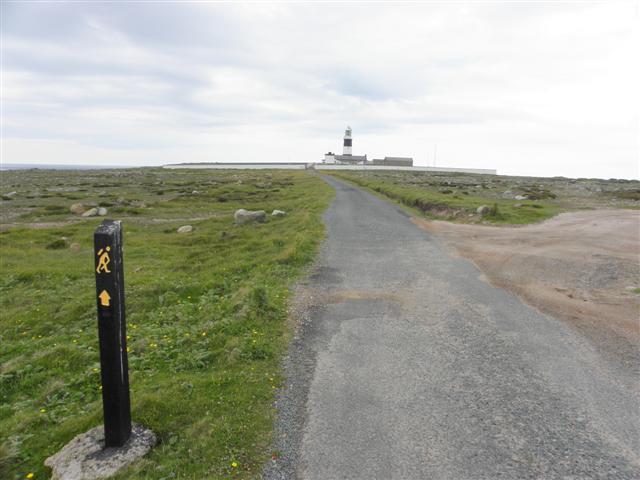
Origin / retained branch
Tory Island Lighthouse
Tory Island is the original lighthouse context for the Barbier & Fenestre hyper-radial lenses and the continuing location of the retained branch reconstructed by Chance Brothers.
Heritage Journey
When One Light Became Two
In 1887 Barbier & Fenestre manufactured the hyper-radial lenses installed at Tory Island. Chance Brothers reconstructed the apparatus in the 1920s into two biform branches: one at Tory Island and one later installed at Mew Island and preserved as The Great Light in Belfast.
Story mode is the guided heritage-continuity mode inside the LUX Light Archive renderer.
The Great Light, Belfast by Rossographer · CC BY-SA 2.0 · Source
This 1887 optic once shone from the lighthouses on Tory Island, County Donegal and Mew Island, County Down.
Great Lighthouses of Ireland
Signature moment
Reconstruction and split turned a single hyper-radial lineage into connected branch objects still traceable through evidence.
Conceptual orientation image only. Factual claims are supported in the evidence table below.
The journey
Verified fact
Barbier & Fenestre manufactured the hyper-radial lenses installed at Tory Island in 1887.
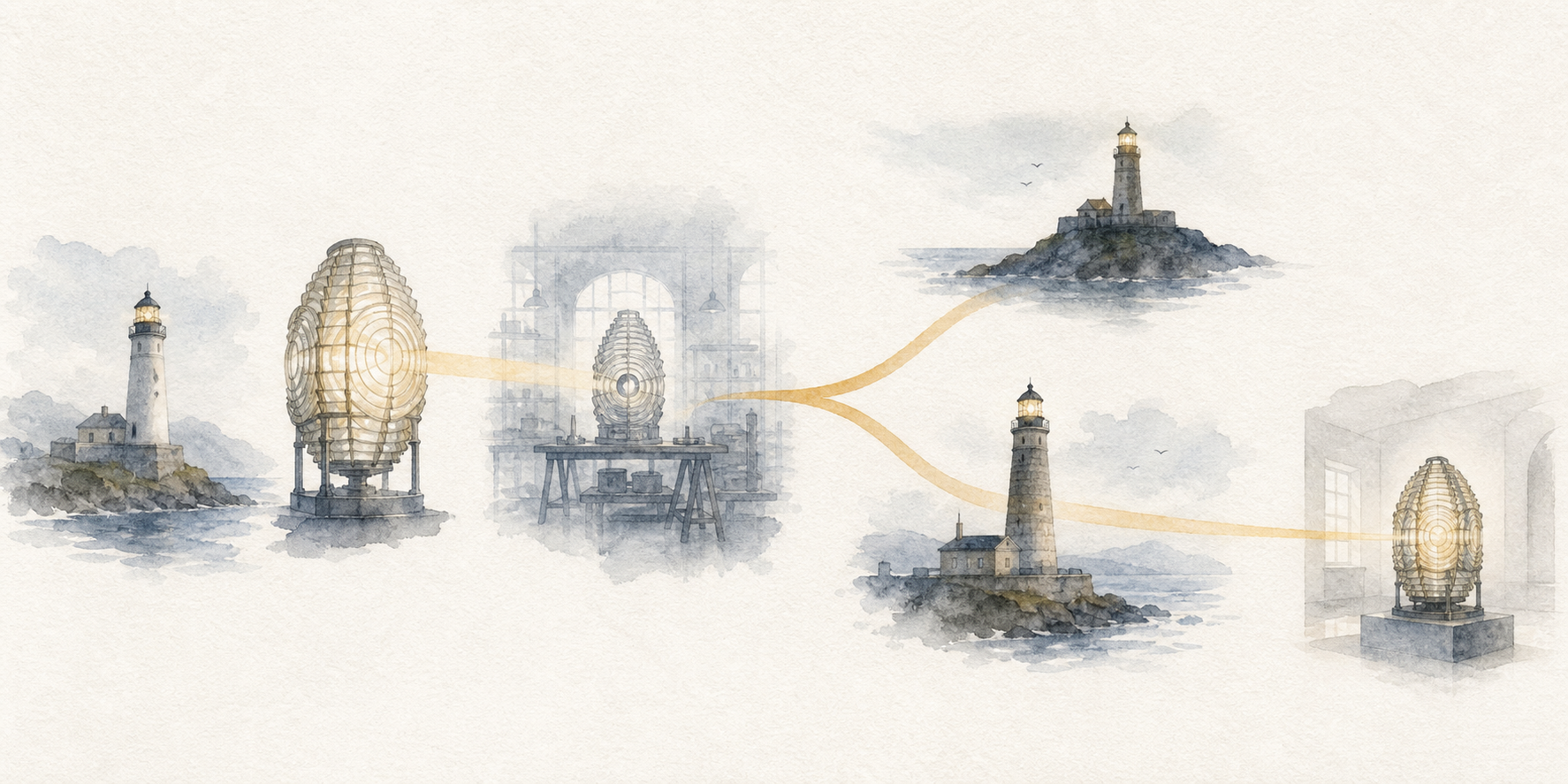
Probable reconstruction
Chance Brothers reconstructed the 1887 lenses in the 1920s into two connected biform branch identities.
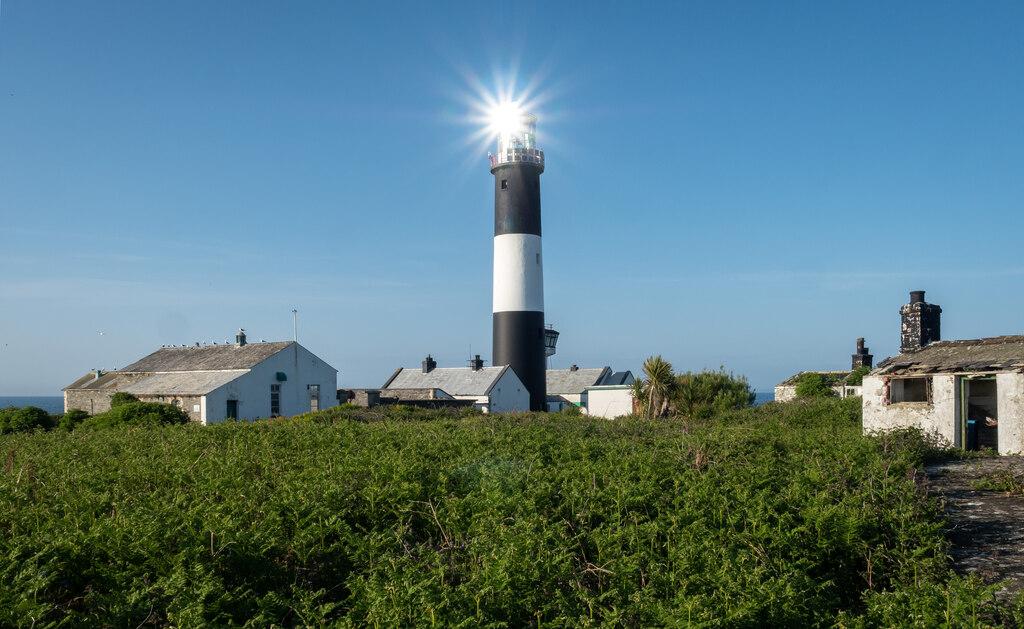
Verified fact
The Mew Island branch is restored and preserved as The Great Light, a public heritage display in Belfast.
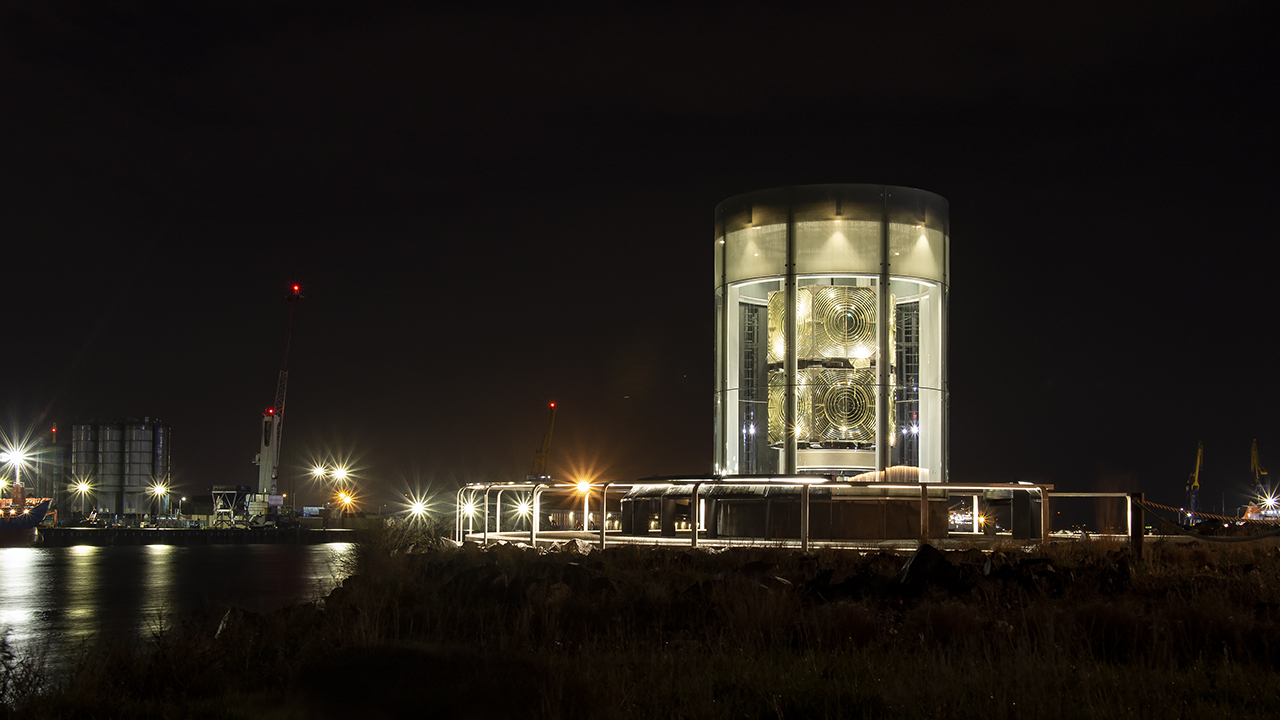
Across the coast
Geographic movement of the Mew/Belfast branch across mapped heritage places. Smethwick workshop and Dun Laoghaire restoration are documented in the timeline but have no published coordinates.
Loading detailed map...
Tory Island LighthouseOrigin
Barbier & Fenestre manufactured the hyper-radial lenses installed at Tory Island in 1887.
Mew Island LighthouseBranch B
Irish Lights records a biform optic transferred from Tory Island replacing Mew Island's original triform optic in 1928.
The Great Light, BelfastPreservation
The Mew Island component is preserved and displayed as The Great Light at Titanic Quarter, Belfast.
Places in this journey
Origin / retained branch
Tory Island is the original lighthouse context for the Barbier & Fenestre hyper-radial lenses and the continuing location of the retained branch reconstructed by Chance Brothers.
Operational branch
Mew Island received the derived optic component in 1928 and used it until its removal in 2014.
Public heritage identity
Belfast is the current public display context where the restored Mew Island component is preserved and interpreted as The Great Light.
Why it matters
This journey shows why lighthouse heritage cannot always be understood as one object in one place.
The Barbier & Fenestre hyper-radial optic associated with Tory Island was reconstructed, divided, and continued as two connected heritage objects: one branch at Tory Island and another later preserved as The Great Light in Belfast.
This is a clear example of identity through transformation.
Each connection follows reviewed archive relations and evidence.
Related journey
Shared geographic context: Chance Brothers Smethwick Works
See the connectionCross-entity routes follow the same governed relations as entity pages, ordered as one readable path.
Heritage Journey
When One Light Became Two
The Great Light follows Barbier & Fenestre lenses made for Tory Island in 1887, reconstructed by Chance Brothers in the 1920s, divided into Tory and Mew Island branches, and later preserved as a public display in Belfast.
LUX Light Archive is the heritage renderer of the LUX143 research field, preserving lighthouse continuity through evidence, memory, movement, and sources.
Understand how this archive fits into the wider research field.
Inside this heritage renderer, Story and Research are two modes of the same evidence-grounded journey: Story gives a guided path, while Research shows the sources, relationships, uncertainty, and open questions behind it.
This 1887 optic once shone from the lighthouses on Tory Island, County Donegal and Mew Island, County Down.
Great Lighthouses of Ireland
Verified fact
Installed at Tory IslandBarbier & Fenestre manufactured the hyper-radial lenses installed at Tory Island in 1887.
Probable reconstruction
Reconstructed and splitChance Brothers reconstructed the 1887 lenses in the 1920s into two connected biform branch identities.
Verified fact
Public display in BelfastThe Mew Island branch is restored and preserved as The Great Light, a public heritage display in Belfast.
In 1887 Barbier & Fenestre manufactured the hyper-radial lenses installed at Tory Island. Chance Brothers reconstructed the apparatus in the 1920s into two biform branches: one at Tory Island and one later installed at Mew Island and preserved as The Great Light in Belfast.
This journey shows why lighthouse heritage cannot always be understood as one object in one place.
The Barbier & Fenestre hyper-radial optic associated with Tory Island was reconstructed, divided, and continued as two connected heritage objects: one branch at Tory Island and another later preserved as The Great Light in Belfast.
This is a clear example of identity through transformation.
Inspect the governed relationship and evidence path behind each selected journey.
Related journey
Shared geographic context: Chance Brothers Smethwick Works
Cross-entity routes follow the same governed relations as entity pages, ordered as one readable path.
Connected research view
Select an event, object, or place to trace it across all three views.
Barbier & Fenestre manufactured the hyper-radial lenses installed at Tory Island in 1887.
The object lineage leaves Tory Island and is reconstructed by Chance Brothers in Smethwick before the Mew Island transfer.
The reconstructed optic lineage branches into a Tory-retained component and a component later installed at Mew Island.
Irish Lights records the Tory Island vaporised paraffin era with a biform 1330mm dioptric annular lens.
Irish Lights records a biform optic transferred from Tory Island replacing Mew Island's original triform optic in 1928.
The Mew Island optic component was removed and restored in Irish Lights workshop context before public display.
The Mew Island component is preserved and displayed as The Great Light at Titanic Quarter, Belfast.
This graph is not a map of places. It is a map of identity transformation. It shows how one original optic became multiple connected heritage objects through reconstruction, split, relocation, restoration, and public display.
No path selected.
Geographic movement of the Mew/Belfast branch across mapped heritage places. Smethwick workshop and Dun Laoghaire restoration are documented in the timeline but have no published coordinates.
Loading detailed map...
Tory Island LighthouseOrigin
Barbier & Fenestre manufactured the hyper-radial lenses installed at Tory Island in 1887.
Mew Island LighthouseBranch B
Irish Lights records a biform optic transferred from Tory Island replacing Mew Island's original triform optic in 1928.
The Great Light, BelfastPreservation
The Mew Island component is preserved and displayed as The Great Light at Titanic Quarter, Belfast.
Stable route nodes keep physical geometry, interpretive role, source evidence, and Story-beat synchronization separate from illustrative scene placement.
Begin with the documented Tory Island position where the optic lineage enters the story. This node represents a real place, not the start of one continuous voyage.
Place: Tory Island Lighthouse55.27262, -8.24940 · source coordinateStory beat: Installed at Tory IslandSources: Irish Lights - Tory Island LighthouseMove across an explicit time jump to the Mew Island branch installed in 1928. The evidence route connects object identity; it is not a literal pedestrian or sailing itinerary.
Place: Mew Island Lighthouse54.69872, -5.51373 · source coordinateStory beat: Reconstructed and splitSources: Irish Lights - Mew Island LighthouseFinish at the documented public display context for the restored Mew Island component now interpreted as The Great Light.
Place: The Great Light, Belfast54.60194, -5.91028 · reference coordinateStory beat: Public display in BelfastSources: The Great LightOfficial and object-specific sources carry the strongest confidence; secondary sources are shown as corroborating context.
Research still in progress — these do not affect accepted relationships above.
Traditional databases describe objects.
LUX follows what becomes of them.
It preserves relationships between places, assets, transformations, evidence, and changing identities, so heritage remains recognizable even when its form changes.
Original editorial content on this page: Creative Commons Attribution-NonCommercial-ShareAlike 4.0 International. See Rights & Reuse.
"The Great Light" · the-great-light · © LUX143 · Creative Commons Attribution-NonCommercial-ShareAlike 4.0 International · https://light.lux143.org/heritage-journeys/the-great-light/ The Great Light, Belfast by Rossographer · Rights status: CC BY-SA · CC BY-SA 2.0 (https://creativecommons.org/licenses/by-sa/2.0/) · Source: Geograph Britain and Ireland — https://commons.wikimedia.org/wiki/File:The_Great_Light,_Belfast_-_geograph.org.uk_-_6052546.jpg · © Rossographer Walking towards Tory lighthouse by Kenneth Allen · Rights status: CC BY-SA · CC BY-SA 2.0 (https://creativecommons.org/licenses/by-sa/2.0/) · Source: Geograph Britain and Ireland — https://commons.wikimedia.org/wiki/File:Walking_towards_Tory_lighthouse_-_geograph.org.uk_-_2493019.jpg · © Kenneth Allen Mew Island Lighthouse by Rossographer · Rights status: CC BY-SA · CC BY-SA 2.0 (https://creativecommons.org/licenses/by-sa/2.0/) · Source: Geograph Britain and Ireland — https://commons.wikimedia.org/wiki/File:Mew_Island_Lighthouse_-_geograph.org.uk_-_7506912.jpg · © Rossographer
LUX Light Archive, Heritage journey: "The Great Light", the-great-light, https://light.lux143.org/heritage-journeys/the-great-light/, accessed 2026-09-24, archive v0.24.572.