Aniva Lighthouse Models — video journey
A sequential Mayachnik project journey through models of Aniva Lighthouse; used as heritage interpretation, not as field evidence.
Open video on YouTubeHeritage Journey
From a navigational threshold to a monument held in books, models and memory
A remote rock, a nine-storey concrete lighthouse, a historical signal and a powerful afterlife in memory.
Story mode is the guided heritage-continuity mode inside the LUX Light Archive renderer.
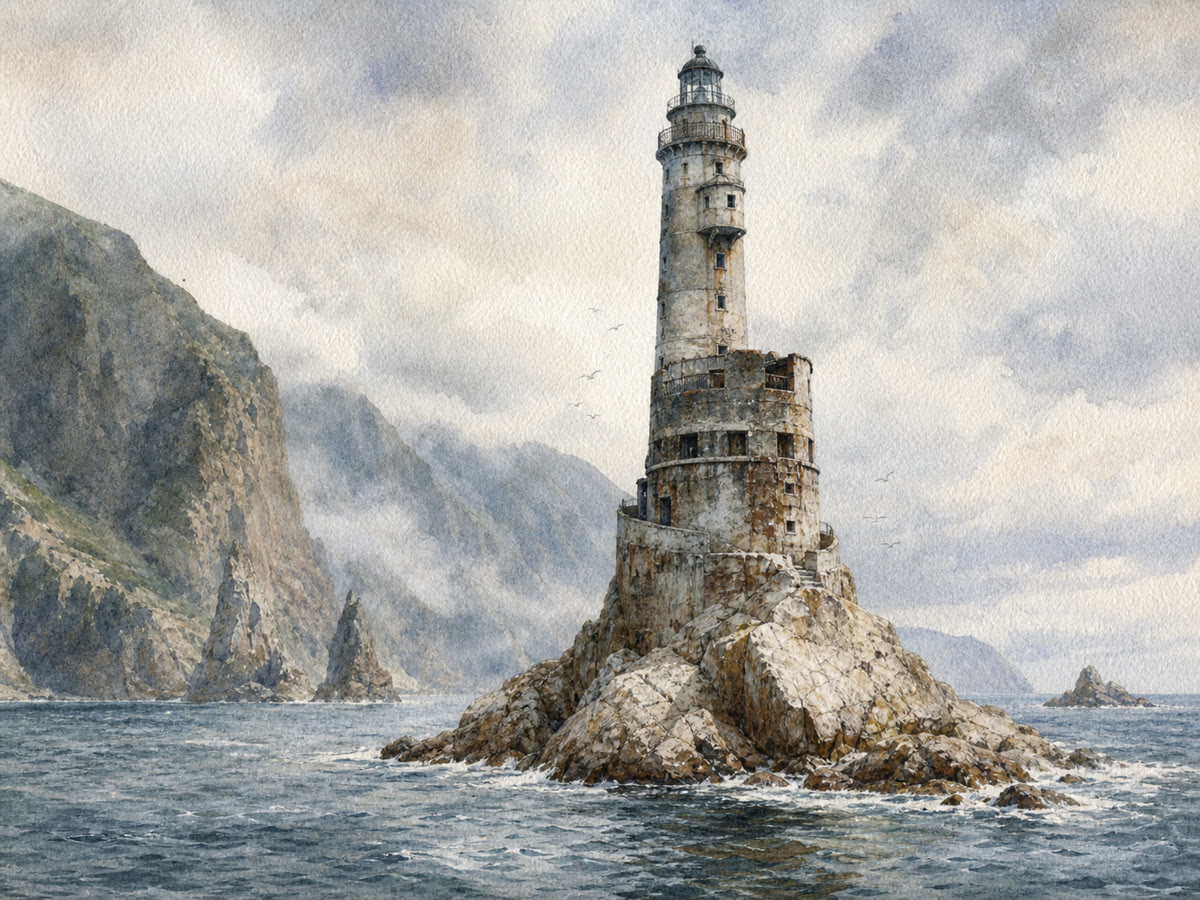
AI-generated illustration — interpretative, not documentary evidence · Project illustration
Aniva is no longer readable only by its beam. The tower, books, models and unanswered questions now carry its identity.
LUX Light Archive interpretation
Signature moment
Operation and heritage are not the same state.
Conceptual illustration only — not to scale.
The journey
Verified fact
Long before the lighthouse, Cape Aniva entered navigators' knowledge through naming, survey and the difficult waters around the southern Sakhalin approaches. The 2001 historical essay preserves this maritime context.
Verified fact
A 31-metre, nine-storey concrete lighthouse designed by Miura Shinobu was completed on Sivuchya Rock. Its circular tower and technical building formed one structure exposed directly to sea and weather.
Verified fact
After 1945 the lighthouse passed into the Soviet Pacific Fleet Hydrographic Service. The historical essay records repairs and equipment modernisation, while the structure remained the same coastal identity.
Verified fact
The 2001 essay recorded a 40 m focal height, a white flashing sector light and a range up to 17 nautical miles. LUX keeps these values as a publication-time snapshot, not as evidence that the light operates today.
Interpretive bridge
Aniva no longer performs its former navigational function, but the structure remains culturally legible through historical books, a new Samarin edition, Mayachnik models and two project videos. Documentation continues after operation ends.
Watch
A sequential Mayachnik project journey through models of Aniva Lighthouse; used as heritage interpretation, not as field evidence.
Open video on YouTubeA short Mayachnik introduction to the Aniva lighthouse diorama and surrounding territory; used as project documentation, not as field evidence.
Open video on YouTubeAt the cape
The map marks the reviewed structure position on Sivuchya Rock. Conceptual beats about the 2001 record and present-day memory deliberately clear the geographic highlight.
Loading detailed map...
Sivuchya Rock, Cape AnivaContext
The historical essay connects the cape with seventeenth-century naming and nineteenth-century survey and navigation context.
Place
Navigational threshold and surviving site
Sivuchya Rock holds the 1939 structure at Cape Aniva. The same place anchors the navigational past and the lighthouse's present heritage identity.
Why it matters
Aniva's visual drama can easily overpower its evidence. This Journey keeps the spectacular structure, the historical signal and today's heritage condition in separate, traceable layers.
The old essay and new Samarin edition show how books preserve a lighthouse after its operational story becomes uncertain, while models and video make the inaccessible structure legible to new audiences.
Heritage Journey
From a navigational threshold to a monument held in books, models and memory
Aniva Lighthouse rose from Sivuchya Rock in 1939 as an integrated concrete tower and technical building. This Journey follows the navigational landscape of Cape Aniva, the lighthouse's construction and post-1945 service, the technical state recorded in a 2001 historical essay, and its present afterlife in books, models and video — without presenting historical light data as current operation.
LUX Light Archive is the heritage renderer of the LUX143 research field, preserving lighthouse continuity through evidence, memory, movement, and sources.
Understand how this archive fits into the wider research field.
Inside this heritage renderer, Story and Research are two modes of the same evidence-grounded journey: Story gives a guided path, while Research shows the sources, relationships, uncertainty, and open questions behind it.
Aniva is no longer readable only by its beam. The tower, books, models and unanswered questions now carry its identity.
LUX Light Archive interpretation
Verified fact
A cape learned through navigationLong before the lighthouse, Cape Aniva entered navigators' knowledge through naming, survey and the difficult waters around the southern Sakhalin approaches. The 2001 historical essay preserves this maritime context.
Verified fact
A tower made one with the rockA 31-metre, nine-storey concrete lighthouse designed by Miura Shinobu was completed on Sivuchya Rock. Its circular tower and technical building formed one structure exposed directly to sea and weather.
Verified fact
The lighthouse changes serviceAfter 1945 the lighthouse passed into the Soviet Pacific Fleet Hydrographic Service. The historical essay records repairs and equipment modernisation, while the structure remained the same coastal identity.
Verified fact
A signal preserved as a historical snapshotThe 2001 essay recorded a 40 m focal height, a white flashing sector light and a range up to 17 nautical miles. LUX keeps these values as a publication-time snapshot, not as evidence that the light operates today.
Interpretive bridge
The light ends; the lighthouse keeps speakingAniva no longer performs its former navigational function, but the structure remains culturally legible through historical books, a new Samarin edition, Mayachnik models and two project videos. Documentation continues after operation ends.
A remote rock, a nine-storey concrete lighthouse, a historical signal and a powerful afterlife in memory.
Aniva's visual drama can easily overpower its evidence. This Journey keeps the spectacular structure, the historical signal and today's heritage condition in separate, traceable layers.
The old essay and new Samarin edition show how books preserve a lighthouse after its operational story becomes uncertain, while models and video make the inaccessible structure legible to new audiences.
Connected research view
Select an event, object, or place to trace it across all three views.
The historical essay connects the cape with seventeenth-century naming and nineteenth-century survey and navigation context.
The concrete nine-storey lighthouse designed by Miura Shinobu was completed on Sivuchya Rock.
The historical essay records transfer to the Pacific Fleet Hydrographic Service, repairs and equipment modernisation.
The essay records focal height, sector light and range as a 2001 publication-time technical state, not as current operation.
The non-operational structure remains culturally visible through research, a new book edition, models and Mayachnik video documentation.
The Research graph separates the Aniva lighthouse identity, its surviving structure, the Sivuchya Rock place and the reviewed evidence that connects them.
No path selected.
The map marks the reviewed structure position on Sivuchya Rock. Conceptual beats about the 2001 record and present-day memory deliberately clear the geographic highlight.
Loading detailed map...
Sivuchya Rock, Cape AnivaContext
The historical essay connects the cape with seventeenth-century naming and nineteenth-century survey and navigation context.
Official and object-specific sources carry the strongest confidence; secondary sources are shown as corroborating context.
| Relationship | Objects | Date | Confidence | Review | Sources |
|---|---|---|---|---|---|
| Located atHERITAGE-REL-000341Appears in Story: A cape learned through navigation · Appears in Story: A tower made one with the rock · Appears in Story: The light ends; the lighthouse keeps speaking | Aniva Lighthouse structuretoSivuchya Rock, Cape Aniva | 1939 | high | reviewed | Сахкино — Маяк Анива |
Research still in progress — these do not affect accepted relationships above.
A conventional lighthouse card can mix construction, signal and current status into one timeless description.
LUX keeps Aniva's 1939 fabric, post-1945 service, 2001 technical snapshot and present heritage afterlife readable as different phases.
That separation lets the story remain vivid without claiming that a historical white flashing light still operates today.
Original editorial content on this page: Creative Commons Attribution-NonCommercial-ShareAlike 4.0 International. See Rights & Reuse.
"Aniva: The Lighthouse on the Rock" · aniva-lighthouse · © LUX143 · Creative Commons Attribution-NonCommercial-ShareAlike 4.0 International · https://light.lux143.org/heritage-journeys/aniva-lighthouse/ AI-generated illustration — interpretative, not documentary evidence · Rights status: Used with permission · Project illustration
LUX Light Archive, Heritage journey: "Aniva: The Lighthouse on the Rock", aniva-lighthouse, https://light.lux143.org/heritage-journeys/aniva-lighthouse/, accessed 2026-09-24, archive v0.24.572.