Heritage Journey
Women Who Kept the Light
Keepers, auxiliaries, and electromechanicians in French lighthouse service
A source-backed journey through the women who maintained French lighthouse lights while official recognition lagged behind the work.
LUX Light Archive is the heritage renderer of the LUX143 research field, preserving lighthouse continuity through evidence, memory, movement, and sources.
Understand how this archive fits into the wider research field.
Inside this heritage renderer, Story and Research are two modes of the same evidence-grounded journey: Story gives a guided path, while Research shows the sources, relationships, uncertainty, and open questions behind it.
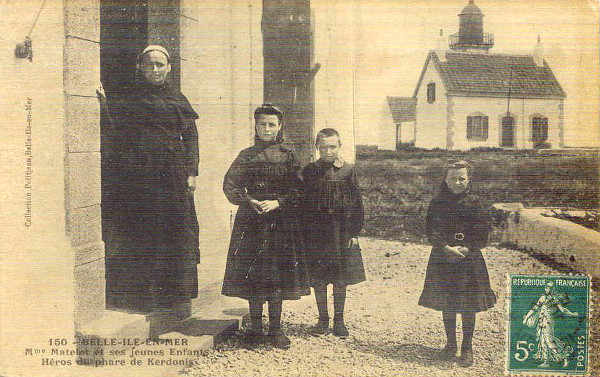
The work was visible from the sea before the worker was secure in the institution.
LUX Light Archive interpretation
The journey
- 1886
Verified fact
The work enters the appointment recordMarie-Perrine Durand is contracted to light Rosédo after her husband dies in service. The appointment is renewed annually, without the security of the classified keeper corps.
- 1889
Verified fact
Recognition arrives with a weaker statusThe 1889 regulation permits women in certain secondary lights. Marie-Perrine Messager becomes a gardienne hors-classe at Pontusval.
- 1895–1910
Verified fact
Knowledge passes through women, not through one merged familyAt Pontusval and Les Moutons, daughters succeed mothers and sisters succeed sisters. Each appointment remains a distinct person and act of service.
- 18 April 1911
Verified fact
At Kerdonis, the light does not go outAfter Alexandre-Désiré Matelot dies before taking the watch, Eugénie Matelot and her children keep five red flashes every 25 seconds visible on the horizon.
- 31 October 1983
Verified fact
Precarity reaches ParliamentGisèle Halimi asks why a gardienne auxiliaire remains dependent on her husband’s employment and can lose her fixed-term contract when his service ends.
- 1984–2001
Verified fact
Status and the technical profession finally openBécédia records titular status the following year and the 1984 opening of the electromechanician competition to women. Françoise André later serves offshore at Sept-Îles.
In brief
From Marie-Perrine Durand’s 1886 Rosédo appointment to women entering the electromechanician profession, the record shows labour becoming visible before it became secure.
Connected research view
Graph, time and place
Select an event, object, or place to trace it across all three views.
Interactive Movement Timeline
AppointmentRosédo — annual responsibility without classified status
A yearly abonnement records real operational responsibility while leaving the appointment outside the classified keeper corps.
Evidence: none linkedConfidence: unknownRegulationWomen’s service becomes explicit but subordinate
The regulation permits women in specified secondary-light appointments; the status remains outside the classified corps.
Evidence: none linkedConfidence: unknownOperational continuityKerdonis — the characteristic remains visible
The five red flashes every 25 seconds continue after Alexandre-Désiré Matelot dies before his watch.
Evidence: none linkedConfidence: unknownLinked entities: Eugénie Matelot and her children at Kerdonis lighthouseParliamentary recordThe dependent contract is challenged in public
The written question records that an auxiliary keeper’s fixed-term employment depends on her husband’s lighthouse service and asks what measures will remedy that situation.
Evidence: none linkedConfidence: unknownProfessionThe technical competition opens to women
Bécédia records titular status for the auxiliaries and names Françoise André and Sylvie Chalumeau-Brousse as the first two women appointed in the electromechanician profession.
Evidence: none linkedConfidence: unknown
Relationship Graph
This graph is not a map of places. It is a map of identity transformation. It shows how heritage objects, places, and public identities connect through evidence-backed relationships.
No path selected.
Journey Map
No reviewed coordinates are available for this Journey yet.
Evidence
Official and focus-specific sources carry the strongest confidence; secondary sources are shown as corroborating context.
No evidence-backed relationships yet.
Source Baseline
- Assemblée nationale — question no. 39689 and responseofficial_parliamentary_recordAppears in Story: Precarity reaches Parliament
- Jean-Christophe Fichou — Des femmes dans les phares : les gardiennes auxiliairesscholarly_public_historyAppears in Story: The work enters the appointment record · Appears in Story: Recognition arrives with a weaker status · Appears in Story: Knowledge passes through women, not through one merged family · Appears in Story: At Kerdonis, the light does not go out · Appears in Story: Precarity reaches Parliament · Appears in Story: Status and the technical profession finally open
- France Télévisions — Gardiennesdocumentary_film
- Gardien de phare — post on Gisèle Halimi and the gardiennes auxiliairesdiscovery_lead
- Ministère de la Culture — Phare de Kerdonisofficial_heritage_inventoryAppears in Story: Knowledge passes through women, not through one merged family · Appears in Story: At Kerdonis, the light does not go out
- Wikimedia Commons — Kerdronis2.jpgpublic_domain_media_repositoryAppears in Story: Knowledge passes through women, not through one merged family · Appears in Story: At Kerdonis, the light does not go out
- INA — 1983 : Honorine Le Guen, personnage phare de Riantecnational_audiovisual_archive
Identity Changes
- Work without securityOperational responsibility appears through annual or family-dependent appointments.
- Named but subordinateGardienne hors-classe makes the work official without equal status, pay, or pension.
- Technical professionThe electromechanician pathway formally opens to women in 1984.
Current Status
- Accepted source-backed pilot with ten separate historical Person records.
- Exact historical employment labels remain visible and are not normalized to “helper” or “keeper’s wife”.
- Bécédia is the main synthesis; claims that need personnel-register confirmation remain explicitly open.
- The parliamentary PDF is used for the 1983 question and published response; the France TV documentary is linked for further viewing, while the LinkedIn post remains a discovery lead only.
Open Questions
Research still in progress — these do not affect accepted relationships above.
- Confirm exact appointment dates, stations, and personnel-file references for Françoise André and Sylvie Chalumeau-Brousse in an authoritative service register.Appears in Story: Status and the technical profession finally open
Rights & Attribution
Content License
Original editorial content on this page: Creative Commons Attribution-NonCommercial-ShareAlike 4.0 International. See Rights & Reuse.
Media Rights
- Historic postcard showing Eugénie Matelot standing with her children at Kerdonis lighthouse. · Rights status: Public Domain · License: Public domain · Third-party material
Attribution
"Women Who Kept the Light" · women-who-kept-the-light · © LUX143 · Creative Commons Attribution-NonCommercial-ShareAlike 4.0 International · https://light.lux143.org/heritage-journeys/women-who-kept-the-light/ Eugénie Matelot and her children at Kerdonis lighthouse · Rights status: Public Domain · Public domain (https://creativecommons.org/publicdomain/mark/1.0/) · Source: Wikimedia Commons — https://commons.wikimedia.org/wiki/File:Kerdronis2.jpg · © Public domain
Citation
LUX Light Archive, Heritage journey: "Women Who Kept the Light", women-who-kept-the-light, https://light.lux143.org/heritage-journeys/women-who-kept-the-light/, accessed 2026-09-17, archive v0.24.571.