The Light Is Not the Lighthouse
Open the comparative article connecting Cordouan, La Coubre and Ar-Men.
Open media sourceHeritage Journey
What does it take to keep one warning alive on the Hell of Hells?
Follow Ar-Men from rare landing windows and fourteen years of construction to triple flashes, automation and modern conservation.
Story mode is the guided heritage-continuity mode inside the LUX Light Archive renderer.
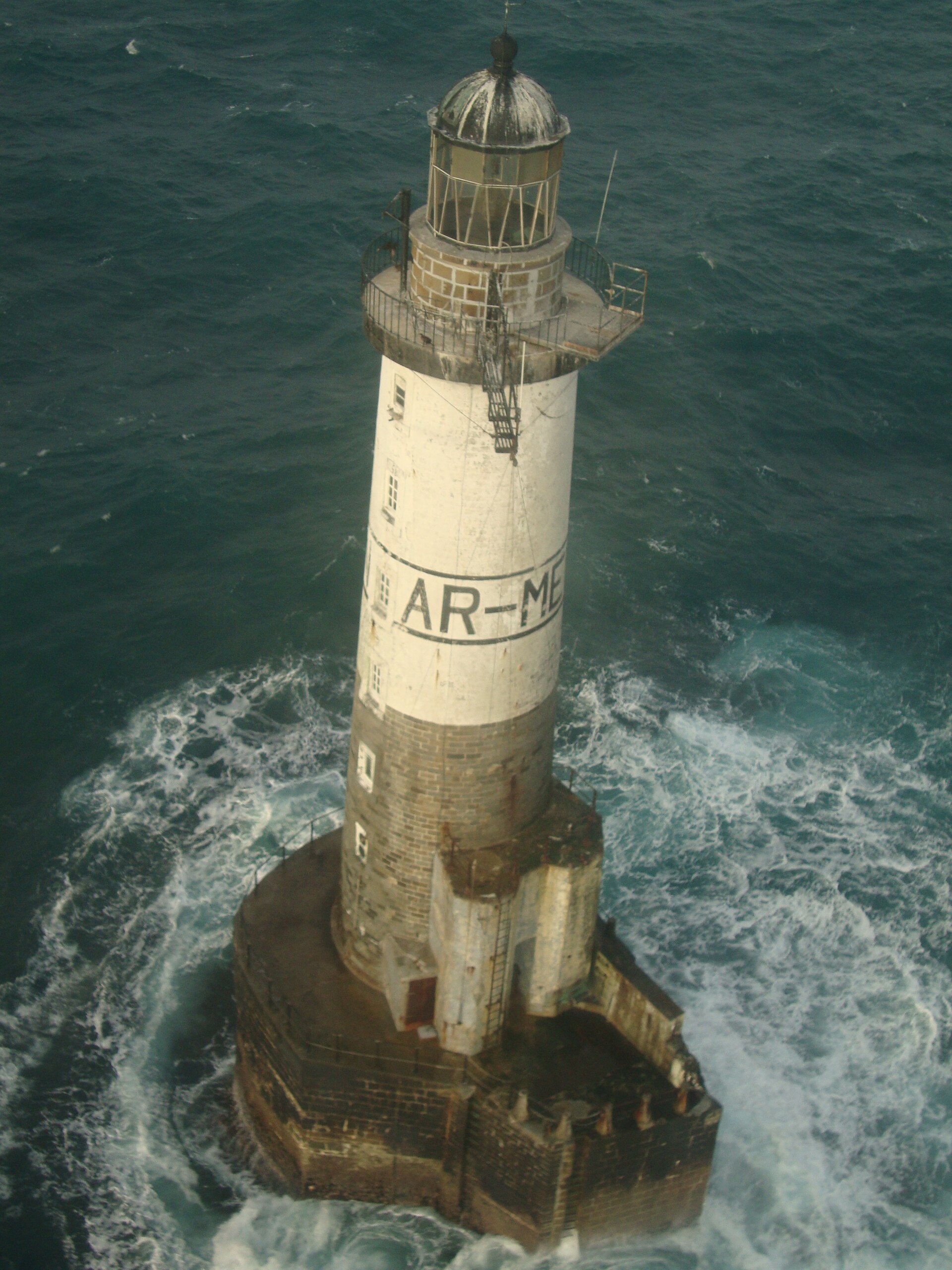
Phare Ar-Men 2 by Jocelyn Caron · CC BY-SA 3.0 · Source
Signature moment
Automation and restoration alter human presence and machinery while the reef and mission remain.
Conceptual illustration only — not to scale.
The journey
Verified fact
Construction campaigns depended on rare moments when workers could reach and drill the almost submerged reef.
Verified fact
Ar-Men entered service after an exceptional construction effort on the Chaussée de Sein.
Verified fact
The grouped triple-flash characteristic became the lighthouse's enduring navigational signature.
Verified fact
Electrification and automation transformed staffing and apparatus while the reef-warning function continued.
Verified fact
The rotation support was modernized and later lantern work addressed hazardous materials while operational and heritage commitments continued.
Video
Open the comparative article connecting Cordouan, La Coubre and Ar-Men.
Open media sourceAcross time
The mapped point represents the reviewed lighthouse site; conceptual beats describe change through time without inventing physical movement.
Loading detailed map...
Ar-Men reefStage 1
Construction campaigns depended on rare moments when workers could reach and drill the almost submerged reef.
Place
Continuity site
Ar-Men turns orientation into a record of dangerous construction, keeper endurance, signal discipline, automation and environmental restoration.
Why it matters
Ar-Men turns orientation into a record of dangerous construction, keeper endurance, signal discipline, automation and environmental restoration.
The Story interpretation and Research evidence remain on the same URL.
Heritage Journey
What does it take to keep one warning alive on the Hell of Hells?
Ar-Men turns orientation into a record of dangerous construction, keeper endurance, signal discipline, automation and environmental restoration.
LUX Light Archive is the heritage renderer of the LUX143 research field, preserving lighthouse continuity through evidence, memory, movement, and sources.
Understand how this archive fits into the wider research field.
Inside this heritage renderer, Story and Research are two modes of the same evidence-grounded journey: Story gives a guided path, while Research shows the sources, relationships, uncertainty, and open questions behind it.
Verified fact
Work begins on a rock that resists landingConstruction campaigns depended on rare moments when workers could reach and drill the almost submerged reef.
Verified fact
Fourteen years of work become a lightAr-Men entered service after an exceptional construction effort on the Chaussée de Sein.
Verified fact
Three flashes establish a signal identityThe grouped triple-flash characteristic became the lighthouse's enduring navigational signature.
Verified fact
Automation removes the keepers, not the missionElectrification and automation transformed staffing and apparatus while the reef-warning function continued.
Verified fact
Restoration changes the mechanism to preserve the signalThe rotation support was modernized and later lantern work addressed hazardous materials while operational and heritage commitments continued.
Follow Ar-Men from rare landing windows and fourteen years of construction to triple flashes, automation and modern conservation.
Ar-Men turns orientation into a record of dangerous construction, keeper endurance, signal discipline, automation and environmental restoration.
The Story interpretation and Research evidence remain on the same URL.
Connected research view
Select an event, object, or place to trace it across all three views.
Construction campaigns depended on rare moments when workers could reach and drill the almost submerged reef.
Ar-Men entered service after an exceptional construction effort on the Chaussée de Sein.
The grouped triple-flash characteristic became the lighthouse's enduring navigational signature.
Electrification and automation transformed staffing and apparatus while the reef-warning function continued.
The rotation support was modernized and later lantern work addressed hazardous materials while operational and heritage commitments continued.
The graph separates lighthouse identity, physical fabric, place and dated transformation.
No path selected.
The mapped point represents the reviewed lighthouse site; conceptual beats describe change through time without inventing physical movement.
Loading detailed map...
Ar-Men reefStage 1
Construction campaigns depended on rare moments when workers could reach and drill the almost submerged reef.
Official and object-specific sources carry the strongest confidence; secondary sources are shown as corroborating context.
| Relationship | Objects | Date | Confidence | Review | Sources |
|---|---|---|---|---|---|
| Located atHERITAGE-REL-000145Appears in Story: Work begins on a rock that resists landing · Appears in Story: Fourteen years of work become a light · Appears in Story: Three flashes establish a signal identity · Appears in Story: Automation removes the keepers, not the mission · Appears in Story: Restoration changes the mechanism to preserve the signal | Ar-Men lighthouse station fabrictoAr-Men reef | 1881 | high | reviewed | Phare d'Ar-Men - DIRM NAMO |
Research still in progress — these do not affect accepted relationships above.
A present-day lighthouse card cannot show which parts changed and which identity continued.
LUX keeps the structure, signal, place, evidence and uncertainty distinct while making their continuity readable.
Original editorial content on this page: Creative Commons Attribution-NonCommercial-ShareAlike 4.0 International. See Rights & Reuse.
"Ar-Men: The Cost of Orientation" · ar-men-cost-of-orientation · © LUX143 · Creative Commons Attribution-NonCommercial-ShareAlike 4.0 International · https://light.lux143.org/heritage-journeys/ar-men-cost-of-orientation/ Phare Ar-Men 2 by Jocelyn Caron · Rights status: CC BY-SA · CC BY-SA 3.0 (https://creativecommons.org/licenses/by-sa/3.0/)
LUX Light Archive, Heritage journey: "Ar-Men: The Cost of Orientation", ar-men-cost-of-orientation, https://light.lux143.org/heritage-journeys/ar-men-cost-of-orientation/, accessed 2026-09-24, archive v0.24.572.